




Most bridal labels stake their identity on a single regional craft. A Kanjivaram house stays a Kanjivaram house. A Banarasi specialist rarely wanders far from the loom that made its name. Mrunalini Rao works differently. A single bridal ensemble out of the Hyderabad-based house will regularly carry zardozi worked in the Kashmiri aari style, Kutch embroidery from Gujarat, and dori work from Kolkata, among others crafts—all stitched into one garment.
Each of these techniques comes from a different part of the country and carries its own logic. Aari work, native to Kashmir, uses a hooked needle to chain-stitch thread or metallic zari directly onto fabric, building dense surface texture without ever piercing all the way through. Kutch embroidery, from Gujarat, leans on geometric thread patterns rooted in the region's nomadic textile traditions. Dori work, associated with Kolkata, twists cord into raised outlines that give a motif its edge and dimension. None of these was developed to sit next to another. They come from different climates, different guilds, different centuries of practice.
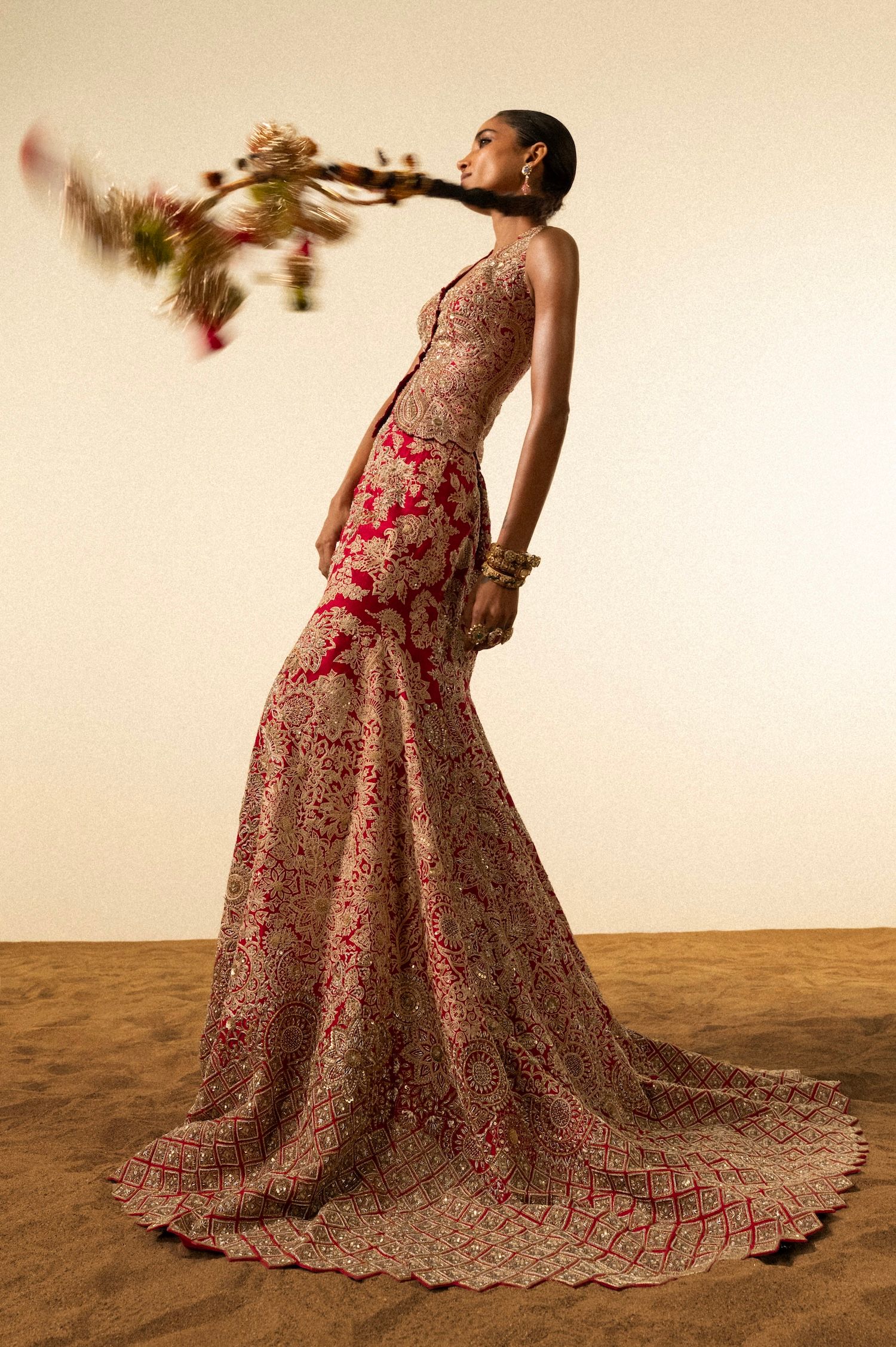
Each technique has its own tension, its own finishing time, and its own artisans who have usually spent years on that one craft alone. Getting aari work to sit next to Kutch patterns without one overwhelming the other, or the seams between techniques becoming visible, takes more coordination than most collections attempt across an entire season.
Why Hastakala holds it together
Mrunalini Rao calls its underlying philosophy, Hastakala, literally the art of the hand, and the brand is careful to describe it as the foundation of everything it makes. Over 450 artisans currently work under that banner, each trained in a specific craft. What keeps a Hastakala piece from reading as multiple unrelated techniques stitched into proximity seems to come down to the motifs chosen to run across all of them. Paisleys, birds, architectural forms and tessellated patterns recur throughout the brand's design vocabulary, and using the same visual language across aari, appliqué, Kutch work, dori and more, gives the eye something consistent to follow even as the hand skills underneath keep changing.
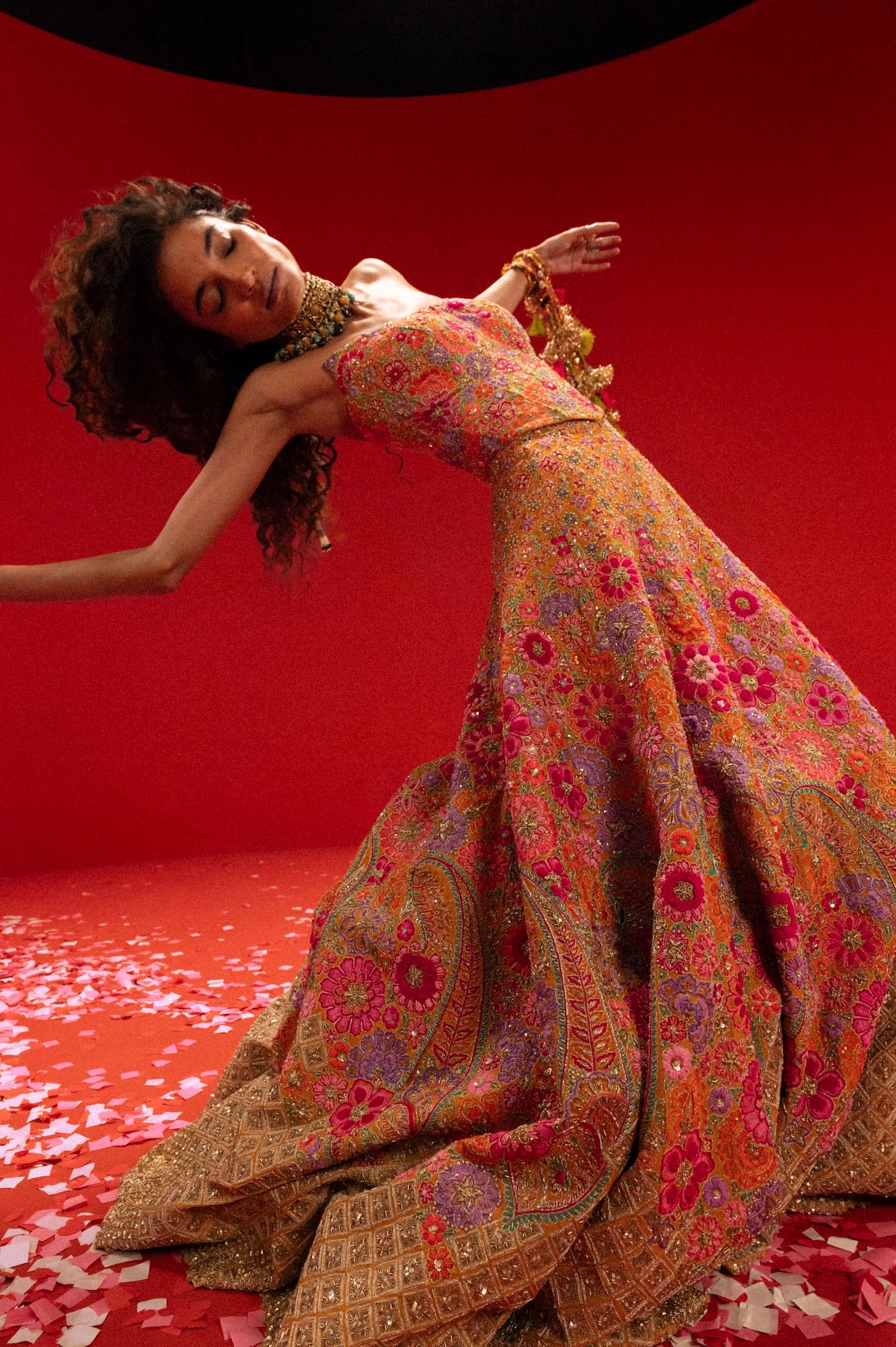
Colour doesn't stay consistent from piece to piece, and it isn't meant to. One design is done in deep maroon and gold, another in burnt orange and coral, a full lehenga in jewel-toned blues and purples, and one skirt mixes soft ivory, blue-grey, pink and gold in colour-blocked panels. What holds it together is that every surface, whatever the colour, is worked edge to edge with the same amount of embroidery.
That is a design decision as much as a craft one. A garment could easily use multiple techniques and multiple unrelated motifs, and the result would likely look exactly like the patchwork this approach is trying to avoid. Anchoring the surface in one motif language while letting the construction techniques shift is what allows the piece to read as a single idea rather than a demonstration of range.
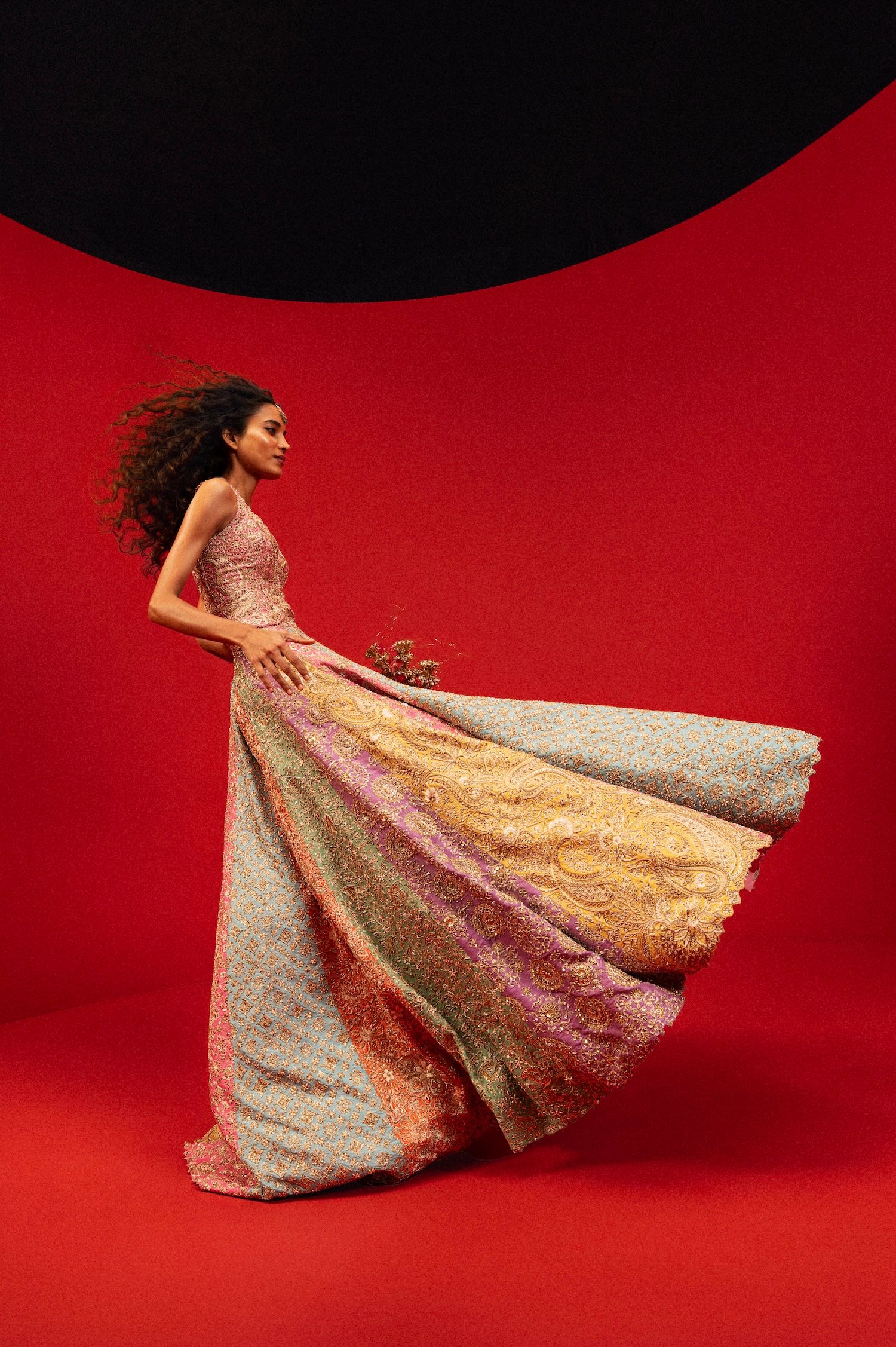
The brand frames Hastakala around the idea that true luxury is made by hand, where intricacy, tradition and human touch come together, and keeping each artisan within one specific craft rather than several is presumably part of what makes that claim hold up. It's a slower, costlier way to build a garment than having fewer hands do more, but it's also the only way various distinct techniques would sit together without one visibly undercutting another.
This bride doesn't do the obvious pairing
This approach also lines up with how the brand describes the customer it's designing for this season: someone drawn to individuality over trends, who wants pieces that feel personal and considered—not assembled to catch a passing look. A garment built from multiple regional traditions is, by definition, not something easily replicated or found elsewhere. It also fits a wider pattern already visible in how the label styles its pieces, pairing lehengas with structured jackets, sarees with tailored waistcoats and corsets with skirts. In practice, the silhouettes split into two kinds. Some pieces are fitted through the body and flare into a trumpet-like train, closer to a structured gown than a traditional lehenga. Others are a more classic lehenga and dupatta, with the dupatta draped a little differently in each look instead of repeated exactly. What makes both feel like they belong to the same collection is the same heavy handwork running through each.
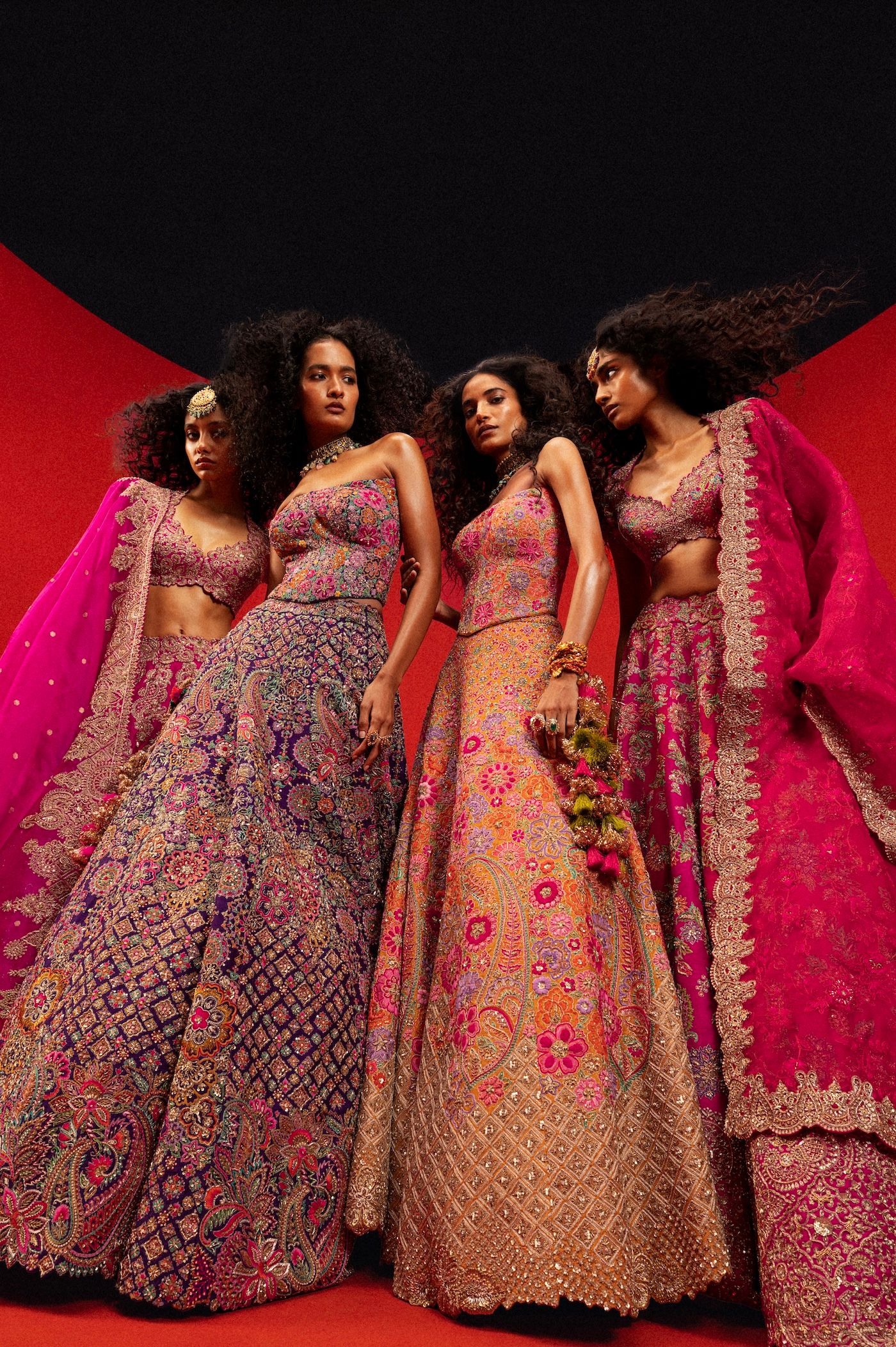
What makes the collection worth paying attention to is not that combining regional crafts is unheard of in Indian couture. It happens elsewhere, usually in small, careful doses. What is less common is doing it as a matter of course, on a single ensemble, with enough consistency that it becomes recognisable as a house style rather than a one-off experiment. Whether a bride actually notices that her dupatta was worked in a different regional technique from her blouse is beside the point. What she is responding to—whether she names it or not—is the amount of coordination it took to make multiple kinds of handwork agree with each other in one modern silhouette.