






One of the true hallmarks of a great TV show and its cultural impact is the place it earns in our vocabulary. Granted, the concepts they introduce are rarely of their own making. Lobsters were going to mate for life regardless of whether Rachel belonged with Ross, accidental double entendres beg for acknowledgement even if we don’t have Michael Scott’s “that’s what she said” to do it, and there was a time when “It’ll pass” were words that didn’t give me PTSD (I love you, Fleabag, but it’s still too soon). Still, coining these terms builds out the worlds we choose to escape to during our sacred TV time and gives us a way to fold it into our real worlds.
The term “bro code”, for instance, originates from How I Met Your Mother and requires no explanation given how easily it has assimilated into our vocabulary. The circumstance that merits its coinage in the show is a love triangle where one character develops feelings for another’s ex—a core violation of the code. Adults, whose second season premiered last week, however, redefines this code of dibs, loyalty, and lowkey property by giving the love triangle a Gen Z update.
That’s kind of what Adults does best.
In our present dire straits of Dramas committing category fraud as Comedies, and Gen Z media that Gen Z doesn’t want to claim, Adults came out of the woodwork and gave us a true comedy that Gen Z has embraced with open arms. After years of sitcoms showing us a diverse friend group in the style of a college brochure, in this show their identities are not their plot lines, but their plot lines are made undeniably better when experienced through their identities.
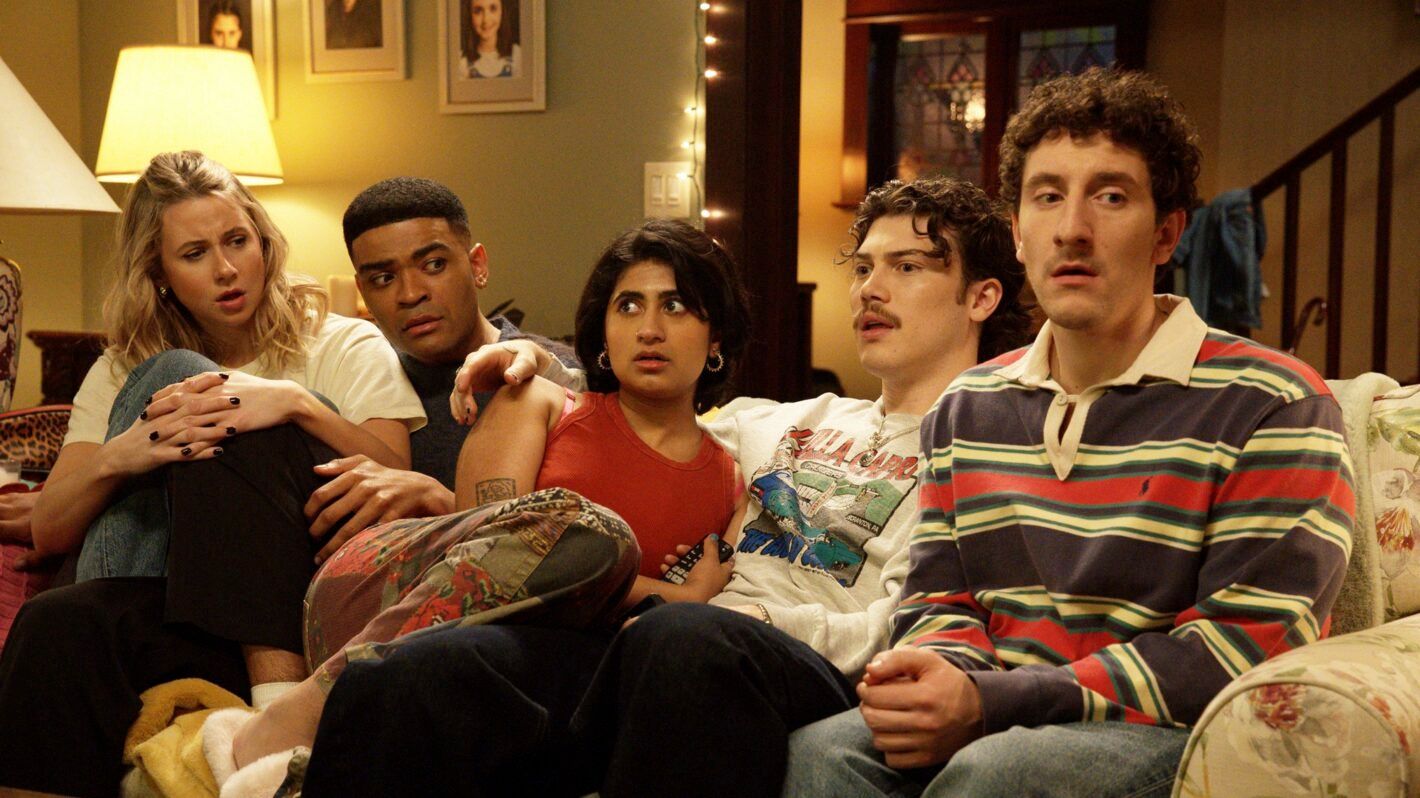
Anton (Owen Thiele) can describe his type as “so gay it turns the corner and becomes straight again” because he can say that. Issa (Amita Rao) can insist on wearing an obnoxious hat at her therapist’s funeral and say it’s a tradition in her culture. And Anton can marry Paul Baker (Jack Innanen) to help him get a green card even though he’s dating Issa, who can insist that the newlyweds kiss—even if Paul Baker is fluid and the kiss has a little too much chemistry. Right?
Popular media has shown us for decades that going after your friend’s ex is strictly and exclusively forbidden—just look what they did to Hannah and Jessa on Girls. But Adults has queered the trope, redefined how it can look, and, along the way, it has given us language for a couple of uniquely Gen Z experiences. Below, the words to add to your vocabulary:
Mind wipe
You should be able to tell your friends your innermost thoughts...without consequences. And this is the word for that. The rules are simple: I need to say it, but after this moment you don’t need to have heard it. Simply utter “mind wipe” before and perform the mind wipe hand gesture after! It’s a 2026 update to no-judgement friendships—great for legal grey areas, humiliating confessions, family secrets. Ironclad as attorney-client privilege, if you’re a good friend.
Friend Slut
A “friend slut” is someone who’s everybody’s friend. This particular type of people pleaser often speaks in hyperbole: “I’m obsessed with you” falls out of their mouth regardless of whether they actually remember your name. When you have their attention, you might think you’re the most important person in the world, but their love is intense, fleeting, and for all. It’s a compulsive friendliness that is as ephemeral as it is intoxicating.
Shame friends
The show defines them as old friends “who you still use the R-word with”. You’ve evolved since, so these are friends who maybe aren’t quite your people and maybe they don’t fit into your life anymore, but they were there for you way back when you had no one, and that means something. You don’t need your real friends to meet them, but you can’t cut them off. Not after all you’ve been through together.
The window
“The window” is, of course, the week or so after something problematic happens at your workplace, let’s say a sex scandal or “race whoopsie” (as the show puts it), where all the old people in your workplace become afraid of the young people in their office. This is the time to get that appraisal, that title change, that no-fucks-given leave approved... The world is your oyster!
The method
Bandra Gen Zs need to hear this: Standing in line is gross. So is showing ID. “The method” circumvents both these ordeals. Just confidently name drop your way to your destination, elaborating upon every doubt that comes your way, until the web becomes too large and the bouncer is either convinced or too exhausted to push back. It is a complete embrace of “Yes and”, because you cannot take no for an answer, only further explain the nuances of your network, even though it doesn’t exist.
Futzing
Not to be mistaken for the Yiddish futzing, which means to tinker aimlessly. This term, introduced in season two, is a warning that is easy to issue but apparently impossible to take. “Futzing” refers to involving yourself in other people’s business. No matter how good your intentions, you will probably only make it worse.
Man-on-the-street face
“Man-on-the-street face” is kind of like star quality, if that term was almost exclusively about vox-pop street interviews. If that’s the kind of approachability you possess, leave the house armed with a song you’re listening to, a hill you’re willing to die on, a PSA, your Gaydar on, and at least two Subway Takes. Just to be safe.
Paul Baker suffers from this condition, as well as the one below.
Firsty-lasty
This is someone whom you must call by their full name (see: Paul Baker). Just first name is weird, no matter how close you are. It’s like Julius Caesar or seeing a teacher outside school. Like hearing a word you’ve only read in books said aloud nothing like you heard it in your head. Kind of a reverse-Zendaya.
Knock-knocks
A “knock-knock” is a falsely conceived reason to pop by. Just in the area? Likely story. A favourite for high-school over-achievers who miss school, people who want to check in on their ex, a former colleague who still shows up at office parties and all the suspicious, paranoid people in any situation they like!
Heartbreaking when clocked.
Groupcest
“Groupcest” is the salacious act of becoming involved with someone from the friend group. Some groups are more guilty of it than others. When I was in high school there was a group referred to as the “recycling club” due to their proclivity for groupcest.
Gen Xers and millennials might be offended by the incest-ification of the beloved friends-to-lovers trope. But given the situationship economy we seem to be in, the severity is justified.
Honourable mention: “Hehe”, which is not the same as a “haha”. “Haha” is for work, and “hehe” is for sex. Just something to keep in mind for your next professional email!
Season two of Adults is now available to watch on JioHotstar