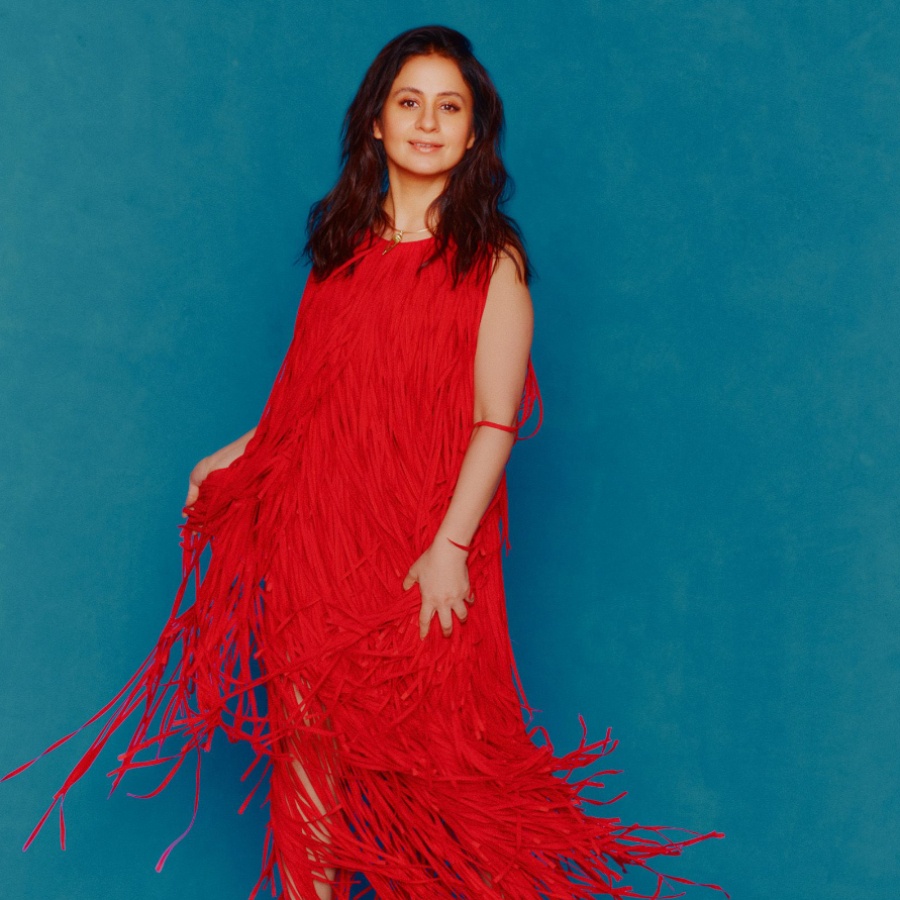
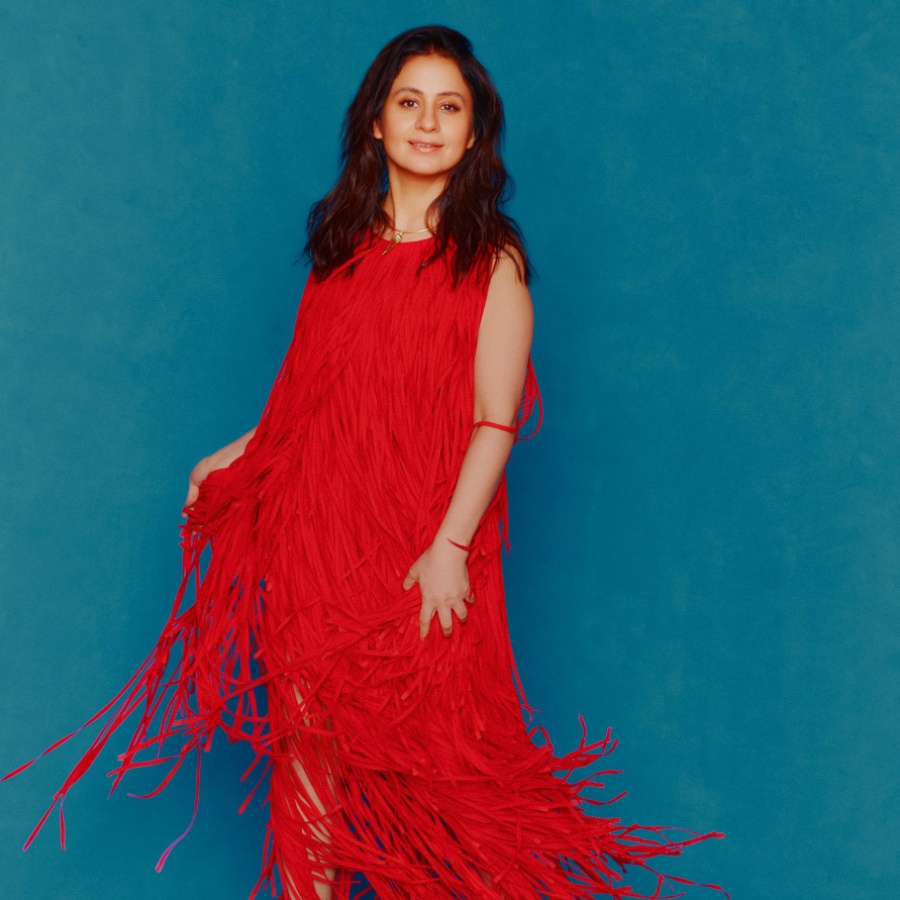
Harri just dropped his first eyewear collaboration and no, the sunglasses aren’t inflatable
The Indian-born, London-based designer behind fashion’s most recognisable latex silhouettes on his collab with Portuguese eyewear brand Vava and the comfort of going home
Harikrishnan Keezhathil Surendran Pillai doesn’t like to party. The 32-year-old designer, better known as Harri KS or just Harri as his eponymous label is known, may be synonymous with his avant-garde latex creations and as one of the London fashion scene’s most distinctive voices, but off the runway he’s decidedly low-key.
Last weekend, Harri unveiled his first eyewear collaboration with independent Portuguese brand Vava at Mumbai’s Nilaya Anthology. The evening featured a panel discussion, a performance, and a DJ set. Yet when I catch up with him the following day and ask how he celebrated, his answer is decidedly understated. “I’m a bit of an introvert,” he says. “I ended up speaking to a lot of people, many of whom I had either worked or studied with before. It’s quite surreal coming back after five years and reconnecting with everyone. Everybody is chatty.” As for his approach to small talk? “Travel is always a neutral topic. Wellness is picking up,” he laughs. “I tend to avoid talking about fashion on an industry level because the conversation can quickly become negative.”
Titled ‘Solarpunk’, the collaboration introduces five limited-edition sunglasses that translate Harri’s sculptural language into eyewear. Crafted in limited numbers using bio-based materials, such as polyamide powder derived from castor oil as well as biodegradable cellulose acetate sourced from cotton and wood-pulp fibres, the frames feature aluminium accents and crystal lenses and are graphic yet restrained.
ADVERTISEMENT
A glimpse from the launch event
The CL0030 and CL0031 models are made with eco-friendly cellulose acetate
Away from the launch and the fanfare, I catch Harri just before he boards a flight home to Kerala. Looking forward to spending time with family, he’s most excited about learning to cook with his mother and returning to a house still scented with the familiar nostalgia of Medimix soap. Below, the designer talks about his self-imposed uniform of fleece hoodies, why Vava felt like a natural collaborator, and the role movement plays in bringing his sculptural creations to life.
You’ve been spending more time in Mumbai recently. What brings you here?
It’s mostly been work. We’re building the ecosystem around our ready-to-wear line ‘MuseumWear’. A lot of our work is quite conceptual and not necessarily something people wear every day, and this line makes Harri a little more accessible. A big part of that has been figuring out manufacturing and sourcing, some of which now happens in Mumbai, while our fabrics come from different parts of Asia. So, I’ve actually been spending quite a bit of time here over the last few years. That said, whenever I do find myself with a bit of free time, I make a point of going for a benne dosa [at Benne in Bandra] at least twice while I’m here.
While your work is so maximalist, your own wardrobe feels quite restrained in comparison. Do you have a uniform?
I’m from Kerala, and there isn’t a lot of fashion culture there, so I’ve never consumed fashion like the rest of India or even London. In London, there are certain pieces that everyone seems to aspire to own—a Margiela shoe, a Burberry trench, a pair of Prada glasses. Even people who aren’t particularly interested in fashion understand and appreciate those references. I never really had that relationship with clothing.
When I started the label, the way I dressed was entirely practical. Coming from India, adapting to London’s weather was a challenge. My uniform became a thick fleece hoodie, black trousers, and a pair of Adidas or New Balance trainers. I probably own six or seven versions of the same hoodie, all in the same size, along with a couple of pairs of black trousers and the same shoes. There’s something about putting on that uniform that immediately puts me in work mode.
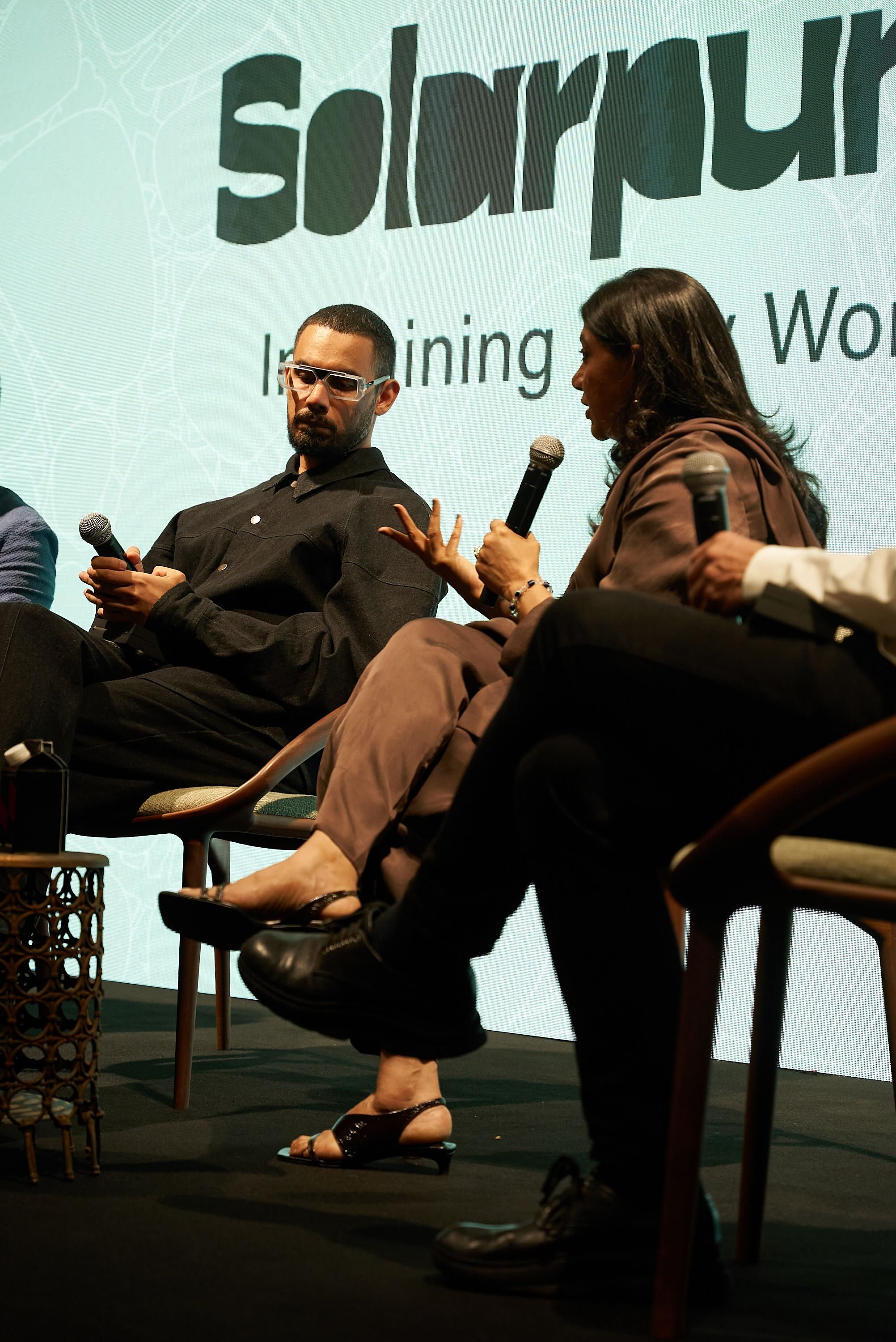
The designer in conversation at Nilaya Anthology | Reshma Mulik
Tell us more about the denim look you wore for the event.
What I wore was one of the first pieces from our ready-to-wear line. As we’ve been developing the collection, I’ve been thinking more about the kind of clothes I’d genuinely want to wear daily. At some point I’d love to design my own version of the perfect fleece hoodie.
This particular piece is made entirely from a nice 390 GSM denim. We spent a lot of time refining the construction and fit, but what interests me most is the silhouette. Pattern-cutting is my background, and circles are a recurring obsession in my work. If you lay the garment flat, it forms a circle. The same thinking appears in the inflatables—it’s just expressed differently here. Denim felt like the right material because it’s universal. Whether you’re in Korea, India, Europe or the US, everyone understands denim. Latex will always be a signature of the brand, but denim allows us to translate those ideas into something people can incorporate into their everyday lives.
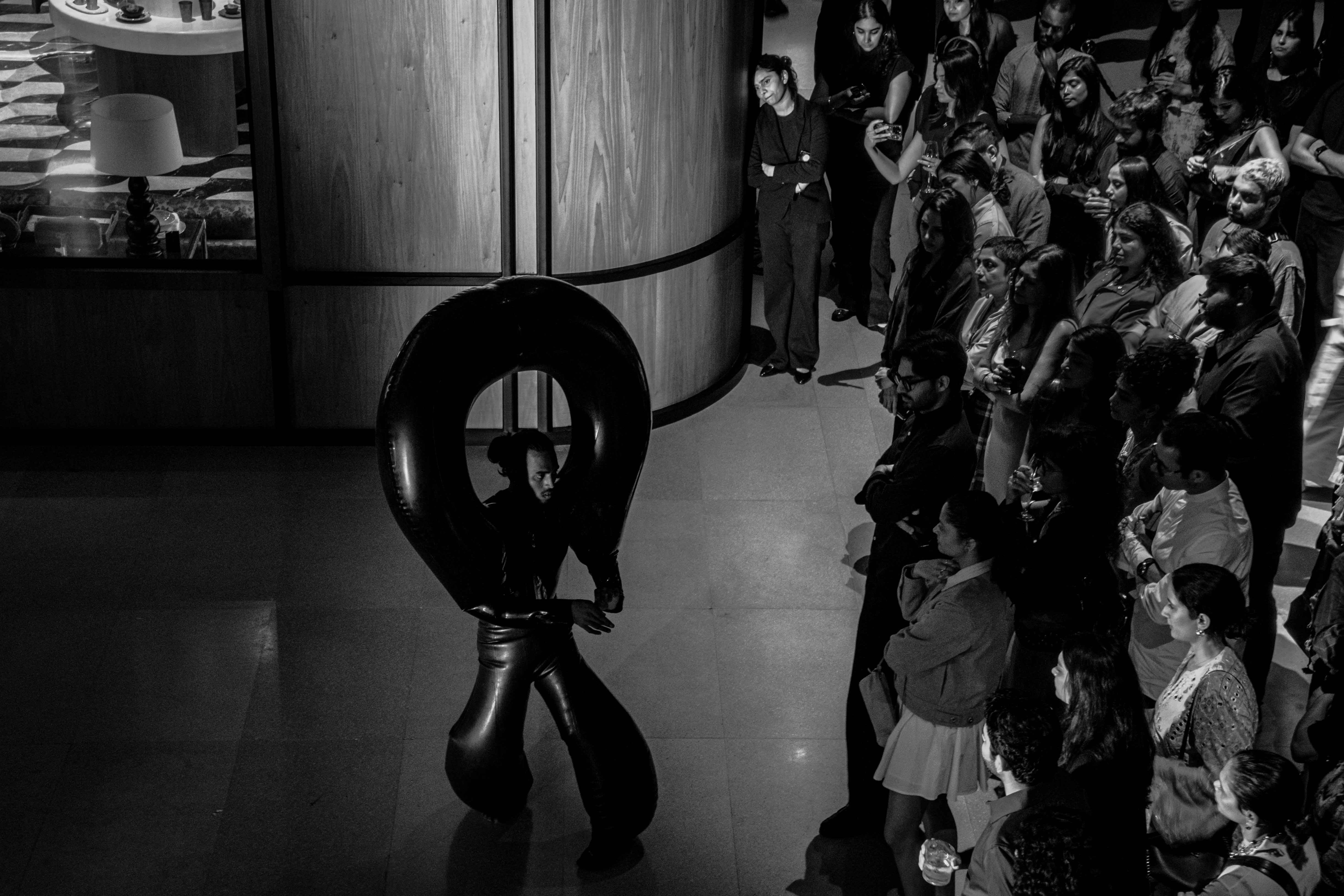
You also had movement artist Navin Kelamane perform in one of your inflatable pieces...
I think of my practice in different phases. The first part is very personal and intuitive—imagining forms and shapes. A lot of that comes from my background in bodybuilding. When you’re a bodybuilder, you spend months imagining what you want your body to look like and then working towards it. I’m the kind of person who can sit at an airport and spend hours looking at aeroplanes and appreciating their structures. That’s where it starts. Then I translate those forms into patterns and garments. The interesting thing is that without movement they’re really just sculptures or static objects.
I remember one of my earliest shows. A model was wearing one of the striped inflatable pieces and just started moving instinctively. It wasn’t choreographed. Suddenly, the garment came alive in a way I hadn’t anticipated. Seeing it in motion opened up a completely new world for me.
A performance by Navin Kelamane at the event | Kiara Anthony
What made Vava feel like the right collaborator, and why did this feel like the right moment to work together?
I’ve always loved Vava’s shapes. There was already a visual language that felt familiar to me, so the collaboration made sense from the beginning. What really interested me, though, was the material innovation. The material we used is derived from castor oil sourced in Gujarat and then processed and 3D-printed in Germany. I liked the idea that something with roots in India could be transformed through such advanced technology. It wasn’t really about making a pair of sunglasses. It was about seeing what happens when two different design worlds meet through material, form, and process.
Are there any subtle references to India within the collaboration?
What’s always interested me is looking beyond the obvious markers of Indian craft. When people talk about Indian design internationally, the conversation often gravitates towards a handful of familiar references—embroidery, textiles, rugs, jewellery. But India has thousands of craft traditions, many of which remain largely unknown outside their regions.
Years ago, I worked with Channapatna craft (the traditional lacquered wooden toy-making tradition from Karnataka) at a time when very few people outside India were engaging with it in a contemporary context. That curiosity continues to inform the way I work. With this collaboration, the connection to India comes through the material.
Was there a particularly interesting reaction to the collection—something someone saw in the design that you hadn’t anticipated?
People expected me to create an inflatable pair of sunglasses! Because that’s what they’re most familiar with from my work, but that was never the intention. When you’re designing something like eyewear or shoes, you don’t translate your design language literally. For me, it’s about world-building. The sunglasses are designed to complement the clothing and exist within the same universe rather than becoming a miniature replica of the garments themselves.
ADVERTISEMENT
If you had to imagine the ideal wearer of these glasses, who would it be? What would they be wearing, and where would they be headed?
I did have one person in mind while designing them—my friend Leanne, who founded the Institute of Digital Fashion in London. She’s also a mentor, a mother, and one of my customers. I find what she does incredibly inspiring because she balances so many roles at once. I can picture her wearing the glasses with a black bomber jacket from one of our previous collections. And as for the destination, probably her office—might not feel conventionally glamorous, but that’s the idea.
Are you big on sunglasses yourself?
Not at all. It’s funny because I grew up in Kerala, where wearing sunglasses wasn’t really a thing. In fact, in smaller towns it could almost be seen as a little disrespectful or overly self-conscious. I think that stayed with me. Even when I moved to the UK, I had a similar relationship with clothing. It took me a long time to feel comfortable wearing things like jackets or blazers. For the first 18 years of my life, I used to wear shirts and trousers. Suddenly you’re in a completely different environment and trying to unlearn those ideas about what feels appropriate. So, in a strange way, I’ve never owned any. The first pair I properly held in my hands were the ones I wore at the event.
What’s something you notice about the way people dress that most others probably overlook?
Because I’m a tailor and a pattern cutter, I’m hyper-aware of clothing. If someone is standing in front of me, I’m immediately noticing the composition, the weave, the texture, the construction, the finishing. I’m like a scanner, not from a judgmental point of view—it’s just how my brain works.
The upside is that it makes you incredibly respectful of clothing. Most of what I wear I’ve made myself. Some of those pieces are five or six years old and were originally created while I was learning pattern cutting. I rarely throw anything away. What’s interesting is that the more you understand clothing, the less attached you become to what it represents. I’ve completely detached clothing from status. I can spend the day talking about fashion and then go home, put on my father’s lungi and shirt, and feel exactly the same.
In some ways, I’ve become more of an observer of clothing culture than a participant in it. That’s both a good thing and a bad thing. As a designer, you need a certain amount of fantasy and obsession with fashion. I don’t really have that anymore. That’s probably why I’m so drawn to sculpture and performance—they give me something to think about beyond the garment itself.
The Vava x Harri eyewear capsule collection is available online on harri.store, at Vijay Opticians and other leading eyewear boutiques in India