




Food21 Jul 20266 MIN

Everyone’s fermenting everything. A fermentation festival was just a matter of time

Working with koji, cheese, feni, and kitchen-scrap tamari, chefs, makers, and researchers are driving a “culture” shift in Indian fermentation. Desi Cultures explores just this

Image

There’s a vessel in Payal Shah’s kitchen that she just keeps feeding. In goes leftover bisi bele bhath scraped from the bottom of a pot. Also in there: a spoon of leftover mint chutney, half an aloo bun, the last piece of a sushi order. Then come koji and salt. Gravity takes over from there. Days later, what drips out the bottom is deeply savoury and delicious.

The Bengaluru-based fermenter and Kōbo Fermentary founder calls it her reverse tamari. She lives alone, people keep sending her food, the fridge is small, so this not-quite-compost bin is what she came up with. Shah feeds it the way a baker would feed a sourdough starter. “Each batch tastes completely different,” she says. Given what goes into it, it would have to. You couldn’t repeat it if someone paid you to standardise it.

Payal Shah’s kitchen-scraps tamari is as good a snapshot as any of where Indian fermentation is going these days. It’s playful, resourceful, and not interested in the line separating purist tradition and experimentation. 

Shah is co-curating this year’s Desi Cultures, an online fermentation festival-conference, with its founder and food researcher Shubhra Chatterji. Chatterji launched the first edition of Desi Cultures in 2020, mid-lockdown, when Instagram was a parade of sourdough, SCOBYs, and starters. Yet, most of us overlooked the ferments already on our plates: dhokla, appam, khameeri roti, kanjivada. The conference was a reminder that we have our own eating cultures. Six years later, the conversation has widened and matured. “In 2020, we never thought we’d talk about fermentation from a diaspora point of view or an industry point of view,” Chatterji says. “How does coffee in India use fermentation? How do the new non-traditional alcohols use it? Koji was never something we thought of as Indian fermentation, and now we are.”

Running this week, the festival brings together chefs, cheesemakers, distillers, historians, and anthropologists across 10 online talks, all exploring one sprawling question: what can fermentation from our subcontinent contribute to the future of food?

For the last decade, chefs and fermentation enthusiasts have been falling hard for other people’s microbes. Copenhagen’s Noma opened a fermentation lab and started bottling its own miso. Gochujang crept into dishes everywhere. Every cafe from Bandra to Berlin is now pushing kombucha. Meanwhile, India has been sitting atop a microbial larder so old and so woven into our daily cooking that, amid all the noise about kimchi and kombucha, it is easy to overlook that, between our achaars and dosa, our axone and kaanji, fermentation has always been part of the Indian table.


If there’s one microbe currently enjoying celebrity status, it’s koji, or Aspergillus oryzae. It’s the mould behind miso, soy sauce, and sake, and has become the fixation of every Indian fermenter worth their salt. In addition to many of the speakers at this conference whom we spoke to, chefs like Gresham Feranades, Adwait Anantwar, Buland Shukla, Varun Totlani, and Vanika Chaudhary have created dishes with koji in their kitchens.

Shah also pitches it at full volume. “In my opinion, [koji] has made the same difference as fire and salt did to cooking,” she says. “This is the next transformational power. It has existed in Chinese, Japanese, and Korean cuisines for a very long time. We’ve just discovered the technology of harnessing what koji can do.”

And it turns out koji was never really foreign. Its closest wild relative, Aspergillus flavus, grows wherever there’s agriculture, Shah says, which means Aspergillus’ cousins are probably already in our kitchens too. It could be riding on the bran of unsprayed rice, and Shah reckons the similar wild cultures are at work in the ferments we already make. For Indian ingredients, then, koji behaves more like a long-lost relative than a total stranger. At Masque, for example, Totlani has a koji-fermented benne-style dosa as part of one hugely popular course. It brings a naturally sweet, nutty, buttery umami note to the batter.

A fermented food that is perhaps a staple in every Indian kitchen is one of Chatterji’s favourite examples of something few people even think to file under fermentation: ghee. “Every season, every altitude has a slightly different ghee flavour,” she says. The summer batch comes out sweeter, the winter one nuttier. “That’s one of my favourite fermented products. And if you say ghee to people, they’ll be like, where is the fermentation in ghee?”

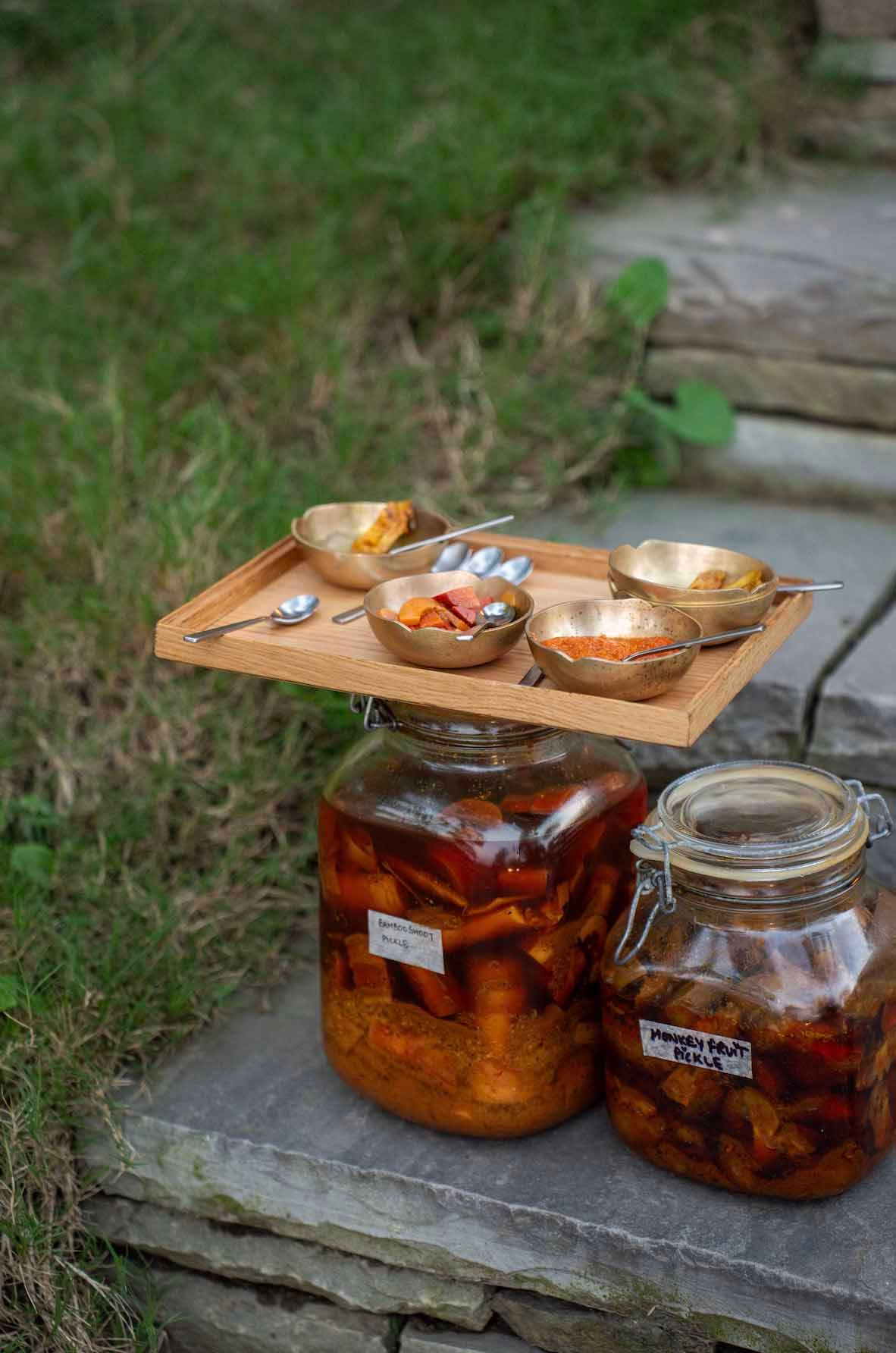
At Naar, chef Prateek Sadhu’s Himalayan restaurant near Kasauli, he and executive chef Kamlesh Negi turn radishes into an orange salt and cook with timur, the wild Himalayan cousin of Sichuan pepper. It runs a minor con on his vegetarian guests. Sadhu also lacto-ferments bottle gourd in brine, then smokes it, until the lauki, which most people avoid, turns out meaty, sour, and dense. “We don’t even announce that you’re eating bottle gourd,” he says. “Vegetarians ask, ‘Is this some kind of meat? Are you playing a prank?’ At the end of the day, it’s lauki that has completely changed texture and taste. So, it really fucks with your mind.” Sadhu is much keener on preservation in Indian cultures and subcultures than he is on koji. Ask what has him most excited, and he doesn’t hesitate: the northeast. “For me, it’s a gold mine still to be discovered. They’ve been doing it for centuries; it’s part of their culture.” Pun unintended.

_DSC9531.jpg
At Naar, chef Prateek Sadhu lacto-ferments bottle gourd in brine, then smokes it, until the lauki, which most people avoid, turns out meaty, sour, and dense along with other preservation techniques 

Namrata Sundaresan, the Chennai cheesemaker behind Käse, makes the same case with milk. “Ask anyone what cow’s milk tastes like, and they’ll say sweet,” she says. “It’s only when the cheese, the fermentation, the ageing come in that the milk starts to express itself. It’s now that the beauty of the terroir actually comes into play.” France has its alpine wildflowers; India, mostly, does not, so here the expression is through sour cream and cultured-butter notes, and it changes with the calendar. Even so, her nominee for the funkiest thing happening in Indian fermentation isn’t a milk product. It’s a number.

Five years ago, she says, you could name India’s artisanal cheesemakers on two hands. Now there are close to 40, each bringing out a bit of themselves in their curd, including newer makers such as Mausam Narang (Eleftheria) and Amit Mittal (Kumaoni Blessings). And Käse now makes about 40 varieties of cheese, from fresh to aged, as well as some signature varieties, such as lavender cheese with buds and pastoral cheeses.

Greater interest in fermentation brings new viewpoints too. In Goa, feni-maker Hansel Vaz of Cazulo is holding on to the hyperlocal spirit’s wildness, insisting on earthen pots and the unpredictable yeast that floats in on the breeze instead of the stainless-steel tanks and lab strains regulators might prefer. “A tank tastes different from an earthen pot,” he says. “If we industrialise fermentation, that would be the saddest thing, because that’s where the flavour comes from.” The demands can tip into the surreal. At one point, Vaz says, officials wanted distillers to string saris beneath the cashew trees so the apples would drop into cloth rather than onto the “dirty” ground, as they always have. Never mind that a sari in a dry summer forest is a fire waiting to happen. He likens regulated feni to supermarket ham.

So where does a curious beginner even start? “Start with whatever you like,” Shah says. “If you like fizzy drinks, start with kaanji. If you like pickles, do that. It’s a very personal journey.” And Desi Cultures is an invitation to begin that journey, and to discover a subcontinent's worth of microbes.

‘Desi Cultures’ online events run from July 20 to 24, streaming each evening from 5 pm to 8 pm. In-person satellite events around the country run till July 26 and are listed here. A festival pass (₹1,500) covers all talks, live and recorded. Register at desicultures.in

The Nod Newsletter

We're making your inbox interesting. Enter your email to get our best reads and exclusive insights from our editors delivered directly to you.