




If you ever find yourself in the 8th arrondissement of Paris around 11 am (barring Tuesdays), you’ll notice a buzzing queue on the road flanking the Dior flagship on Avenue Montaigne. It’s where the entrance to La Galerie—the house’s exhibition space—is located, where throngs of tourists and fashion enthusiasts line up six days a week to discover, gawk at, and take pictures of pieces from the maison’s archives in the very place they are conceived. Last month, Dior updated its permanent exhibition to include the works of Jonathan Anderson, the current creative director of its women’s, men’s, and haute couture collections, alongside all his predecessors, including creations by Christian Dior himself.
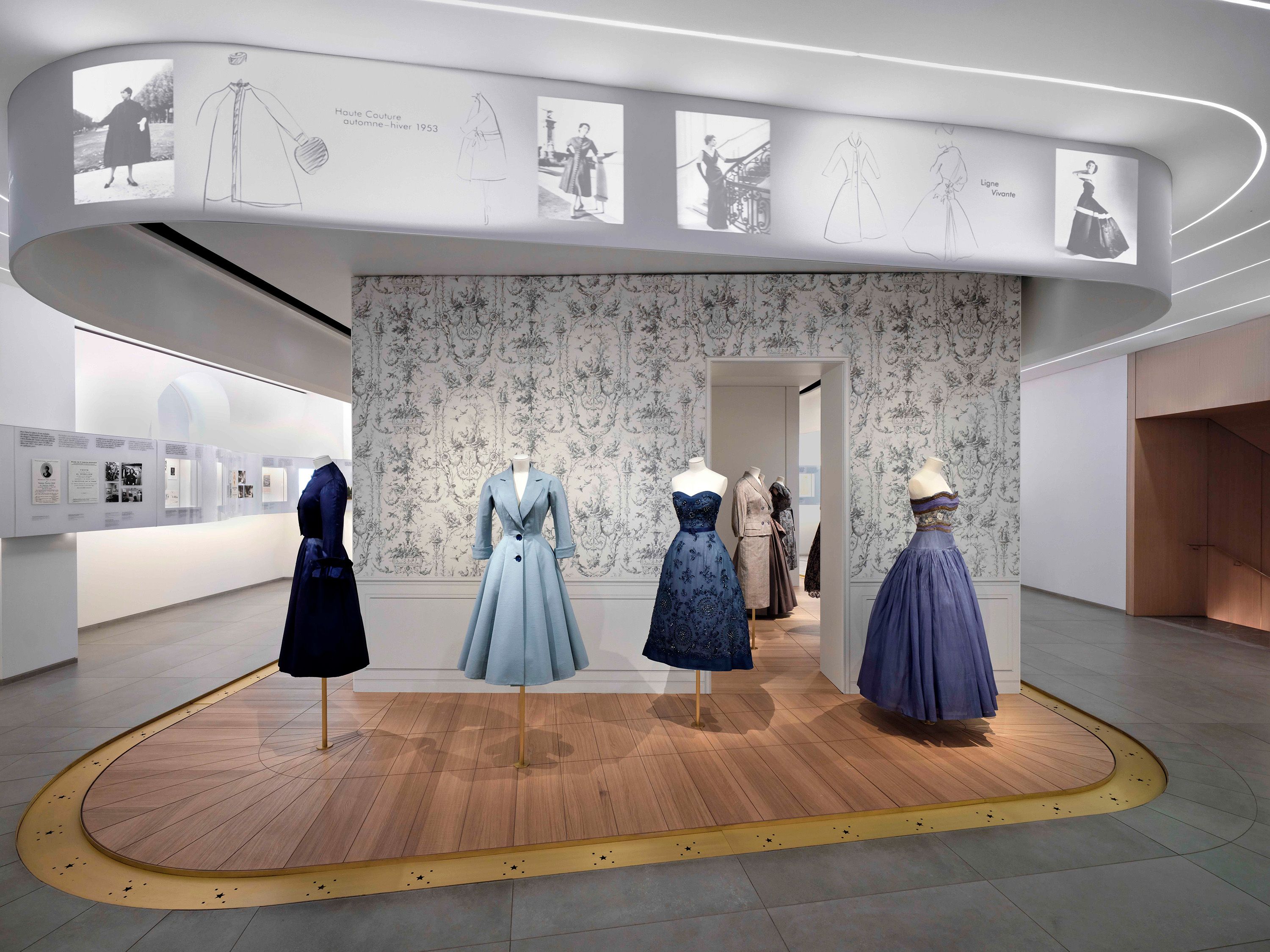
Spread across three floors and 13 themed rooms, the exhibition brings together about 150 garments, accessories, sketches, photographs, objects, and archival documents from the house’s history spanning almost 80 years.
Upon entering, you are greeted by the address’s iconic spiral staircase against a towering wall of 3D-printed hats, shoes, bags, and miniature replicas of garments meticulously arranged in a rainbow gradient. Almost everyone stops to take a photograph.
The actual exhibition begins on the third floor, where the mood turns academic for a brief moment. The first room charts the birth and early life of Christian Dior, the founding figure of the fashion house in 1946, and how he burst onto the scene in 1947 with the radical ‘New Look’, which shaped post-War fashion with its fitted bodice and A-line skirt. The chronology continues through his sensational international success and sudden demise in 1957 and the appointment of his protégé Yves Saint Laurent. Then, the exhibition abandons the timeline and heads into an inky black space in full bloom.
‘Enchanted Gardens’ is a darkened room filled with floral dresses from Dior’s different eras. Here, the bulbous white Cloche dress from Anderson’s spring 2026 debut covered in thousands of tiny flowers is displayed alongside dresses from Raf Simons and Maria Grazia Chiuri, among others, immediately establishing the exhibition’s central idea. Anderson’s work isn’t in a separate section announcing a new future but has been folded into the house’s visual language, placed in conversation with those who came before him.
Our guide, Adam Dehmohseni, explains that the house initially did not maintain an archive. Several early pieces on display are either donated by Monsieur Dior’s clients or recreated by the atelier from old sketches, notes, and photographs. You can just imagine an archivist zooming into a grainy black-and-white image, trying to discern what material a dress is made of.
In the next room hang portraits of Christian Dior and his seven successors—Yves Saint Laurent, Marc Bohan, Gianfranco Ferré, John Galliano, Raf Simons, Maria Grazia Chiuri, and finally, Anderson—each paired with a signature design. Ahead, the building becomes part of the exhibit. Visitors encounter the grand staircase from which models would descend during haute couture presentations (back when clients would watch the latest collections inside the maison than through a livestream). Through a transparent glass floor, we also get a glimpse into Monsieur Dior’s original office, as well as the wood-panelled cabine on the floor below, where models would come in daily for fittings and get ready before shows. The couture workshops are located directly above.