



Enjoy Responsibly04 Feb 20267 MIN

As the Tang-style jacket craze illustrates, Chinese is chic now. Should you participate?

From qipaos to “Mandarin jackets”, Chinese aesthetics are trending again. Appreciation isn’t the problem—vagueness is

A collage of Chinese aesthetics going mainstream: pankou closures on jackets inspired by the Tang suit, Jahnvi Kapoor in a qipao-inspired Roberto Cavalli dress

Illustration by The Nod; Adidas; Róhe; Instagram.com/janhvikapoor

A couple of months ago, a friend who had just returned from a holiday in China greeted me with “You’re meeting me at a very Chinese time in my life” and refused to elaborate. At the time, I laughed and moved on. Only later did I realise she was referring to what the internet has since dubbed Chinamaxxing—because any trend worth taking seriously must have the suffix “maxxing” these days.

On TikTok and Instagram, people are drinking hot water and tea, eating congee for breakfast, and ladies who lunch have adopted a new pastime: mahjong. Everything from traditional Chinese medicine to Chinese astrology is blowing up. As someone who grew up being bullied for her school lunch and has been called countless names, it’s hard not to feel a small thrill of vindication watching all of this unfold.

I’m an Indian-born, third-generation Chinese Indian; my grandparents moved to India from China in the late 1930s. For much of my childhood, the cultural markers that are now being enthusiastically consumed online were things I learned to minimise, if not actively hide. So, it brings me great joy to see parts of my culture celebrated. But joy, I’ve learned, can coexist quite comfortably with discomfort.

This isn’t the first time the mainstream has flirted with Chinese culture. Growing up in the early 2000s, I remember the qipao, or cheongsam, being a popular silhouette circulating through pop culture: halter-neck, backless satin tops with Mandarin collars, form-fitting dresses with side slits and pankou closures (handmade cord fasteners with a button knot and a loop). Kate Moss on her 22nd birthday. Nicole Kidman at Cannes. Mary Jane in Spider-Man (2002). Jennifer Aniston wore it in Friends. This was Chinoiserie for the Y2k wardrobe, part of a much older Western fascination with an imagined “East” that blended motifs from Chinese, Japanese, and other Asian cultures into a single aesthetic.
Designers, of course, have borrowed from traditional Chinese dress for decades in much the same way Indian textiles are endlessly “referenced”—admired, abstracted, and rarely credited in full. John Galliano did it at Dior in the late ’90s and early aughties. Jean Paul Gaultier did cheongsams with flesh-baring, diagonal slits across the front for his autumn/winter 2001 haute couture collection. Roberto Cavalli did a series of cheongsam-inspired minis for spring/summer 2003. Tom Ford has done it at Yves Saint Laurent. Alessandro Michele still borrows from it—his collections are almost always a smorgasbord of cultural references. The list goes on. All of this—how the West has borrowed from China—was eventually wrapped in institutional legitimacy by the Met’s 2015 exhibition, China: Through the Looking Glass, which attempted to interrogate this long history while also, somewhat ironically, aestheticising it.

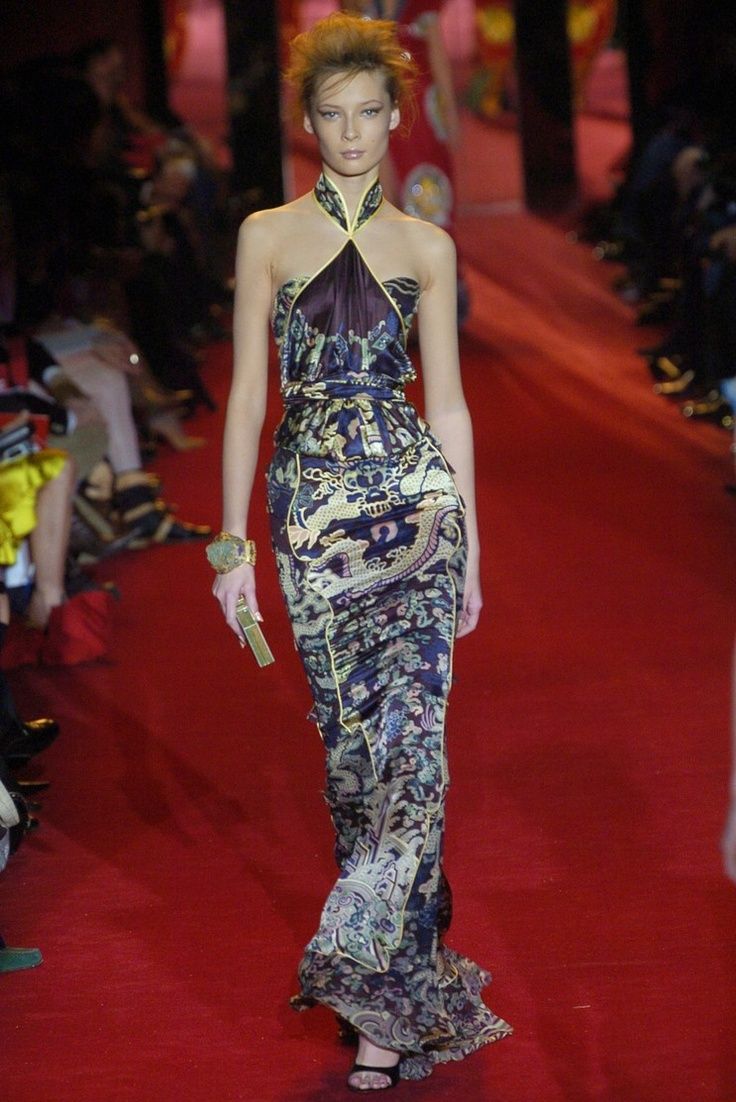
A cheongsam-inspired dress from YSL by Tom Ford FW2004
A cheongsam-inspired gown from Yves Saint Laurent autumn/winter 20024 by Tom Ford

Fast forward to now, and Cavalli’s 2003 moment has resurfaced again. Last July, Lindsay Lohan wore a qipao-inspired Cavalli minidress while promoting Freakier Friday. In October, Janhvi Kapoor was spotted in a yellow version, captioning her post: “Feeling grateful and humbled ❤️ and extra cute in this little yellow number 💋”. It wasn’t offensive—but it was lazy. Imagine the response if a non-Indian wore a sari or a sari-inspired dress without naming its origins or acknowledging where it came from. If you are to wear something with such a strong cultural connotation, wear it with awareness. We manage this balance all the time in Indian fashion; providing context isn’t that hard.

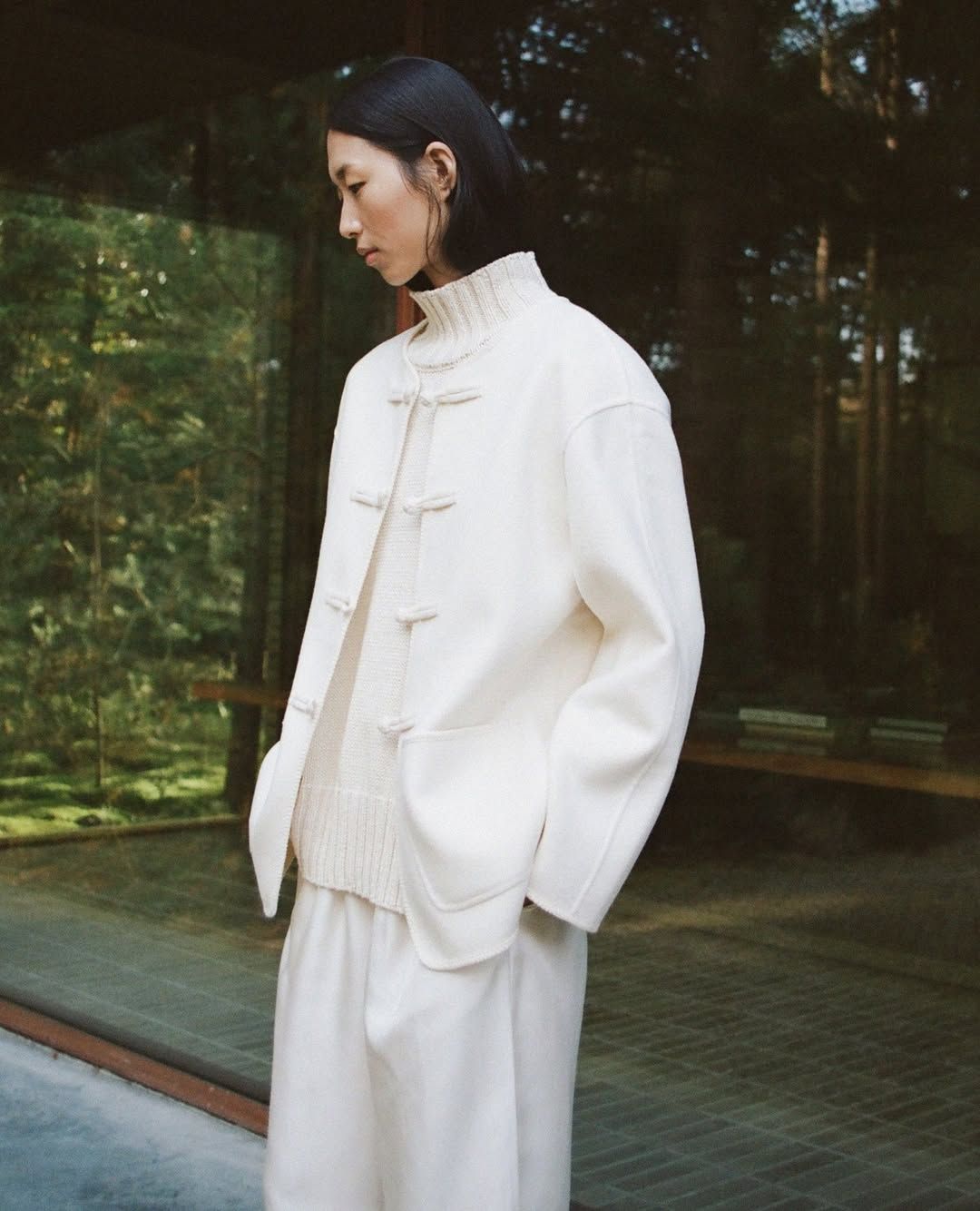
Which brings us to the current fixation: the “Mandarin” jacket. Amsterdam-based label Róhe’s version—which is finished with traditional Chinese pankou closures instead of buttons or a zipper—emerged as one of the most popular styles of 2025. One article even deemed it an “Olsen-inspired” winter jacket, stating the “toggle buttons conjure a kind of eccentricity that makes you question if the piece isn’t actually a rather excellent vintage buy.” Since becoming the subject of online discourse, where people pointed out there’s nothing such as a “Mandarin jacket”, only a Mandarin collar, it has quietly been renamed the ‘Pankou Closure jacket’ on the brand’s website. Similarly, Reformation has a slim-fit jacket called the ‘Regin’. Arket has an overshirt with “velvet strap fastenings with decorative knots”. Spanish resort wear brand Amlul is promoting its new “reinterpretations” of its “iconic Egia jacket”, which clearly borrow from traditional Chinese dress but don’t credit the source. Its website also has dresses and vests with Mandarin collars and frog buttons, but the garment descriptions simply read “inspired by asiatic dresses”, “Handmade in our atelier in Spain with premium French fabrics”. The outerwear trend isn’t popping up out of nowhere. Fitted, cropped jackets featuring decorative closures have been rising in popularity more broadly, from Hussar-style jackets with decorative braiding and frog fasteners to men increasingly opting for stand-collar silhouettes reminiscent of Nehru jackets instead of blazers with notch and peak lapels.

Rohe 'Mandarin' double faced wool Pankou Closure jacket
Róhe’s double faced wool pankou jacket

Still, nothing captured the internet’s attention quite like the Adidas Tang-style jacket released as part of its limited-edition Lunar New Year capsule available exclusively in select markets such as China, Hong Kong, Macau, and Taiwan. Adidas has been releasing capsules around the Lunar New Year for over a decade, but this piece—featuring traditional toggle closures, created in collaboration with London- and Shanghai-based designer Samuel Guì Yang—went viral after being spotted at Shanghai Fashion Week in October. In fact, it sparked such a frenzy that Adidas followed it up with a collection for pets. This year, to mark the Year of the Horse, the brand has reunited with Yang for their Lunar New Year collection as well as dropped another collaboration with Edison Chen’s Clot. The shoes—one with a cowhide horse print and the other with frog button closures instead of laces—are, frankly, insanely cool.

The trend has trickled into India too. Halter-neck blouses with Mandarin collars, Chinese-inspired brocades, and fusion silhouettes are trending. In fact, one well-known sari brand even released an entire collection based on the idea. The clothes were of course gorgeous, and I genuinely loved the concept. It’s an amalgamation of my two cultures—the one I inherited, and the one I grew up immersed in (I was born in Varanasi). But the campaign fell apart on closer inspection. It was shot in Thailand and featured an Indian model and a Thai model, as if one Asian identity can visually substitute another. The casting leaned on a familiar assumption: that identities are interchangeable as long as the model looks ‘Asian enough’, that specificity doesn’t matter. On the brand’s website, the collection is described as a “playful dance between Oriental culture and Banarasi heritage”, while descriptions for many of the garments read “intricate motifs inspired by Oriental culture”.

This kind of vague attribution isn’t harmless. Anyone who works in Indian fashion knows how specific provenance is—how quickly a craft loses meaning once it’s reduced to “inspired by”. Remember Prada’s Kolhapuri chappal fiasco from last year? Which is why this kind of vagueness feels especially glaring. If you are borrowing from a culture—especially one that has been historically flattened or exoticised—and profiting from it, you don’t get to be sloppy about naming it. And if you’ve done your research and chosen not to be specific, it’s not ignorance. It’s Sinophobia and it is racist.

For what it’s worth, I don’t believe that wearing a qipao—even a modern version of it—is inherently offensive. Please wear it. Enjoy it. Now, I can’t telepathically scan strangers on the street to check whether they have the awareness of the origins of the designs they’re sporting, but just as someone who wouldn’t want a Western brand ripping off the sari or dupatta and renaming it a boho or Scandinavian scarf and making money off it, the same sentiment applies here. Don’t call it Oriental (which, by the way, is a term that’s still deeply loaded and offensive). Name the culture; it’s not that difficult. It’s Chinese. And if you can, buy from independent Chinese designers. There are plenty that thoughtfully marry elements and crafts from traditional Chinese attire with a modern sensibility to make them wearable: Samuel Guì Yang, Shanghai-based Ao Yes, Hong Kong-based Sau Lee by Cheryl Leung. Designers like Vivienne Tam (whose vintage pieces are now coveted on resale platforms), Shiatzy Chen, and Hong Kong-based brand Shanghai Tang have been doing it for decades.

But I would also advise buying these styles only if they add value to your wardrobe. Qipaos and Tang-style jackets are more than just trendy garments or a “2026 It-girl must-have”. This isn’t about policing who gets to wear what, or “my culture is not your costume”. It’s about how fashion has long extracted cultural motifs for profit, often without credit, context, or care. None of the adaptations inherently negate or defame Chinese culture, but they are infinitely better when inspiration is named and acknowledged.

So yes, it’s okay to be in a Chinese time in your life or in your Chinese Era. I, in fact, love it. Just do it with a bit of thought. Thoughtfulness, after all, never goes out of style.

The Nod Newsletter

We're making your inbox interesting. Enter your email to get our best reads and exclusive insights from our editors delivered directly to you.