




When it comes to inheriting diamond jewellery, the question of ownership is often paramount. Who receives what? Who keeps which piece? But energy travels differently. It lingers in metal, settles into stone and gathers quietly with every wear. In the Grewal household, jewellery was never static. Diamonds in particular moved—across wrists, across moods, across generations and sometimes, across countries. For Sasha and Kaabia Grewal, sisterhood has always been a negotiation of instinct rather than territory. Jewellery simply makes that instinct visible.
A universe built on emotional shorthand
“Building a jewellery house with your sister feels like creating a universe with someone who already understands your imagination,” says Kaabia. “We share references, memories and a deeply emotional way of seeing beauty. It feels like continuing a conversation we started as children; only now the conversation has become a house.” Sasha adds.
That conversation began long before Outhouse, the celebrated jewellery label, materialised. It started in front of mirrors, inside jewellery boxes, in the quiet rituals of trying on what belonged to their mother and grandmother. Natural diamond jewellery especially, carried a different gravity. It was never trend-driven or seasonal but held history—and that’s something that was always meant to be shared.
The foundation relies on sisterhood
If most siblings establish boundaries, the Grewal sisters dissolved them before anything else. “The rule is beautifully simple: Everything is shared,” Sasha says. “Jewellery has always moved fluidly between us, almost like a wardrobe of memories. There is something special about seeing a piece you love take on a new life on your sister, styled in a way you would never have imagined. It’s like extending the story of a piece through both of us.”
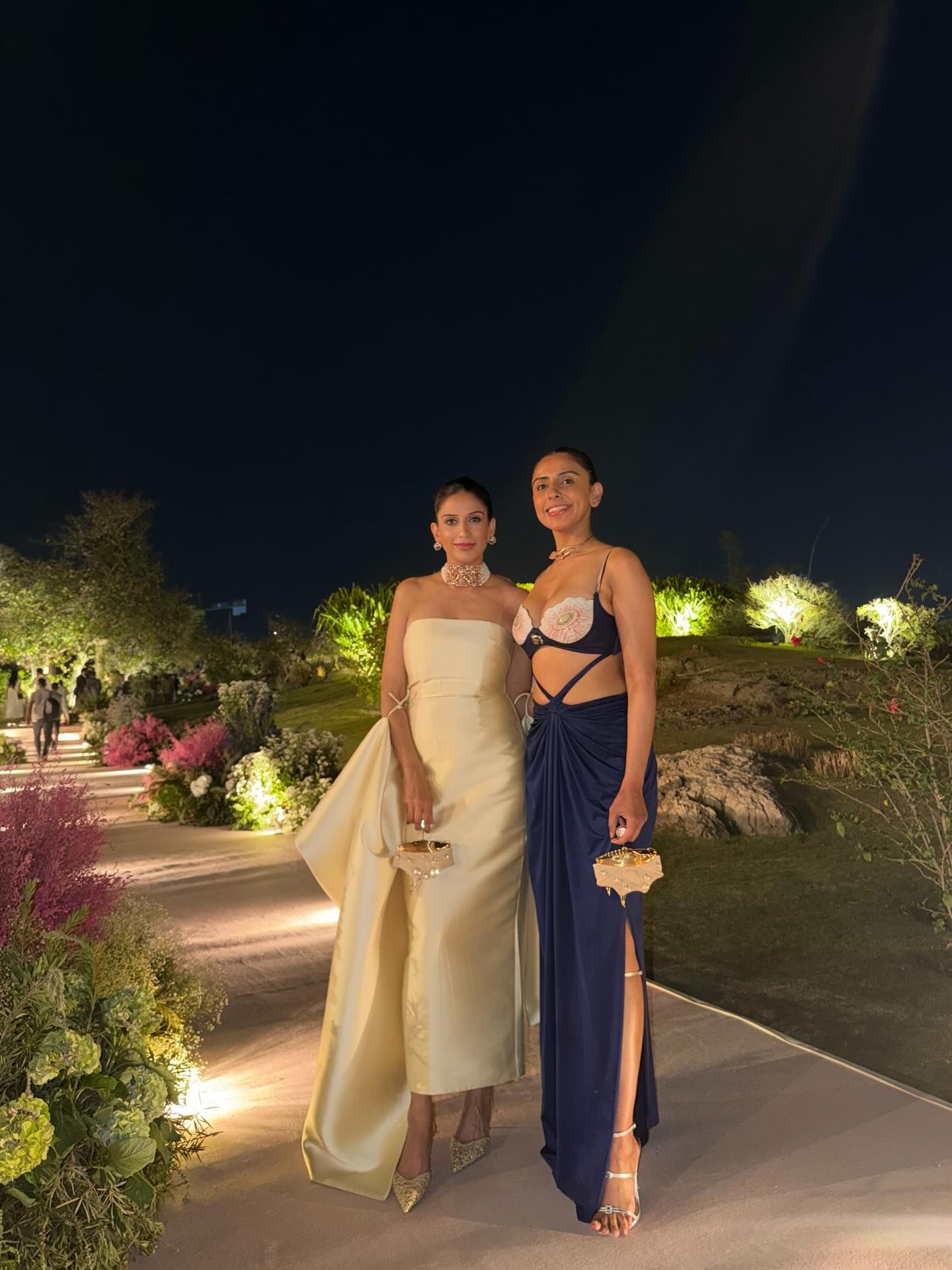
Sharing requires surrender. It means allowing something you love to be reinterpreted. Yet for them, possession has never been the point. “Not personally,” Kaabia says when asked about arguments over jewellery. “We share everything far too freely for that,” she adds.
When a natural diamond absorbs energy
Natural diamonds introduce another layer to this sisterly exchange: irreversibility. Formed over millennia, each stone carries geological singularity before it is set in metal, before the sparkling heirloom even touches the skin. Once worn, it begins a second life.
“Completely!” Sasha says when asked whether natural diamonds absorb individual energies. “Diamonds carry memory and intention. As soon as you put something on, it begins to gather emotions and experiences. Each piece feels different depending on who wears it, how it moves, and the moments they witness. Over time, they become infused with the life around them, almost like quiet keepers of personal history,” she explains.
The makings of an heirloom
The same diamond on two sisters does not read the same. “There have been so many moments when I have fallen in love with a diamond piece, only to see it come alive on Sasha in a completely unexpected way,” Kaabia reflects. “Suddenly, it feels as though it was always meant for her. Jewellery has a beautiful way of choosing its wearer.”
This is where rarity acquires true meaning. While lab-grown stones can replicate cut and clarity, replication cannot reproduce history. The emotional singularity that forms once a diamond becomes entwined with specific lives resists duplication. “Singularity is everything,” Sasha says. “Even when two pieces are designed to look the same, the moment they become part of someone’s life, they become entirely unique. Diamonds gather stories, they stay with you through milestones and become deeply personal. That is what transforms it from an accessory into an heirloom,” she adds.
Some things are meant to last
Knowing a natural diamond is irreplaceable changes the whole ball game. “You begin to wear your diamonds with intention. You remember where you wore it, who gifted it, and what moment it quietly witnessed,” says Kaabia. “Over time, it becomes something you care for emotionally as much as physically, because it holds pieces of your life within it,” she adds.
Among the pieces the Grewal sisters treasure most is a traditional Punjabi maangtika passed down from their great grandmother, via their mother. There is also their grandmother’s diamond studded navratan nath, worn on her wedding day and later entrusted to the next generation.
When asked what matters most when jewellery is passed down, Sasha does not hesitate. “The memory always comes first. Design and stones give jewellery its beauty, but the story gives it its soul. When a piece is passed down, what truly travels with it is the emotion, the history and the life it has already lived.” Which is why sharing a natural diamond with your sister is a marker of the ultimate trust–you’re sharing not just the stone but also your stories, your memories–and perhaps that is the most valuable asset someone can inherit.