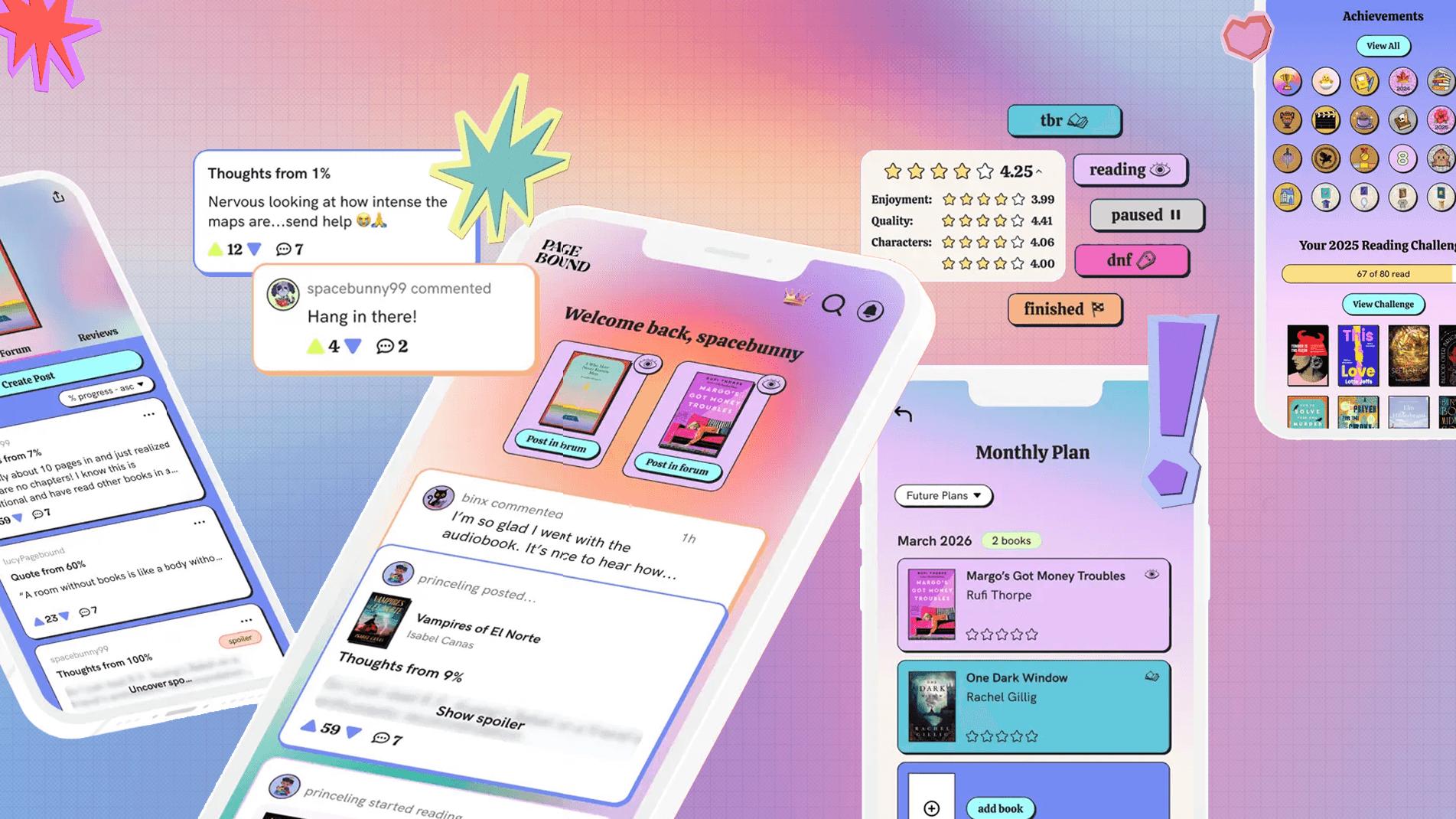




The internet has no shortage of places to keep track of your books. Goodreads has the giant catalogue, StoryGraph has the stats, and Fable has the book clubs. Pagebound is the newer kid on the block, bringing its own mix of reading lists, social forums, themed quests and, importantly, a very pretty interface.
Founded by Lucy Zhao and Jennifer Dobak, Pagebound launched early last year and has picked up plenty of traction since, with more than 50,000 downloads on Google Play and a 4.8 rating on the iOS App Store. It is very pretty, for one. Pastel colours, a smooth interface, and a general lack of the clunky feeling that tends to accompany book-tracking apps make it unusually pleasant to spend time on. I opened it expecting to browse for a bit and ended up reorganising my reading life.
The library is where you start. Books can be marked as currently reading, interested, finished, paused or DNF, and you can make custom shelves for anything that doesn’t fit neatly into those categories. I’ve already made one for internet culture, with Algospeak by Adam Aleksic, Never Logged Out by Ria Chopra and Your Perfect Dream Girl by Sukhnidh Kaur among the books on it. You can also plan ahead, which is useful if your TBR resembles a long-term infrastructure project. Pagebound lets you create monthly shelves or go bigger and make a reading plan for an entire year.
The Discover section is where things get more entertaining. Users can see which books were most discussed, most finished, and most added to TBRs the previous day. There’s also a daily featured emoji that sets the mood for the books being surfaced. On the day I checked, it was a coffin, so the recommendations naturally veered towards vampires, death, grief, and gothic drama. Dracula, The Dead Romantics and The Vampire Lestat all appeared. You can also follow readers whose lists and recommendations catch your eye, which makes finding your next book feel a little less like feeding keywords into a machine.
Then there are Quests, which might be my favourite part. These are basically themed reading challenges where you get a badge at the end, which you can display on your profile to show your knowledge and expertise in a particular genre or topic. I joined the Shady Hollow quest, a cosy-crime series challenge, and started reading the first book. I will get a badge when I finish the first book and more options to decorate it if I read multiple books from the quest. Other quests can be much broader. Evil Scientists, for example, includes 14 books ranging from RF Kuang’s Babel to Helen Phillips’s Hum. There are limited-time quests too, as well as forums where people doing the same quest can discuss their progress.
Your profile is built around your reading taste from the get-go. When you join, you pick five books that you think say something about you as a reader, giving people an instant sense of your taste. Your profile also shows your current reads, lists, posts, comments, and quests, while a reading wrap tracks things like pages and minutes read.
This is where Pagebound starts to distinguish itself from the other reading apps. The founders describe it as what would happen if Goodreads and Reddit had a baby. Every book has its own forum, where readers can keep adding thoughts as they work their way through it. The conversation stays attached to the book, a little like a Slack thread, where readers can keep track of the discussion rather than disappearing into a general social feed. It is also entirely text-based, so there’s none of the pressure to photograph your book next to a coffee and a strategically placed pair of glasses. Compared with StoryGraph, which is heavily focused on reading statistics and habits, or Fable, which leans more into book clubs and community, Pagebound feels like it is trying to do a bit of everything while keeping the book at the centre. There are no AI features either, which is becoming a distinction in itself.
The app is still a work in progress. Its points-based gamification is being developed, and there is a lot to explore, which can feel slightly overwhelming when you first arrive. The giveaways feature is currently limited to US readers and at the moment quest creation is also limited to only top contributors, so you’ll need to put in a request through the Pagebound team if you have an idea for one.
But I like that the app doesn’t seem interested in making you perform being a reader. It is more about keeping track, finding things you might actually want to read, and talking to people who have read them too. I’ll still happily post a curated bookshelf picture on Bookstagram. But if I want to know what I’m reading next, Pagebound, available on both Android and iOS, might have just become my new favourite place to look.