





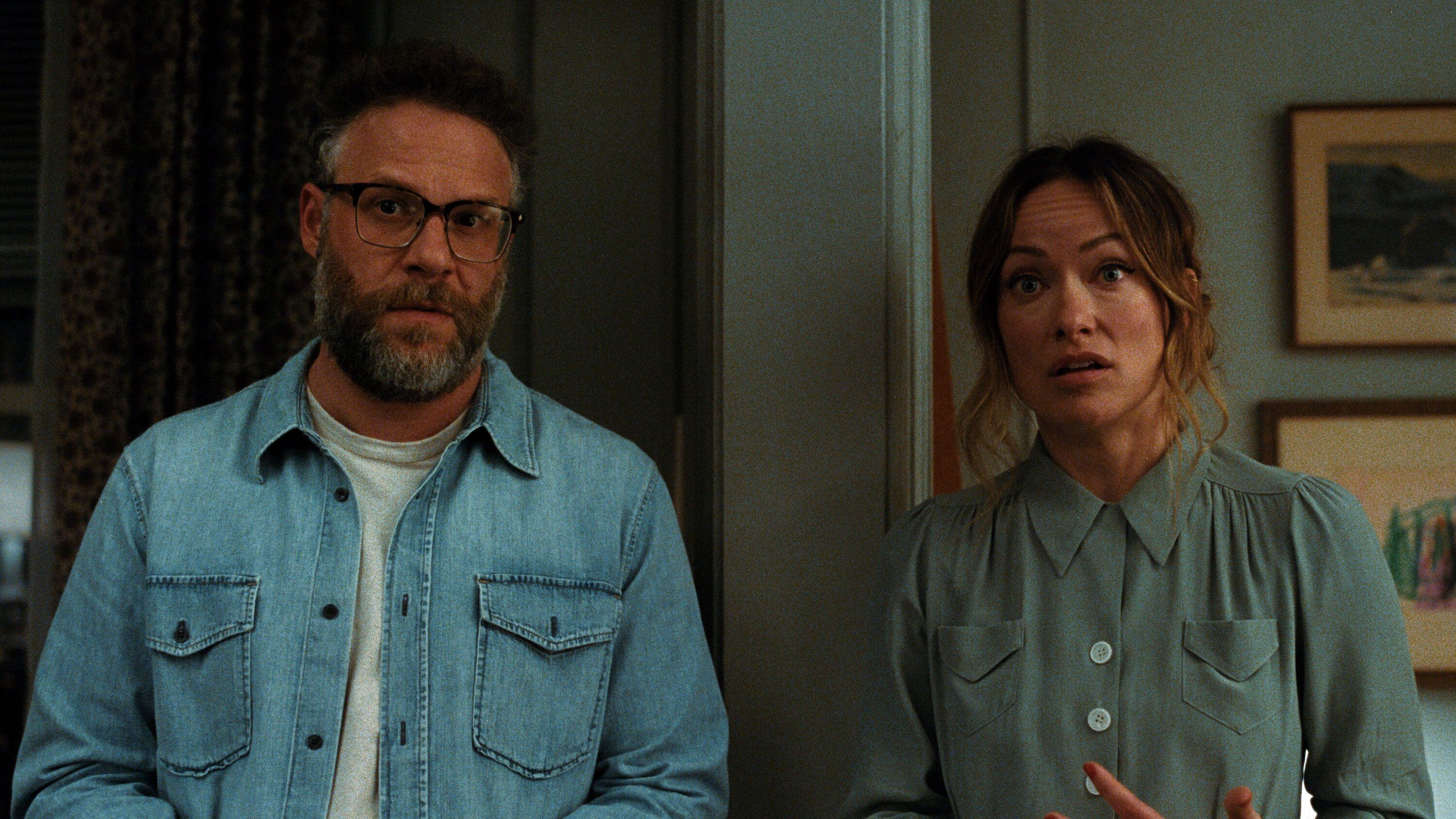
The first thing to collapse in The Invite is the soufflé that Olivia Wilde’s Angela has painstakingly prepared, but it’s far from the last. Angela and her husband Joe (Seth Rogan) have invited their upstairs neighbours over for dinner, and Angela would like this dinner to communicate several things: that she and her husband have a thriving marriage, that their newly renovated apartment has always looked this good, and that she regularly conjures up aerated French dishes on a weeknight without breaking a sweat. Joe, meanwhile, has forgotten to pick up the wine, has collapsed on the floor due to a back injury inflicted by the folding bicycle his wife insists he use, and would seemingly rather do anything than play host to two strangers.
It doesn’t take long for the film to establish that Angela and Joe’s marriage is far from rosy—they’ve been together for 15 years, have a daughter, and argue with the kind of clinical precision that only comes with knowing exactly how to push each other’s buttons. Angela, a former artist, now channels her creative energy into decorating their San Francisco apartment. Joe, meanwhile, teaches music at a prestigious conservatory but visibly flinches at the mention of his former indie band’s one-hit-wonder success.
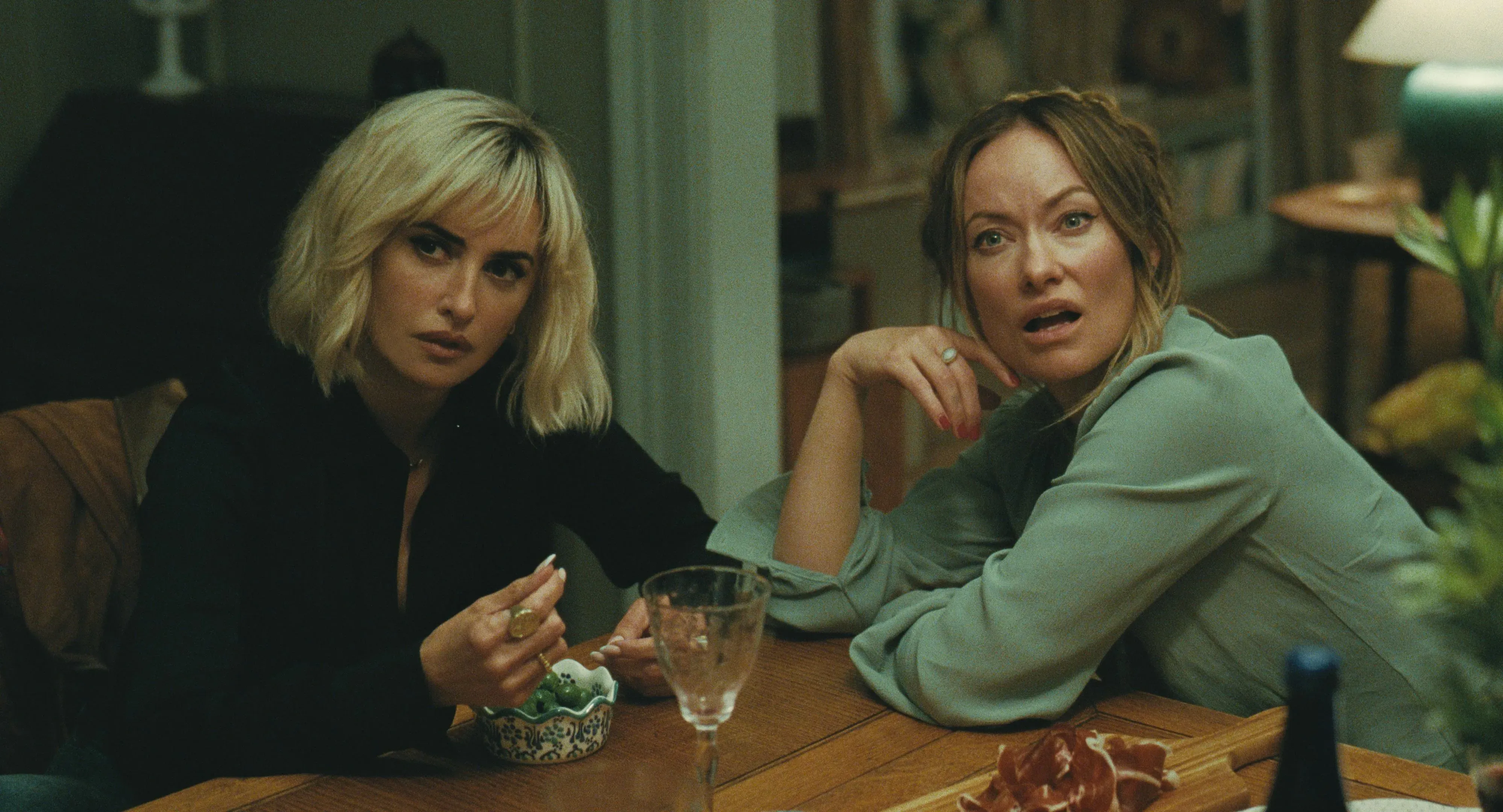
In contrast to these murky marital doldrums are Hawk (Edward Norton) and Piña (Penelope Cruz), the starkly glamorous upstairs neighbours whose wall-shakingly loud sex has been keeping Joe up at all hours and made Angela more than a little envious of Piña’s thunderous, echoing orgasms. Hawk, a former firefighter, is the epitome of composure, while Piña is a sex therapist with the kind of piercing gaze that could diagnose your attachment style before you’ve taken your coat off.
The night starts with a bottle of champagne, then progresses to a vintage wine that Joe and Angela have been saving for a special occasion, which turns out to be the right instinct, because nothing says “special occasion” like being propositioned by the hot neighbours that you’ve just discovered regularly host orgies and have come over to scope you out as prospective new sex partners.
Hawk and Piña have ‘preference lists’, which are menus of sexual acts that their partners can fill out, they establish ground rules with military precision, and discuss pleasure with the practical efficiency of an HR organising an off-site. Piña’s sex therapist fluency owes a lot to Esther Perel, who served as a consultant on the movie and who has lent more than a little of herself to Penelope Cruz’s character. Case in point? Piña brings up ‘compersion’, a topic that Perel regularly tackles, which refers to feeling joy when seeing a loved one experience happiness or pleasure, even when that pleasure doesn’t directly involve you. Angela, however, mishears this as ‘compression’, which is a Freudian slip that offers commentary on the state of her own marriage and sex life.
If there’s one thing that sets The Invite apart from mainstream movies that explore non-monogamy, it’s its refusal to turn Hawk and Piña into cautionary figures who are made miserable by their unrestrained desires. While films like 2010’s The Freebie or 2025’s Dakota Johnson-starrer Splitsville have long treated open relationships like a narrative mousetrap where everybody learns to appreciate monogamy by the time the closing credits roll, Hawk and Piña seem affectionate, genuinely amused by each other, and sexually awake to their desires, and their relationship ends the evening being rock-solid, which is more than can be said about Joe and Angela’s flailing marriage. The upstairs couple serve as constant reminders of The Invite’s epigraph, which quotes Oscar Wilde: “One should always be in love. That is the reason one should never marry.”
“I kept expecting that Hawk and Piña would become the punchline, or be revealed as villains of some sort, because that’s usually how poly or non-monogamous people are treated in movies. But that didn’t happen. It was more Joe and Angela who were under scrutiny, which made me enjoy the movie that much more, because even when Hawk and Piña have issues, it’s not because they have orgies; it’s because they’re regular people with regular issues,” says Neel*, a 39-year-old pilot based in Gurugram, who is in an open marriage.
For some people practising ethical non-monogamy, the movie’s refusal to punish Hawk and Piña may be its most welcome feature. Monogamous couples are permitted endless varieties of betrayal, boredom, and psychic warfare without anyone concluding that monogamy has failed as a concept. Here, the open couple is finally allowed the luxury of being complicated without being turned into a public-service message.
“What really struck me was that Hawk and Piña’s characters aren’t treated like freaks or cult members who have joined some kind of movement. They simply have a relationship that works for them, and they’re strict about the ground rules that make that arrangement possible. That’s really the secret to any kind of relationship, not just a non-monogamous one,” says Kriti*, a 34-year-old London-based woman in a non-monogamous heterosexual relationship.
Once Hawk and Piña’s offer to swing becomes explicit, the couples discuss boundaries, smoke a joint, and drink copious amounts of tequila. Angela and Piña share a spontaneous kiss (that director Olivia Wilde reports was truly spontaneous and unscripted), before exchanging partners. Angela is face-up on her kitchen island with Hawk’s head between her thighs when they hear a crash—Joe has taken a fall in his study, interrupting his session with Piña, and exacerbating his back injury to the extent that renders the night over. Despite their best intentions, Joe and Angela’s neglected sex drives can’t quite keep up with their cool, sexy upstairs neighbours, because not even the allure of a night of no-strings extramarital sex can obscure the problems that underpin their marriage.
But not all polyamorous people are as thrilled with the film’s portrayal of their tribe, and some even argue that calling Hawk and Piña polyamorous stretches the label to uncomfortable lengths: “It’s like the showroom version of non-monogamy,” says Fey*, a 35-year-old non-binary artist from Delhi, who has been in a polyamorous relationship for the last four years. “Beautiful couples in a beautiful apartment for one exciting night. In reality, it’s got a lot more to do with scheduling and group chats, and there are occasionally hurt feelings or misunderstandings. It isn’t this glossy perfect thing with people constantly communicating perfectly,” she says.
This distinction—between non-monogamy, open relationships, and polyamory—carries more weight than the average monogamous person may appreciate. What Hawk and Piña offer resembles swinging or group sex more than it does sustaining multiple romantic relationships. There seem to be only a few recurring characters in their sexcapades, and seemingly no arguments about whose parents to spend the holidays with, and nary a mention of Google Calendar invites, which may be where fantasy departs from reality.
“In an open relationship, you usually have one primary emotional partner while also having sexual relationships with other people; polyamory does not necessarily separate the sexual and emotional parts of a relationship,” says Riti Pinakin, a Goa-based dating consultant and relationship coach. “You may have more than one emotional partner and be in full-fledged relationships with two or more people. There are also polyamorous relationships in which one person remains monogamous while the other seeks sexual and emotional fulfilment elsewhere. Swinging is probably the easiest to define in its most basic form. It usually involves two couples coming together and exchanging partners, and tends to focus on shared experimentation and recreation. Swingers do not necessarily have only one other couple they meet—the main idea is often novelty and the excitement of new sexual partners from time to time.”
But being technically correct isn’t really the thesis of The Invite, which is more interested in what non-monogamy looks like from the outside—mysterious, toe-curlingly pleasurable, and more fun than whatever’s going on in the apartment downstairs. Hawk and Piña haven’t been written to represent an entire community, but instead serve as foils who have to make their way of living plausible and desirable enough to make Joe and Angela question the misery that they’ve been living in.
By the end, The Invite doesn’t sell polyamory so much as it makes monogamy answer a few follow-up questions—Hawk and Piña haven’t exactly fixed the marriage downstairs, but they’ve made it impossible for Joe and Angela to ignore that their relationship isn’t working in its current shape.
Will The Invite prompt the poly-curious viewer to immediately open up their relationship once they leave the cinema? Probably not. “No relationship, ethically non-monogamous or otherwise, can survive without copious amounts of trust and communication. I have seen many cases where one person becomes very excited by the idea that they can retain the familiarity and peace of a long-term relationship while also experiencing the novelty and thrill of new sexual partners,” says Pinakin. “But very often, one person has pushed for it and the other has agreed out of fear rather than genuine willingness. The first partner may think they’ve found a loophole to bypass the natural lulls of a long-term monogamous relationship, but unless both sides are approaching it with a similar level of enthusiasm, eventually the arrangement hurts either the reluctant partner or both of them. That is not to say that non-monogamy or polyamory cannot be successful; I know very successful relationships that have made it work—when both people approach it from a place of genuine curiosity and willingness,” she adds.
But honestly, should Penelope Cruz ever arrive at their doorstep carrying a flawless flan and a clearly articulated consent framework? There’s suddenly a lot more on the table.
*Some names have been changed upon request