





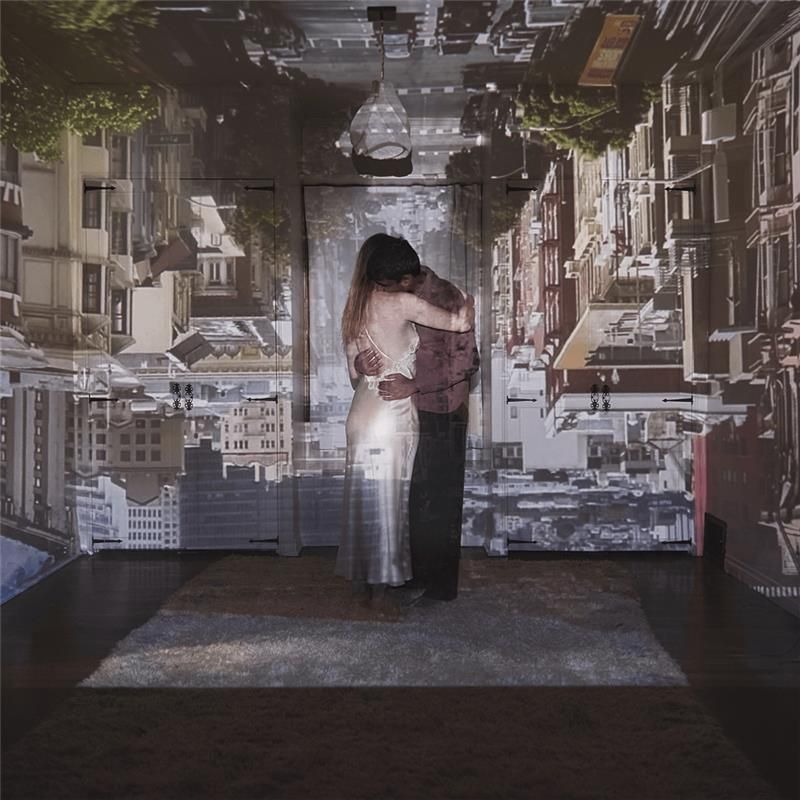
Everyone already knows Prateek Kuhad has gone well beyond being a reluctant indie music maverick into his “main character era”. On his third full-length album, Full Moon Chamber—a fully English project featuring 14 tracks, made in the US and released today—he’s seen driving a car through the desert with love on his mind ( in the video of ‘If I Cannot Be Yours’), captured in a deep, serene embrace on his album cover art and using words like “resy” in one of the songs.
He’s also still one to take his own time. The collaborators may have changed—this time, Kuhad enlisted LA-based producers Nick Ruth and Mike Irish—but his meticulousness has not. Just when the album felt like it was ready in late 2024, a few delays from his label Atlantic Records led him to relook at the project. “I was kind of listening back to that version of the record and I was like, it needs more cohesion, it needs a little bit more. I realised I was not very happy with the vocal takes and stuff,” he admits.
In 2025, he connected with Nick Ruth (whose production credits include pop star turned talk show host Kelly Clarkson) and they were in agreement that the album “just wasn’t hitting” the way he wanted. “We just really worked for a couple of months on really polishing it. I did all the vocal takes again, we did a bunch of new guitars, we did drums—mostly all new. Aaron Sterling [whose past session work includes songs by John Mayer, Taylor Swift, Harry Styles and more], an absolute G, played on it. And then it sounded absolutely incredible,” Kuhad adds excitedly.
Below, the LA-based singer-songwriter talks about the making of Full Moon Chamber, what it’s really like living between Los Angeles, Jaipur, and Delhi, and why Erewhon is overrated.
You still believe in the concept of an album and people listening to a full body of work?
It’s crazy that I even hear that statement—“still believe in an album”. It’s funny what people think about albums these days. I think it’s pretty normal, man, honestly. If anything, I feel like it’s so much easier to make music now, and if you actually look at artists—a lot of legacy artists and major artists—they’re putting out multiple albums now. Like, Drake just put out three albums in a day, you know? So, I don’t think albums are gone. If anything, people still really listen to albums.
What would you say Full Moon Chamber is about, if you had to boil it down?
It’s around themes of change and transformation, but in the context of love and relationships, if that makes sense—through the lens of that.
How do you usually spend the day before an album launch?
Nothing special, to be honest. It kind of depends. Right before any sort of release, even a single or a music video, it’s a little bit hectic a few days leading up to it. Sometimes we’re prepared in advance, videos are getting completed, social media posts getting planned, the larger team is talking to each other a lot, just figuring out last-minute things. With this album cycle, with the first single we put out, ‘Blush’, a few months ago, the few weeks leading up to that were the most hectic, because it was the first time gearing up for a release in a while. After that, it became a lot more settled, everybody kind of knows what's happening. We’re still making things and putting them out, but yeah, nothing out of the ordinary, honestly.
And on the day of the release, does it feel like a big exhale?
It used to feel a lot more intense, and the more records I’ve put out, the more music I put out, I’m already thinking about the next one. Honestly, for me, the exhale moment is when the album itself is done in terms of mixing and mastering—when that’s done is when I’m like “Oh”. Because that’s what takes a lot of work for me. When we’ve actually just submitted it, and it’s like “This is finished, this is the mastered, finished album”, that’s the exhale moment. When it’s actually going out [on streaming], honestly, I don’t really think about it that much.
Tell me about the interludes—’A Poetic Concept’, ‘Lunar Interlude’, and ‘Moonlight Serenade’, the last track.
I did those much later. All the other songs were kind of done. I think this was last year, when we were finishing production and I was just in my LA studio playing around, and these three things came up on different days. Last minute I decided to put them in the album. These three were purely me in the studio, nobody else—I even mixed them myself, literally did everything on those three tracks myself. Initially, the album was just going to be 11 songs; that’s what we were working on, with Nick, my producer, finishing everything off. And during that these three came in and I was like, oh, this would be nice. That’s kind of how that happened.
‘I’m Someone New’ has this grand rock moment that closes it out. What made you go in that direction?
Whatever direction a song goes in, whether it’s writing or production, it’s just a feeling that comes during it, really. I wrote the song a while back with Greg Wattenberg, a producer in New York. It first started off with just the initial part, this verse-chorus-verse thing, acoustic and soft. We did one more writing session online when I was in India, trying to finish the song, and it was like “This is too simple, it needs something else”. I wasn’t planning to really belt it out—we’d written that section as a bit of a lift, more lyrical. Then, many months later, when I was doing the vocal take in the studio, I just started belting it out and it was working, so we went for it. That was around 2023.
On ‘If I Cannot Be Yours’, you use the word “resy”. Where did you pick that up?
I mean, I use “resy” a lot. Resy is an app in the US for booking tables at restaurants. That’s why I said it. I don’t think it’s normal to say that, actually—I’m not Gen Z, I have no idea how people speak. I’m generally pretty cut off from all sorts of culture beyond a point. I just said it because I had that app and it rhymed with “messy”. It could also just be a shorter version of saying “reservation”.
You’ve worked in New York, you’re based in LA now when you’re in the US. What's it like being embedded in that scene, knowing people, knowing who to call?
I never really thought about it that way, but you just kind of settle into it, I guess. I’ve been living on and off in the US for a long time now—I went to college here, at NYU, doing something completely unrelated to music [Math and Economics]. Later, when I started doing music, I slowly built a community of people over the years. I have a label here, so there are people who help out. For a long time, it was just me and my US manager, Nicole. LA definitely has a much bigger community of musicians, producers, and writers. New York has grown smaller over the years, but there are still a bunch of cool people there too.
What’s your peak LA memory?
Around the time I started working on the bulk of this album—I didn’t know it was an album yet—I was doing a lot of sessions in LA, writing with different people. This was summer 2023. I went on a short, one-day camping trip to Joshua Tree with a couple of friends. That’s very LA—to go camp out and drive through the trees in the morning. It definitely affected me and inspired some of the lyrics. There’s a line from ‘Under the Stars’—“Run into the wild and red in the face”. I remember writing that specifically thinking about that trip.
You’re coming back to India soon. What are your plans while you’re here?
I’ll be there next week. We’re mostly working on some listening sessions for this album [details below], which I’m really excited about. We're pressing vinyl for this record—preorders are already out. There’s a cool vinyl-listening culture in India right now, so we’re stepping into that, and we’ll be playing the vinyl in a month or so once the records actually come in. I’m also just coming back—I’m bicontinental now, honestly, pretty much living half here, half there.
Does your routine change a lot between LA and India?
Totally different. LA is very... I don't have any family in the US, I have a few friends, and it’s so spaced out that you spend a lot of time by yourself, which is really nice; I get a good respite. India is hyper-social—my whole family, a lot of my friends. I go between Jaipur and Delhi a lot—you’re never alone, really. Here I’m alone a lot, which I actually like—I get to write and check out a little, go into my own shell. India is more chaotic, but also more fun in different ways. It’s a balance right now.
It sounds like when you’re in LA, you can wake up whenever you want but back home in Jaipur, your parents come and wake you up in the mornings.
Thankfully, my mom and dad don’t do that with me anymore, but yeah, something like that. I have people all around me all the time.
What do you feel is the best setting to hear this album?
Driving, definitely. If you like driving around, it’s a good album to listen to in the car. It’s also good to listen to at home. Honestly, listen to it in any context you like. When I was mixing and finishing it, I heard it a lot in the car and it was really fun.
Now that the album’s mixed and mastered, what’s coming up through the rest of 2026?
Everything is around this album right now—promoting it the best I can. We’re planning tours, in India and other places, once dates are set. There’s one more music video coming for a track when the album drops next week, and the listening sessions I’m really excited about. There’s a lot of other stuff happening—marketing and all—and I’ll be back and forth to the US a lot over the next few months. It’s going to be hectic, living the album for a while. The next six months is just Full Moon Chamber.
The visuals this time feel like a real departure—the videos, the album artwork.
Thank you for noticing that. Yeah, that had a very different approach this time. I have a tendency to rush into things, and this time we really took our time with everything. That comes from the last two or three years. You live and learn, you grow, you change, and my attitude towards making things has shifted a little—not completely, but a bit. I worked with creative director Sijya Gupta, who’s been across all the visuals—ideating and working with different filmmakers—and there’s a lot more intention this time, taking the time to get it right before putting anything out, whether it’s artwork or a video.
I didn’t want any misses. Sometimes you get caught up in the whole social media thing, where you feel like you have to put out more posts. This time I was like, if I really like something, we’ll put it out, otherwise we won’t. There was a lot of filtering, a lot of stuff we worked on that just got scrapped. It’s so crowded these days with everybody putting out so much content—I think curation is important.
Last one. Since you’re in LA, have you been to Erewhon?
LA people are going to hate me for this. I think it [Erewhon] is very overrated. There’s some good stuff there, but it’s just way too expensive for what it is. We go there every now and then, I’ll pick up a smoothie if I pass it, but it’s not my thing. There’s actually this small, niche grocery store called LA Grocery and Cafe close to where I stay, which is what Erewhon should be, in my opinion— the food is good, it’s really curated, quiet, calm, clean. And it’s not even that expensive, weirdly. No hype, all substance. I don’t love it when something’s hyped without the substance to match, and usually it doesn’t.
Full Moon Chamber is out now on Atlantic Records. Kuhad is hosting a limited seating listening session for Full Moon Chamber at Piano Man Jazz Club in Delhi on July 14. For tickets, click here