




In a stark examination room in Delhi’s RK Puram, a woman’s fingertips move with extraordinary precision and speed—pressing, pausing, and listening in a way most of us never will. She cannot see the patient before her. But she can detect what others would easily miss: the earliest signs of breast cancer.
India is among the countries with the highest number of breast cancer-related deaths worldwide, where only one in two women who are diagnosed survive. A small group of visually impaired women is saving lives, courtesy Discovering Hands, an international programme that has been training fully and partially blind women in India since 2017 to become medical tactile examiners (MTEs).
Discovering Hands is the brainchild of Dr Frank Hoffman, who established it in 2008 in Germany. A gynaecologist, he observed that many doctors didn’t have sufficient time to thoroughly examine breasts, leading to an increasing number of early-stage breast cancer cases going undetected.
In an age where science and technology are taking great leaps into the abyss-like realms of artificial intelligence and virtual reality where human touch is slowly becoming rare, Hoffman was convinced by various studies that explained how individuals with visual impairment often cultivate a sharpened sense of touch or tactile acuity.
Using their nuanced sense of touch, the MTEs can feel for abnormalities as small as 0.5 centimetre (the size of a humble peppercorn) that might signal cancer. A sighted physician, in comparison, is able to detect irregularities sized one centimetre and larger.
As it turns out, breast cancer’s deadliness has less to do with biology and more to do timing: the earlier it is found, the better one’s chances of survival. In fact, it is one of the most treatable forms of cancer. Through Discovering Hands, Hoffman began training the blind. Over the last two decades, the programme has been running successfully in countries like Mexico, Austria, Colombia, Switzerland, and India.
Delhi-based Neha Suri was born with retinitis pigmentosa, a rare, inherited condition that causes the vision to progressively deteriorate over the years. Peripheral vision crumbles first. Faces begin to become featureless and letters begin to disappear from the pages despite one’s squint-like focus. Colours, once vivid, begin to lose their glow. Gradually, it leads to complete blindness.
Suri first learned about Hoffman’s programme at the National Association of the Blind India Centre for Blind Women (NABCBW), Delhi, when its founder and director, Shalini Khanna Sodhi, was scouting for Discovering Hands’ inaugural batch in 2017. At the time, Suri had just lost her husband to cancer. A homemaker earlier, she had to step out and step into the role of being the sole provider for her 12-year-old son.
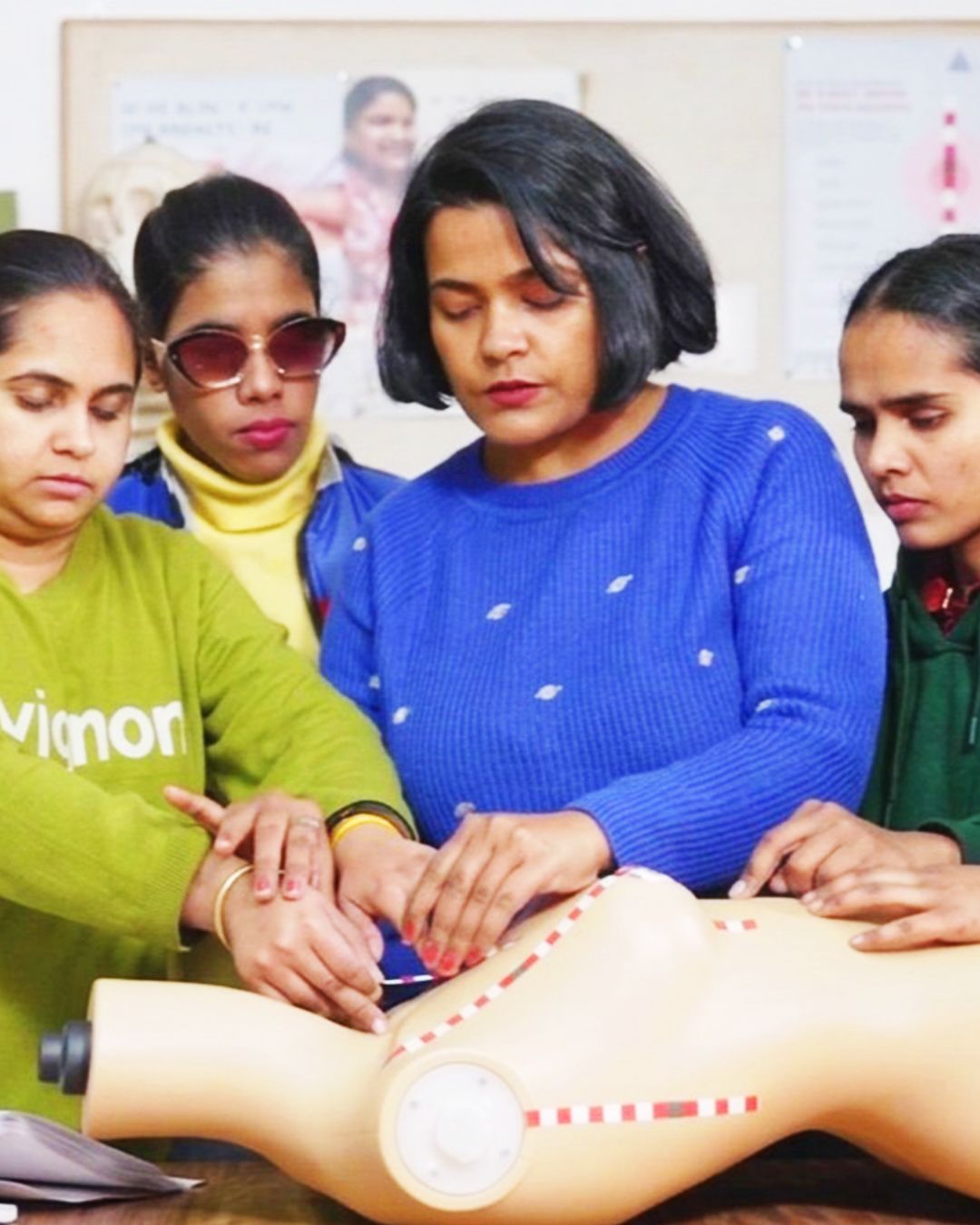
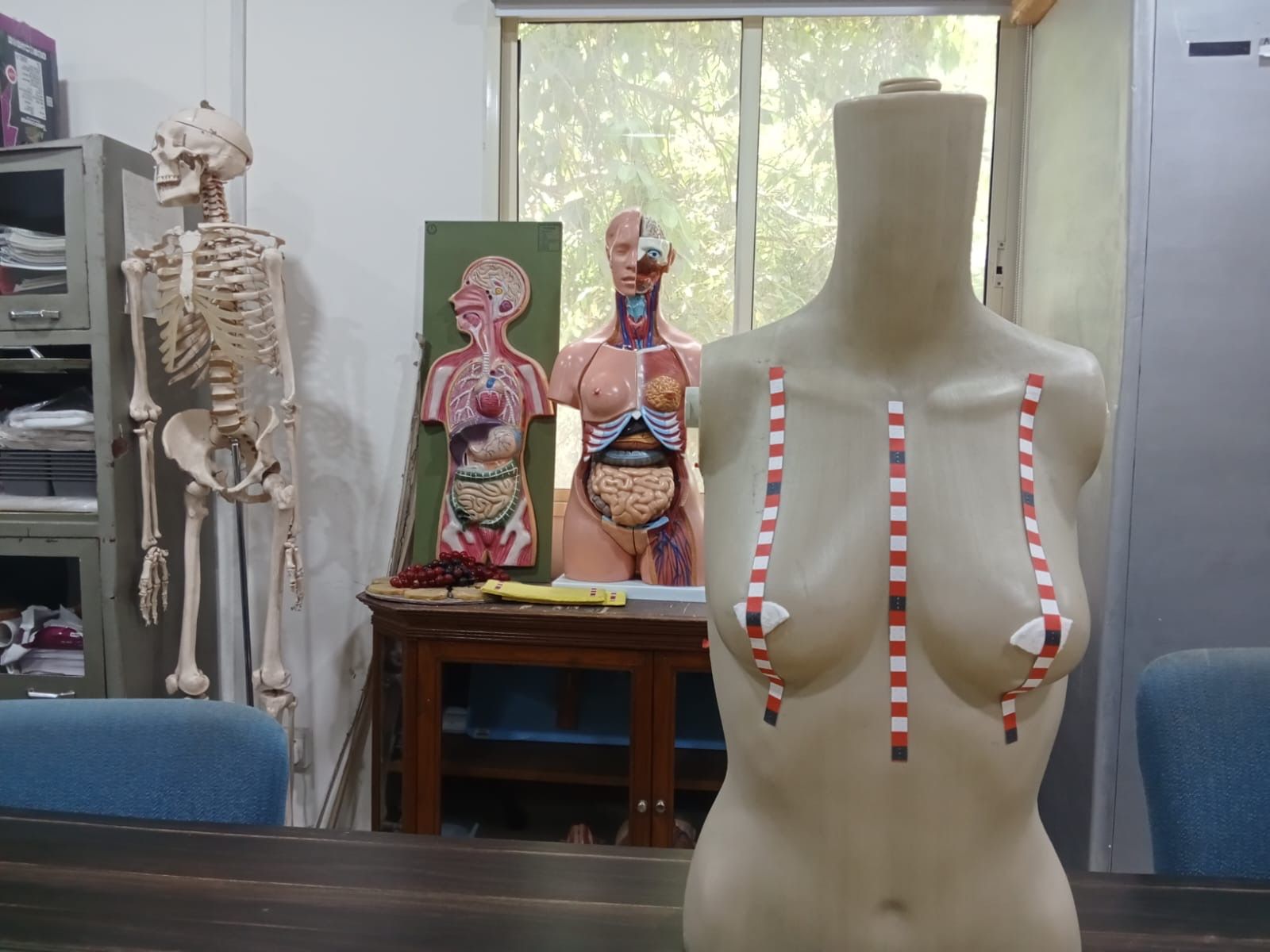
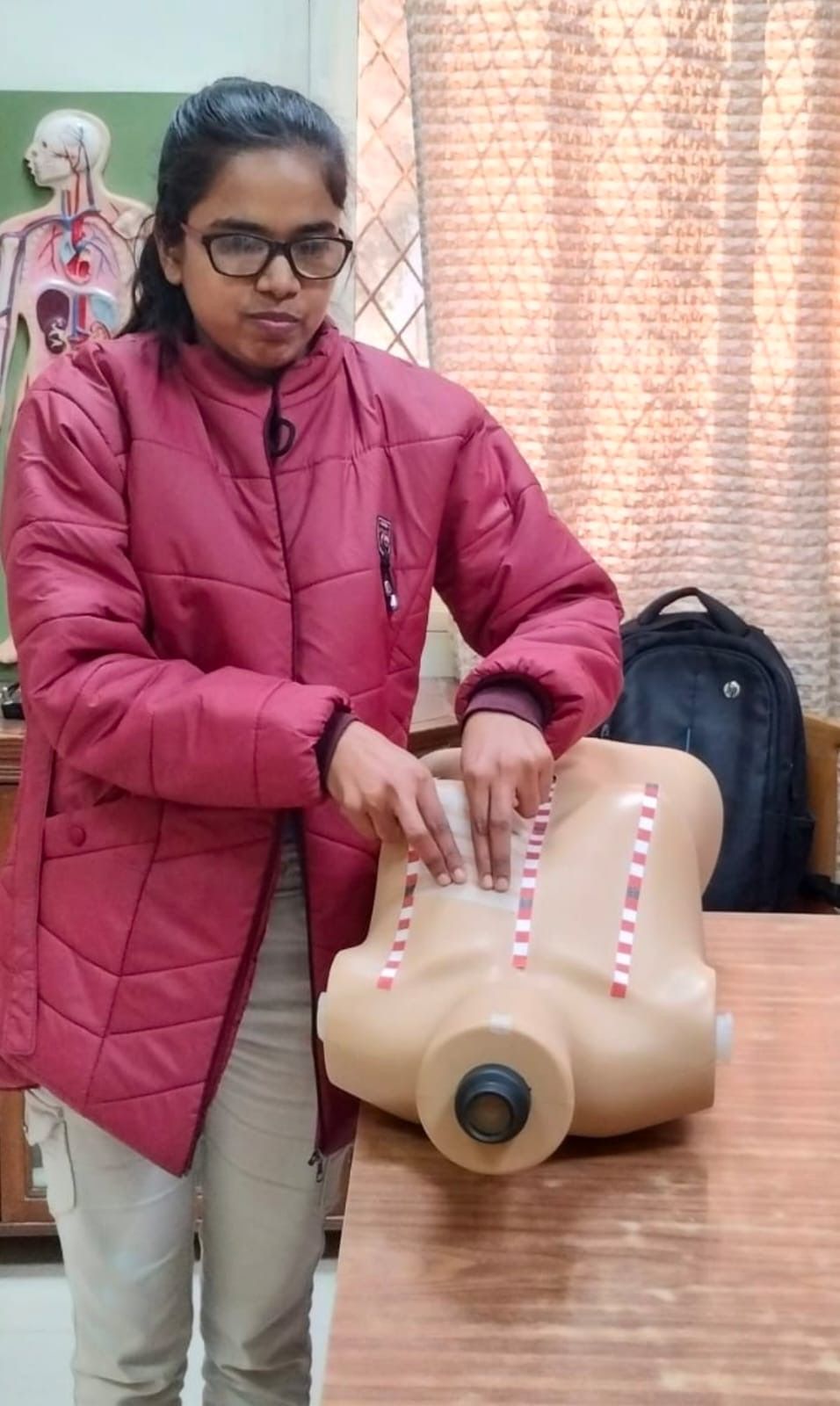
Sodhi nudged Suri to apply. Not every individual associated with NAB is invited to be a part of this programme. Applicants undergo a vigorous five-day assessment course, during which the senior staff members gauge each applicant’s suitability. They are tested on their ability to comprehend new information, sense of touch, memory retention, and agility of their fingers. The process also involves carefully applying DOKOS—a special skin-friendly, medicated tape—onto the breast in a straight manner. The tapes help MTEs divide the breast into four zones. DOKOS are more than markers; they are roadmaps. They aid MTEs in covering each centimetre of the breast. This is their only tool. “DOKOS are paper tapes that have braille numbers and colour codes,” explains Sodhi. “It is a Discovering Hands patent.”
Almost a decade ago, Suri was selected to be part of the first batch. The senior staff at NAB was impressed by her sharp acumen and quick learning skills. The training that followed was exacting. Over nine months—six spent on coursework and three devoted to an internship at Medanta—The Medicity Hospital in Gurugram—sighted instructors taught her important details about the female anatomy, with a greater emphasis on the breast.
Her fingers learned the waltz. “When we examine the breast, our fingers move parallelly, centimetre by centimetre,” explains Suri, likening the movements to a dance in terms of how measured and intentional they are. During the assessment course, the trainees are first trained on a soft mat, before moving to dummies and silicone models that mimic the contours of a human breast. Only later, during the internships, do the trainees work with real patients.
Speed is another factor: the entire check-up must be completed within 30 minutes. Within the next 15, details have to be noted and fed into the computer by the MTE. The findings are then handed to the oncologist, who assesses the information and advises the patient.
Over time, Suri became attuned to pick up the slightest abnormality. By gently probing and applying different degrees of pressure, she could assess the softness or firmness of a lump, its size, shape, and whether it moved or stayed put. She could decipher whether there were more irregularities in the breast, whether these existed in clusters in one region or scattered. Certain changes in texture and even a faint warmth offered crucial clues. Using the DOKOS, she would map the precise location of the lumps, enabling doctors to quickly and reliably find them again.
Till date, over 1,20,000 women in Europe and over 5,000 women in India have benefitted from hands like Suri’s. MTEs are able to discover tumours—regardless of how benign or aggressive they are—well before mammography can detect them. Sodhi recalls an incident a few years ago, where a group of her interns had been sent to the Tata Memorial Centre, a leading cancer institute in Mumbai, for what seemed to be a routine exercise. Its doctors had examined a cohort of 50 patients. “The institute had already done its own research, but we had not been informed,” she explains. Later, the same group was assessed again—this time by MTEs.
“When I went there afterwards, I was informed that out of those 50 patients, their doctors had missed lumps in eight, which our girls had been able to find,” she shares. In comparison to mammography, medical tactile examination is disarmingly low-tech, guided not by machines but simple human touch. It is far easier on the pocket too—this is particularly beneficial for women living in semi-urban and rural regions, where cost and access are formidable barriers.
Mammography is considered a standard for breast cancer screening, but it is generally recommended for women over 40. What about those who fall outside that age bracket? “Nowadays, even women in their early twenties and thirties are being diagnosed with breast cancer,” says Suri. For younger women for whom routine mammography is typically not advised, methods like tactile examination by an MTE offers a different kind of vigilance. An MTE is able to catch malignancies in women as young as 25 years, before symptoms make an appearance.
“There is a popular belief that a blind person is the one who needs help, particularly in the healthcare system,” says Suri, “But here we are, proving everyone wrong. I am making my own money, running my house, and bringing up my son.” Discovering Hands has instilled confidence in Suri and other visually impaired women at NAB. They are able to independently navigate public transportation without anyone’s help as well. Each one of them is changing mindsets, one touch at a time. Incidentally, Suri is now NAB’s IT head and is mentoring younger MTEs.
Yet, their numbers remain small. Since 2017, about 40 MTEs in India have emerged. The training programme is extensive and expensive, costing as high as ₹2 lakhs per person. “Even then, we haven’t been able to find jobs for all of the MTEs across hospitals in India,” admits Sodhi.
Routine breast check-ups are still rare in India. If you’re a woman reading this, ask yourself: when was the last time you had one? In villages, machines and trained technicians are scarce. In cities, denial and inertia can be just as formidable. And yet, the disease does not discriminate. Breast cancer awareness needs to be heightened not only through information, but through intentional funding and expansion of programmes like this one. More hands needs to be trained; more hands need to be given a place to work. At the end of the day, action—whether by a patient, a doctor or the system itself—is the difference between a life preserved and a life interrupted.