




I’m a fiery Sagittarian who is a water baby (beaches over mountains, hands down), but I’m also scared of what’s living under the sea. Scared to the point that I’m convinced my previous life ended at the hands of a sea animal of some sort. A lot of introspection has also led me to understand that what I actually fear is the uncertainty of it all and not knowing what’s swimming around me. This is why I’ve never been able to sign up for scuba diving and, no, watching Zindagi Na Milegi Dobara didn’t help either. However, the idea of underwater meditation in a controlled environment, like a hotel swimming pool, felt less daunting than the open sea, so I decided to give it a shot at the Longevity Summit India 2026 weekend, held in August at Fairmont Mumbai.
Underwater meditation is a way to reset your nervous system and experience stillness. The technique was devised by Dr Arpit Bansal—cancer surgeon, biohacker, and scientific chair of the Longevity Summit India 2026—who made a case for a calm, ‘blue’ state of mind as opposed to our current, overstimulated ‘red’ state of mind, terminology he also spoke about at the summit. Dr Bansal explained how meditating underwater differs from doing it on land: “Most meditation is top-down—you use the mind to quiet the body. You chase the breath, the chant, the mantra. Underwater is bottom-up. The water does the work before your mind gets a say. And what you’re really resting in isn’t the breath itself but the small pause between two breaths.”
But first, the prep before you go under
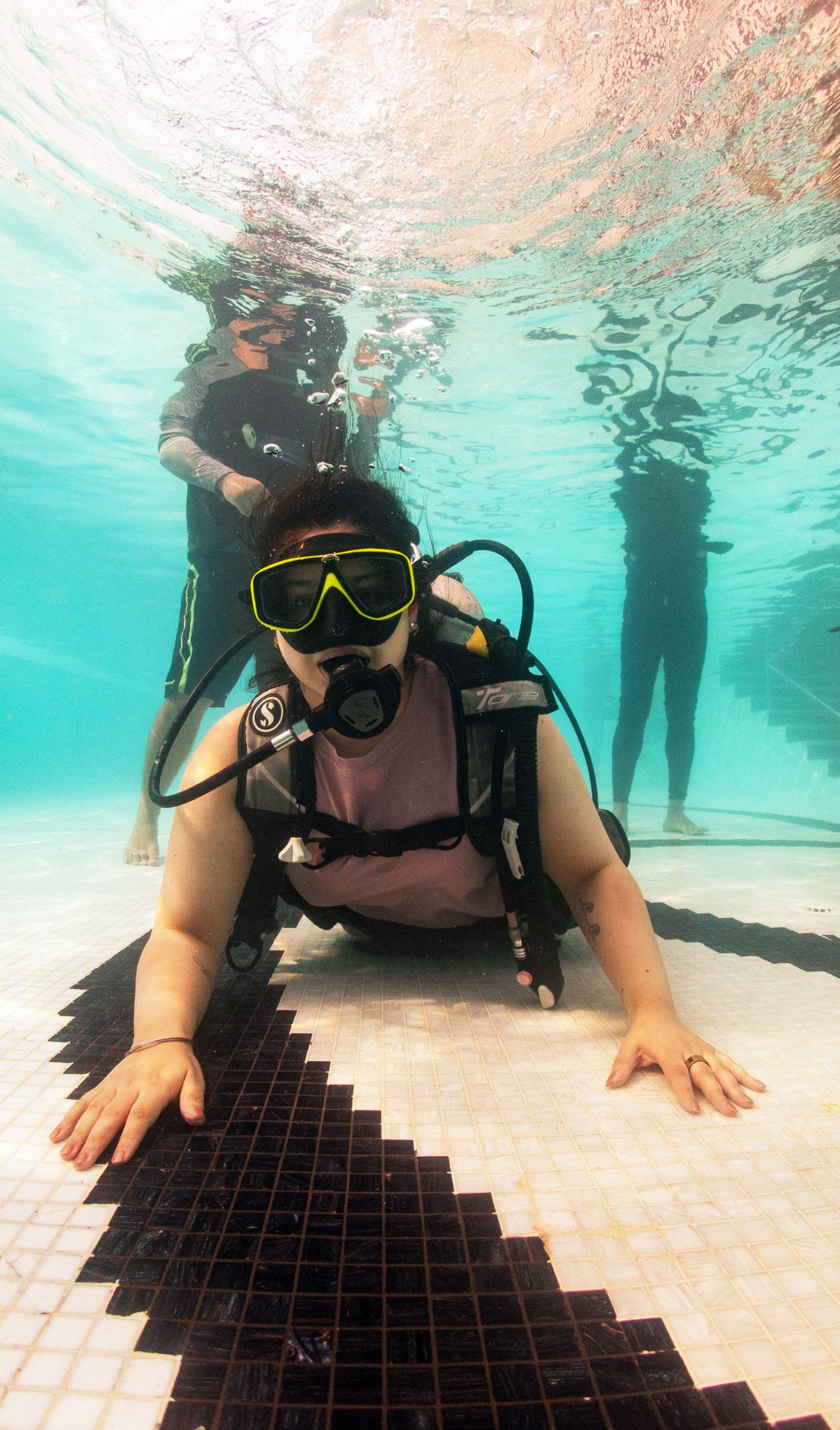
Before we settled in for the 30-minute session, the prep involved wearing a weighted life vest, oxygen tank, goggles, and a mouthpiece to be able to breathe underwater. Second nature for those with a Padi certificate but a brand-new experience for me. As someone with newly discovered claustrophobia, the idea of breathing through an oxygen cylinder and nozzle was 10/10 intimidating. But we pulled through for the sake of wellness. I was also handed underwater earphones so I could experience guided meditation, which I appreciated.
Underwater meditation > on-ground meditation
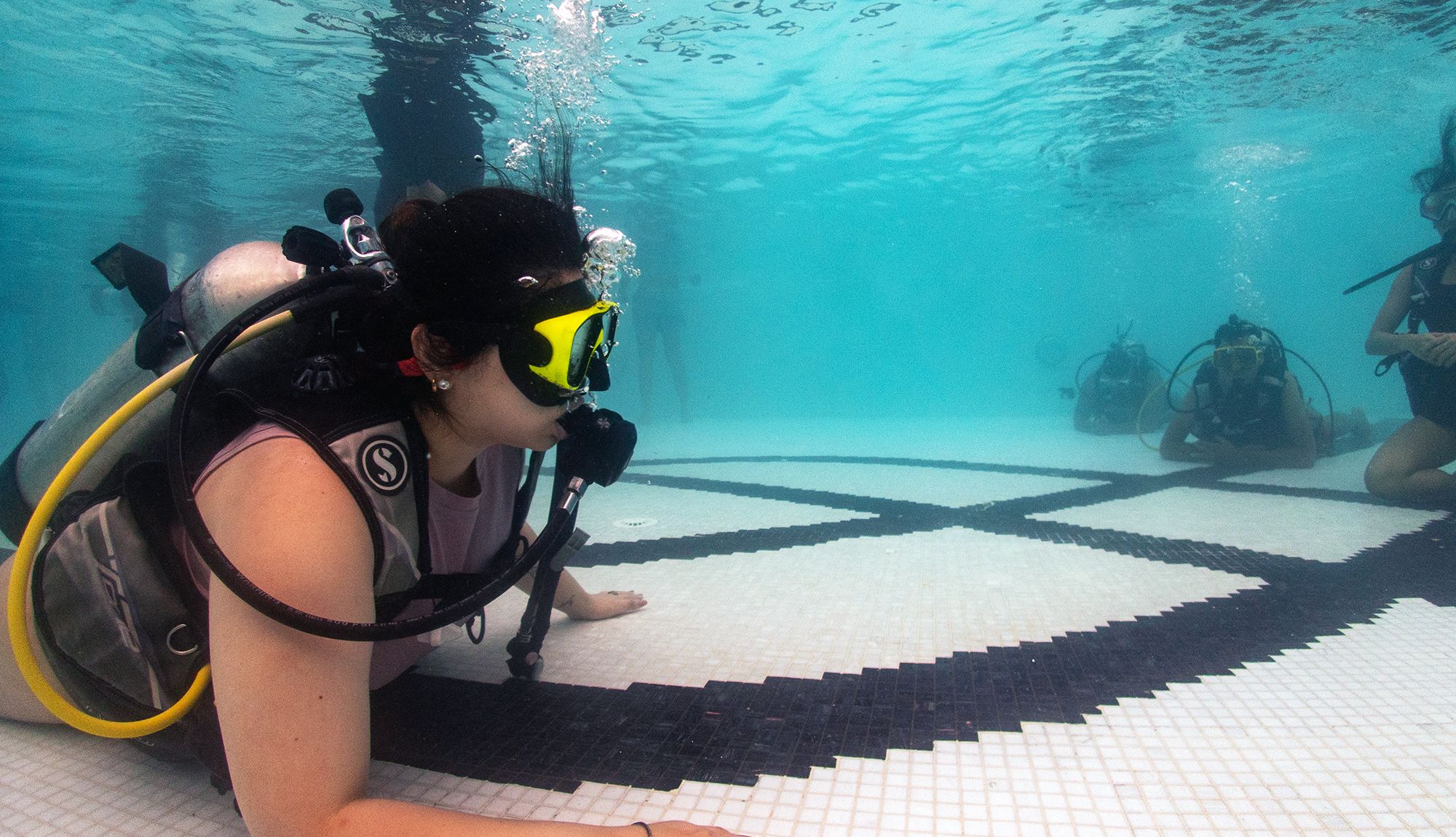
The pool at Fairmont Mumbai is approximately four feet deep, so the fear of not being able to come up for air didn’t exist—yay to this! Once our gear was on, we went underwater to practise breathing from the mouthpiece. A couple minutes in and I got the hang of it. Then, we were asked to simply surrender and sink to the bottom of the pool, on our knees or laying down on our stomachs, like an alligator, for context. I seemed to struggle a fair bit to kneel, so I went with the latter. As soon as I found my comfort and settled in, all I focused on was my breath, which is what traditional meditation asks of you as well. While that can sometimes be a struggle on land, where it comes so naturally, in the water it was somehow easier. There are two things that make this focus possible.
Firstly, while underwater you have to consciously breathe from your mouth via the oxygen cylinder every single time, so there’s no room to focus on anything else. Plus, in a pool, there’s nothing really to distract you—no phones, no ambient noise, just silence. You’re underwater without an agenda or anything else to discover but yourself. I had attended Dr Bansal’s chat on the ‘red’ and ‘blue’ mind the previous day and there was something he said that stuck with me and that I experienced in the pool myself: “Nothing demands anything of you in the water.”
Achieving relaxation pro-max
Underwater, it’s you and your breath alone, focused, measured, and in control. I found myself lost in the vast expanse of the pool, disconnected with the fact that there were six other people around me, that I was running on three hours of sleep, or that I had a guided audio track playing in my ears. Dr Bansal pointed to the science behind this: for one, when you’re immersed in water on all sides, the body can stop holding itself up. Combined with the weighted vest, it simply surrenders. Another factor is that cold water on the face triggers the vagus nerve, which tells your heartbeat to slow down, to calm itself. It’s the body’s dive response that’s designed to help conserve energy and oxygen. Every cell in my body felt at ease and I can’t wait to do it again.
Those interested in a session can reach out to Dr Bansal directly via his Instagram. The next one is happening in Lonavala between November 27 and 29, 2026