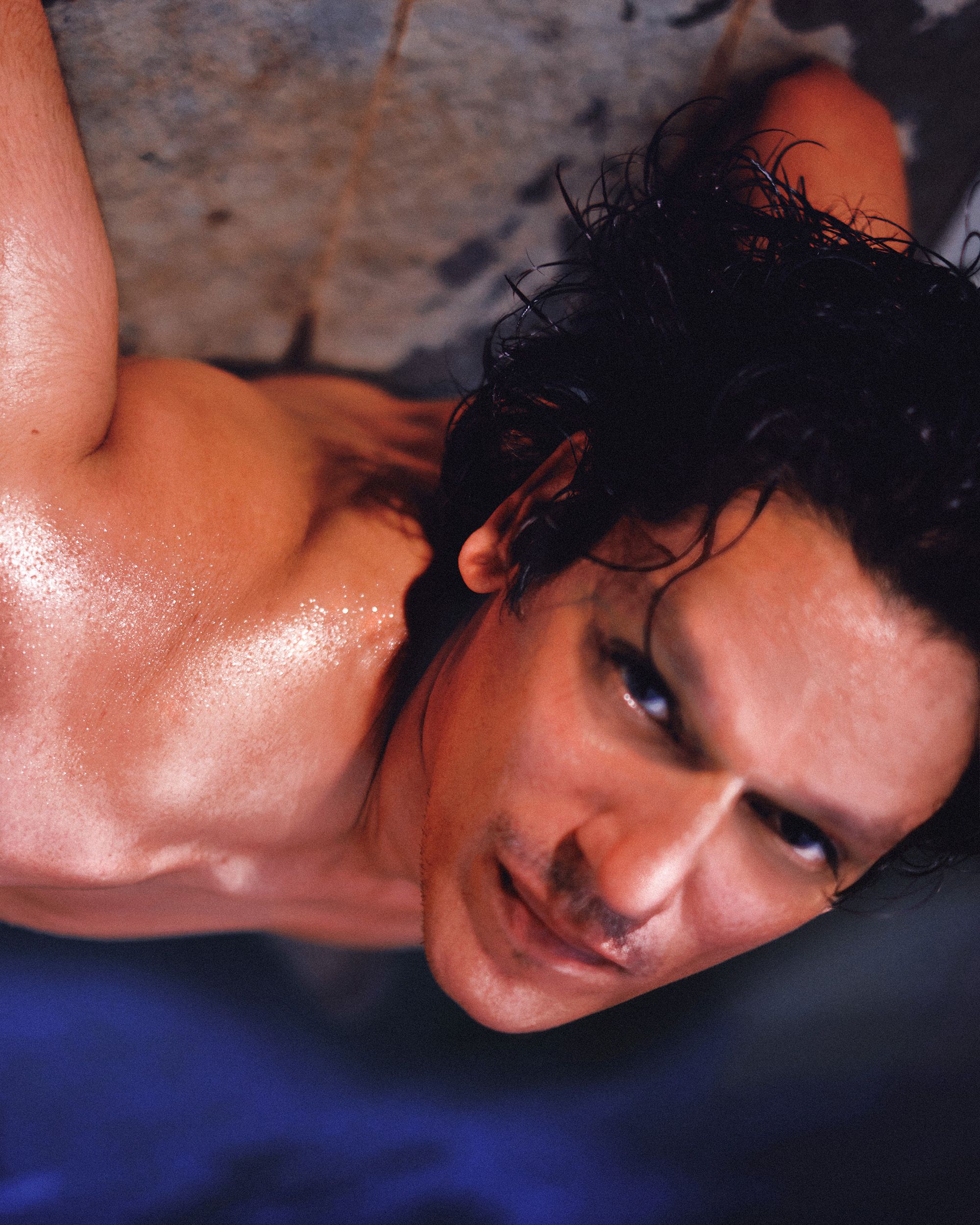
At 40, the chameleonic actor is happy with an image change. After years of portraying the messy outlier, the prolific actor is embracing powerful roles that show his range—whether it’s the lead or the sidekick
Photographs by Rachel Pachuau. Styled by Selman Fazil
A conversation can drift as quickly as it begins. I realise this soon after settling into the drawing room of actor Vijay Varma’s sunlit Juhu apartment, which overlooks a sprawling expanse of emerald green. The view, I tell him, is an anomaly in Mumbai. Varma, dressed down in jeans and a white cotton shirt with blue stripes and a sketch of Mickey Mouse peering from one side, smiles. “It is untouched because that land,” he says, looking towards the glass window of the home he moved into a year and a half ago, “is owned by the airport authority.” At the height of the monsoon, the foggy view outside, Varma says, makes him feel like he is in a hill station rather than a crowded western suburb. Somehow, it becomes the reason we start talking about Mumbai’s unchecked real-estate frenzy, the need for better public transport, and from there, the more serious issue of climate change.
It is the day when news breaks that Mumbai, along with Kolkata and Dhaka, faces the risk of permanent inundation. Varma, who has spent most of his morning reading a new bound script, is quickly alarmed. “Global warming is taking us down,” he sighs, alluding to the recent flash floods near the Nepal-Tibet border triggered by the collapse of a steep hanging glacier in the Himalayas. “And Mumbai, of course, is a low-lying coastal city,” he adds, illustrating this with a map of the western and eastern coastline of the country that he draws in the air. It’s not the kind of issue you expect a celebrity to be so invested in.
Recently, we got a preview of this Woke Varma on social media, when unlike other celebrities, the actor didn’t blindly follow the viral 1980s AI trend, choosing instead to share childhood photos of himself from that time and letting his fans know that this didn’t require “wasting water and energy”.
I’ve spent the week before this interview re-watching films and web shows from Varma’s vast oeuvre, including his award-winning OTT offering Matka King from earlier this year, where he plays the titular character. “I hope some of my earlier work didn’t scar you,” says the 40-year-old actor, a wry smile appearing on his otherwise straight face. Varma seems acutely aware of the choices he has made with his roles—mostly morally grey and, often, excessively flawed—as he, a rank outsider from Hyderabad, transitioned from the big screen to becoming a ubiquitous presence on streaming platforms. From the chauvinistic friend in Pink (2016) to the petty thief in Gully Boy (2019), a nefarious drug lord in She (2020), a sexual predator and murderer in Dahaad (2023), and power-hungry twin in the third season of Mirzapur (2024), Varma is probably one of the few actors to have covered the entire gamut of problematic—even dangerous—outliers.
ADVERTISEMENT
T-shirt, Line Outline. Sunglasses, Gucci
He shed some of that old skin when he played the charming investigative cop in Jaane Jaan (2023) and the fearless pilot-in-command in IC 814: The Kandahar Hijack (2024). And some more of it when he slipped into the role of the conscientious gambling mogul Brij Bhatti in this year’s Matka King, loosely inspired by the life of Mumbai’s matka innovator and film producer Ratan Khatri. It was also the first time he stepped out of an ensemble cast to play the idealist lead: “Brij Bhatti believes that everybody should have an equal chance at making it big in life. And despite having found a way to live his dream, he’s terribly allergic to corruption. He is almost like this Anna Hazare kind of a figure.”
With Lust Stories 3, which released last month, he seems to have redeemed himself entirely. Here, director Vikramaditya Motwane leverages Varma’s slow shift from villainy to ideal by casting him as Hemant, a middle-class Kandivali resident whose wife (Radhika Apte) is goaded into plotting a husband swap by her best friend (Konkona Sen) to make up for the lack of physical intimacy in their marriages. Without giving away too many spoilers, one can safely say that Varma emerges as the winner in this segment of the anthology, devoted to a fault, almost aspirational. It is also one of the reasons Varma was willing to play sidekick. “I am not the central character here. This story was actually about these two ladies,” he says, “But I just loved the script and I would do anything to be part of it.” Varma doesn’t say it out loud, but the way his eyes light up betrays how glad he is to be finally bagging roles that are softer, gentler.
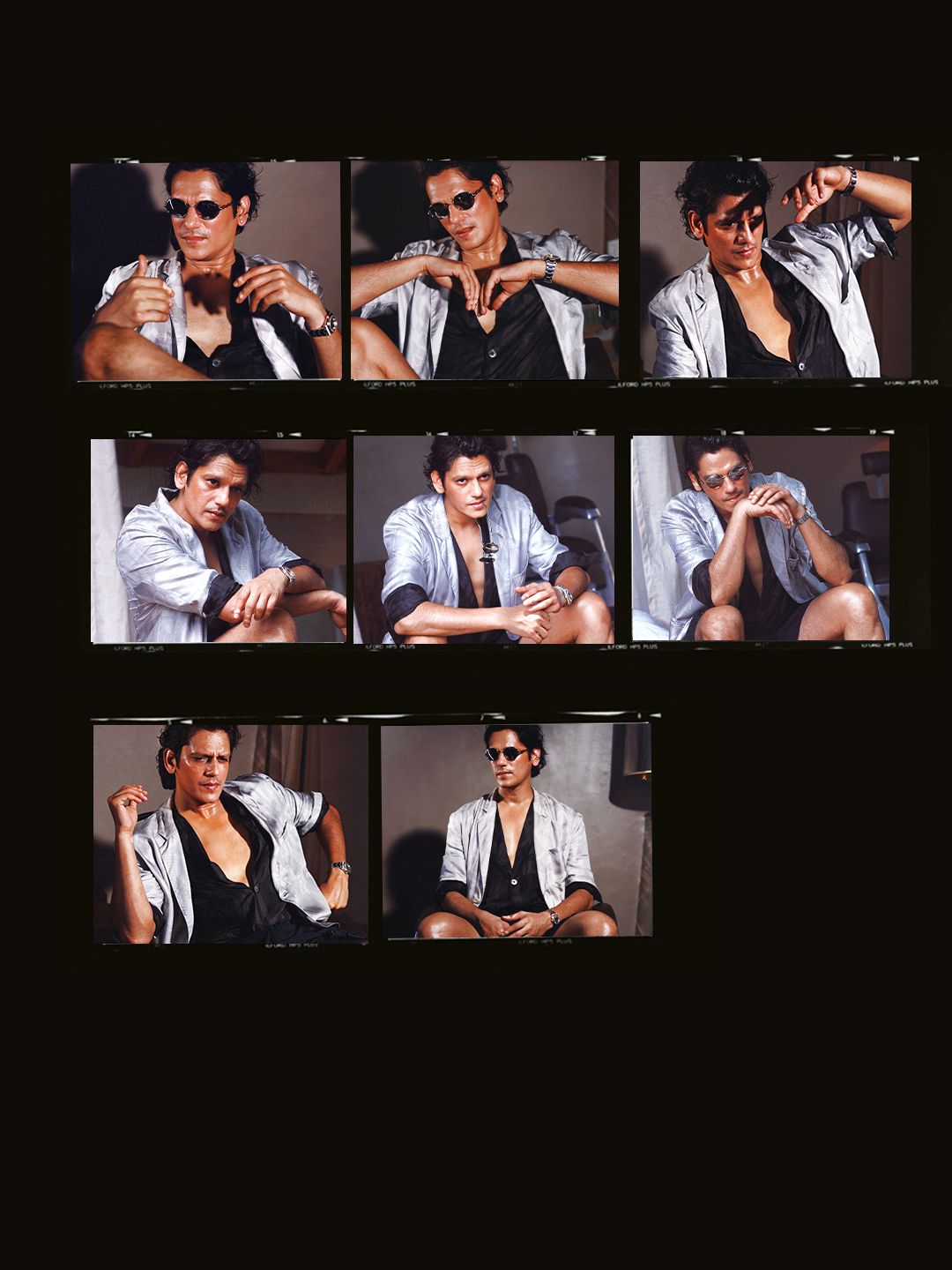
There has also been a parallel evolution of Varma as a style icon, if you pay heed to the increasingly regularity with which he shows up on Best Dressed lists and awards for both men’s and women’s fashion magazines today. In a recent magazine shoot, he was, literally, on fire. Karishma Diwan, his stylist for the last two years, describes him as the “ultimate fashion boy”: “His personal style is very cool, casual, and sporty. But when we’re dressing him up for events, we blend that in with something edgy, almost androgynous. And that’s because he is so open to everything. I could bring a huge jacket, a sleeveless tank or something with a really deep neck, or get him to wear a sari as a dhoti, and he’ll give it a chance,” says Diwan.
The image makeover has not been a conscious one, he confesses. If anything, it has taken a lot of a trial and error to get here.
ADVERTISEMENT
T-shirt, Line Outline. Sunglasses, Gucci
For a long time, Varma was fighting the quieter battle of being “typecast”. After Pink released in 2016, most of the roles that came his way were in the misogynistic mould, where he was “expected to play a man who does something terrible to women”. He recalls, “I turned most of them down.” There was a dearth of work, but the toxic male figure didn’t excite him. “I couldn’t understand why these men would do something like this.” When he agreed, it was because he was convinced by the arc of the character’s journey. “It had to lead into the right direction,” he says, adding, “Almost all the characters where I portrayed any kind of masculinity that was destructive met their end,” referring to roles like the manipulative, wife-beating Hamza Shaikh from Darlings (2022). “In the end, he is run over by a f**king train,” he says, “I feel like cause-and-effect needs to be in place.”
Today, the only kind of masculinity that Varma enjoys is the martial-arts-trained action-hero variety. I discover this accidentally when we move into another room to escape his chattering staff and chance upon a huge framed poster of Bruce Lee hanging on a wall by the corridor. “I am a huge fan,” he says; it’s the one thing he has in common with his Marwari businessmen father, who thumbed his nose at Varma’s choice of career.
Varma has always believed in agency, something he feels he was nearly denied when he was expected to join his family’s handicrafts and antiques business in Hyderabad, where he grew up. He didn’t start out wanting to become an actor; in fact, except for Jackie Chan and a few other action films that his father took the family to watch in cinema halls, he had no exposure to movies as a child. “My father believed that watching films was a waste of time.”
ADVERTISEMENT
Sweater, shorts; Dior
For Varma, dreaming was an act of rebelling. He remembers wanting to become a comic book artist, and later a tattoo artist and fashion designer. None of those dreams took flight. “I was keen on pursuing the arts. I just didn’t know what.” Some amateur modelling gigs and a brief stint at a call centre followed, before he experienced the thrill of theatre. “Something clicked there.” Meanwhile, through a friend who had a voracious appetite for films and whom he often accompanied to the local DVD library, Varma got drawn to films. “I remember watching [the Sanjay Dutt-starrer] Vaastav (1999) together and he kept repeating the dialogues of all the characters. His impersonation created a deep impression. I was observing, soaking in everything,” he recalls, “At some point, my friend’s obsession turned into an interest for me.”
Joining the Film and Television Institute of India in Pune, whose famous alumna include the likes of Jaideep Ahlawat, Rajkummar Rao, Rasika Dugal, and others, cleared the path for him. “I knew then that I was in love with the movies.”
But navigating an industry thriving on nepo babies came with a few hard knocks. He had no godfather when he moved to Mumbai in 2008. The hustling, in particular, was draining and required him to develop a tough shell. He didn’t cave in. Not until 2017. “My first Telugu film [Middle Class Abbayi] and another Hindi film, Monsoon Shootout (2013), which was also the first-ever film I had shot some seven years before, released on the same day.” December 15, 2017, was meant to be a milestone moment in Varma’s career. Instead, Monsoon Shootout, where he played the antagonist and which had a limited 30-screen run, “came and went without a trace”. He recalls, “Reviewers didn’t review it and nobody even saw it.” The Telugu film, he remembers, was a big hit. “But the critics panned me, saying that I looked more like a child actor than a villain.”
On the night of the twin releases, Varma cried himself to sleep. “I felt like my entire existence, all the work that I had done, and all that waiting had come to nothing.” He couldn’t wish things away, so he immediately took off on a solo trip to Shillong and Guwahati. “I began contemplating going back to doing theatre.”
Sometime after he returned, he got a call to audition for Zoya Akhtar’s Gully Boy (2019). Varma got the role of Ranveer Singh’s friend Moeen Arif. “I went in jaded, thinking that this would probably only help me get another film,” he says, believing that his bit role could hardly parallel the prodigiously talented cast of Ranveer Singh, Alia Bhatt, and Vijay Raaz, among others. “But that film changed my life,” he says. Even though he was seen sparingly on screen, he left a lasting impact.
Everything that Varma is today, he credits to that moment of near collapse and unexpected becoming. The simultaneous rise of streaming platforms allowed him to sift through an array of roles, and without intentionally planning any of it Varma became indispensable to this space. Unlike cinema, he finds OTT to be a level playing field. “When streaming came in, all the movies were equally placed next to each other on the same grid [of the viewing app]. You could have Shah Rukh Khan’s films alongside a web series by an unknown actor. That kind of democratisation, to me, was a welcome change. It meant that you did not need to be loud to be heard.”
Jackets, Hermès. Shorts, Almost Gods. Sunglasses, Diesel
Though Matka King (set to return for a new season) has cemented Varma’s position as a hero who can carry an entire show on his shoulders, the actor says playing the lead is not what he is vying for. “I actually prefer the opposite,” he says, harking back to his role in Lust Stories 3. “I think it’s important to balance things out. I don’t want the burden of carrying the success or the failure of a project all the time. I also want to go have fun with the roles and take risks.” The story, he says, will always be king.
Up next, Varma will be seen in Hansal Mehta’sFamily Business on Netflix, where he shares space with veteran star Anil Kapoor, whom he describes as “a firecracker of the next order and the youngest actor I have ever worked with”.
Back-to-back shoots make it difficult for him to do the things he enjoys. He is always trying to steal time for himself, and is open to travelling for a photo shoot, like this one for The Nod in Karjat. “I insisted on doing this outdoors, especially in these rains,” he says. A big believer in down-time, the actor likes going under the radar when he is not working. “Work can completely consume me… I don’t even respond to calls and messages while on shoot. Even if I have some spare time between takes, I don’t bother myself with doing anything else except for being completely ready for what is going to happen in front of the camera, which is why I feel a greater need to decompress.”
He recently took off on a solo trip to Europe, something he had been contemplating for many years, mostly so that he could travel without being recognised. “I finally had a window of 15 to 20 days. I told myself I should just take this opportunity. So, I escaped. I had the best time,” he says. Varma also believes in doing a lot of recovery activities, “like getting my massages and ice baths, and meeting friends and venting to them”.
Of late, after moving into his new home, he has become quite a home bird. “I leave for shoots early in the morning, and come back only late at night, which is why I don’t get to experience this beautiful space that I created. I hope to do more of that now,” he says, back to gazing out of his window, a view he keeps returning to. He finally knows what makes him happiest.