“Slowing down too much rusts you”
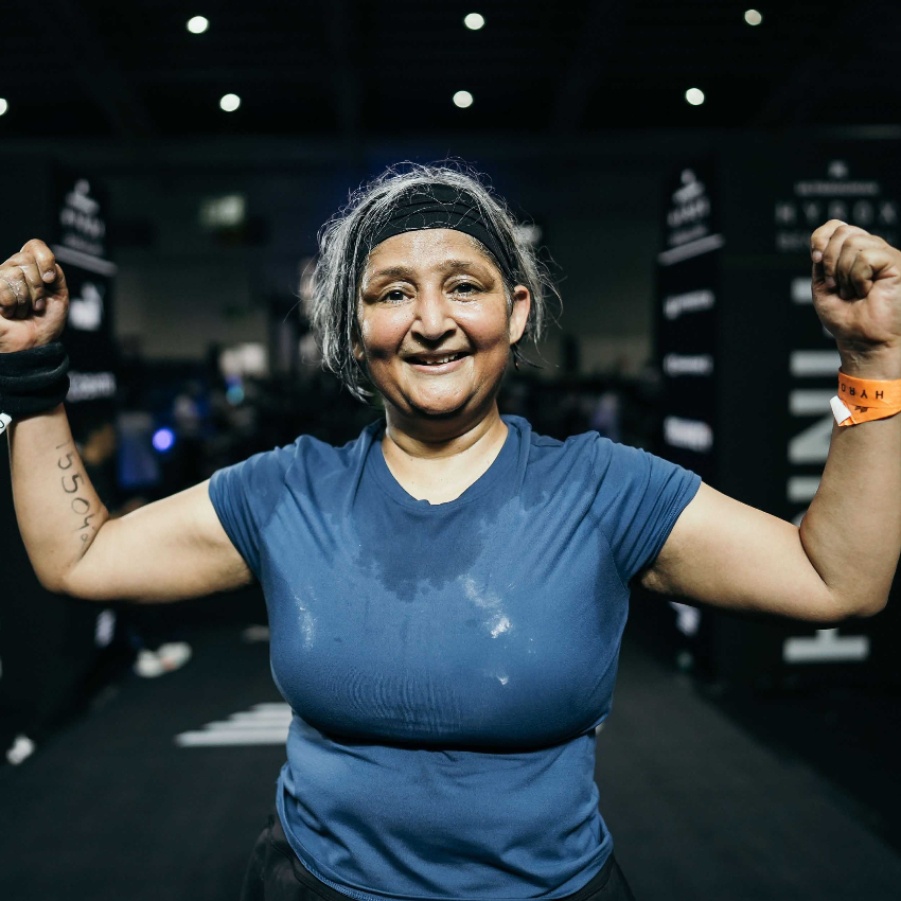
Four years ago, at 54, Jain had never so much as touched a weight or stepped inside a gym. Then she was diagnosed with hypertension. “I was told by the doctor that I would be dependent on medication for the rest of my life,” she recalls. That fear settled deep within her. Then it moved her. A homemaker who had spent a lifetime taking care of her family, Jain began to slowly turn inwards. She started paying attention to herself.
Self-care meant carving out a few hours in the day and going for long, winding walks and discovering new routes in Dehradun. “Initially, my legs would ache,” she admits, “But it gave me relief from housework. I began to value that time.” Over time, her walks stretched to nearly 15 kilometres. Gradually, she added Zumba and bodyweight workouts to her routine by watching YouTube videos at home, before mustering the courage to join a gym. She hired a personal trainer, drastically tweaked her diet, and was able to reverse her hypertension. Today, Jain, a hybrid athlete, can do a mean sled-push weighing 130 kg and runs 10 km marathons.
She is not alone. There has been a steady rise of women in India who are redefining what grandmotherhood looks like. From 82-year-old powerlifter Kittammal Venkatraman, who has won state-level gold, to Milind Soman’s mother, Usha Soman, who performs push-ups like a boss at 86, seniors are choosing to push beyond the quieter, homebound roles of gardening and knitting.
“Once you become a grandmother, you are told to adopt a slower lifestyle,” says Jain. “A relaxed life is good, but slowing down too much rusts you.”
A decade ago, Jain couldn’t have imagined her life like this. In fact, while growing up, she was thought of as the weaker sibling, the one who didn’t quite measure up. “I was never athletic or good at sports in school. My mother used to call me anaaj ka meyl (dirt found while sifting grains) because I wasn’t as strong as my sister, who played football and badminton.” But reinvention has come to define Jain. At 44, Jain pursued a PhD in Nanotechnology from IIT-Delhi and completed it nearly a decade later.
“Becoming a grandmother doesn’t mean a full-stop”
Hyrox began in Germany in 2017. In India, it debuted in Mumbai in May 2025, drawing about 1,650 participants. Less than a year later, in the Bengaluru edition this month, participation nearly tripled, at roughly 4,500 entrants.
After two serious injuries, Jain was unsure whether her body could withstand the strain of Hyrox. But it was her coach who nudged her to sign up for the race. The training was intense and strenuous. Early mornings were devoted to running. She ran up the hills of Dehradun alongside a cluster of younger athletes who were preparing for Hyrox as well. At times, they would finish their runs earlier and patiently wait in the vehicle while Jain laboured through the final stretch.
Often the slowest in the group, she recalls a day during her training period when she experienced dehydration during a run. The sun glowed and the other runners were far ahead. Jain was alone on the stretch. She flagged down a man passing by on a scooter and asked for some water. The stranger handed his jerrycan to her and remarked, “You should move according to your age.” She drank the water and went on to complete her run.
Jain’s Instagram handle, Not Just a Grandma, says it all—it’s upending the conventional script, challenging mindsets, and letting people know that her identity extends beyond her familial role. “I have worked a lot on myself to level up to this degree of fitness,” she says.
On the day of Hyrox, Jain moved through each workstation with steady focus. At the last station, however, she caught herself faltering. At the Wall Balls station—where participants squat and throw a weighted ball high up in the air at a targeted mark—Jain was unable to hurl the ball high enough. “I just broke down,” she confesses. “I stood on the side and cried. Seeing me struggle, my kids, who had come to cheer me on, also teared up.” The thought of being unable to finish the race crossed her mind, “but I knew I had to complete it”.
She did, eventually. It took her longer than most, but she finished the race at 2 hours and 24 minutes, landing a podium finish at number three. She’s already made up her mind and is looking forward to competing in the upcoming Hyrox in Delhi, which will take place in July 2026. “Representation matters and I’m not done,” she adds.