



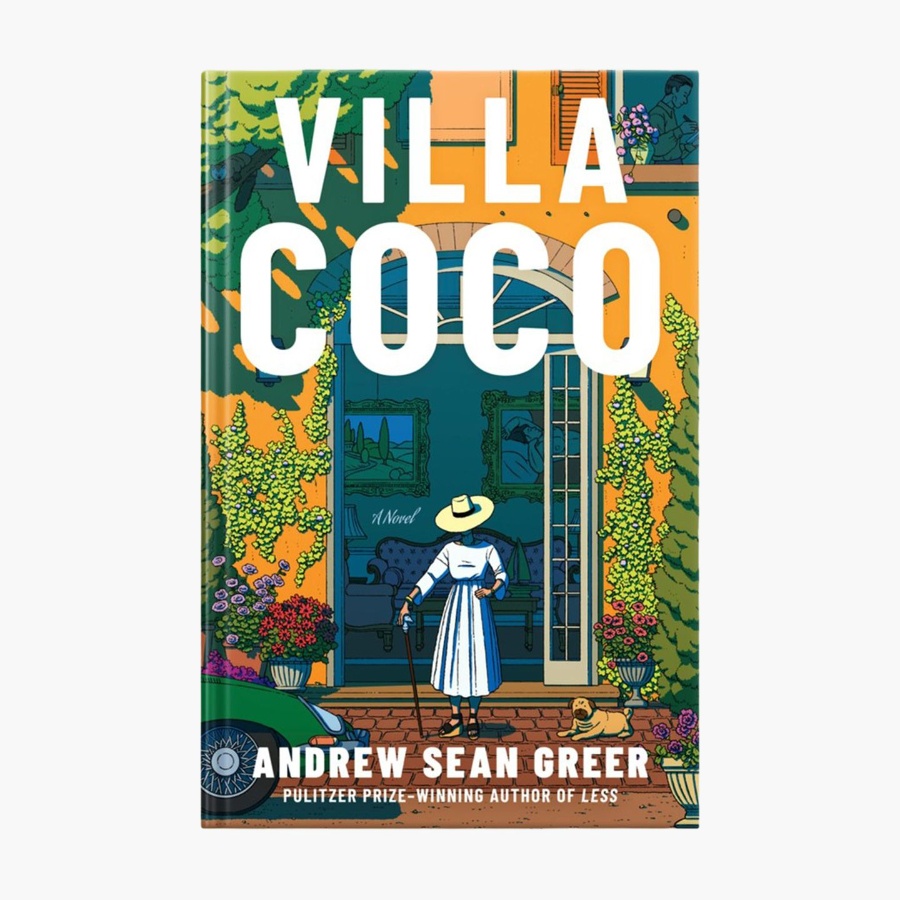

Andrew Sean Greer’s new novel, Villa Coco, begins with a dedication to Beatrice Monti della Corte von Rezzori (“my baronessa”). Beatrice runs the Saint Maddalena Foundation, a writing retreat in Tuscany, of which Greer was a director from 2016 to 2018.
Reading Villa Coco, of course you realise that any similarities between Greer’s real-life baronessa and the one who lives in the titular Villa Coco with her fawn-coloured pugs must begin and end with the title and general demeanour, because the specifics are too full of whimsy to be based on one real person.
Andrew Sean Greer first entered everyone’s TBR lists with his 2017 Pulitzer Prize-winning novel Less, about a soon-to-be-50 author who goes into a tailspin in the global literary circuit just to avoid being in town for the wedding of his ex.
Villa Coco, too, has an elderly protagonist—here it’s the 92-year-old Baronessa Lisabetta, or Coco—but the narrator is a “young man”, all of 21 years, who finds himself at a Tuscan train station with his books and bag and, mysteriously, gin and fish oil. He’s answering an advertisement calling for an adjutant for “the owner of a modest country house” in San Drogo outside Florence to catalogue its collections of art, objects and books, though “hunting martens” is also among the duties listed.
Of course, the owner of the “modest country house”, called Villa Coco, turns out to be our baronessa, a white-maned troublemaker and vertigo sufferer in a house full of winding staircases. She says she’s hard of hearing, though events prove otherwise. She also claims to be half-blind, but she can pick out a wayward strand of hair on a painting.
There’s Gazelle (real name Ghazel), who drives the baronessa’s “Mitsu-bitchy”; the mysterious neighbour, Estelle, whose relation to the baronessa and Villa Coco remains unclear; Pippa the Princess, with her love for flower hairclips and disdain for American English (“The American dialect…Is. Beyond. Me”); Nimali, the Italian-only cook who later develops a fondness for the word “Enough!” and wields it with wild abandon; the kind, dapper Oscar, the baronessa’s salad-eating friend who once went to jail for stealing purple paint (“magenta was no good to me”). And of course the baronessa’s cousin, Giacomo, whom Giovedi keeps getting thrown with. It’s a book full of what in literary parlance are known as “eccentric characters”.
Bewildered and disoriented by the occupants of the place, plagued by a lumpy mattress and the aforementioned marten, “Giovedi”, as the baroness calls our narrator, gets about (or tries) doing the job he (thinks he) was hired for.
In the idyllic setting of the Italian countryside, mysteries unfold in the periphery of Giovedi’s vision. But it’s with his sentences and similes that Greer sinks his claws into you. The back and forth of an ongoing conversation being translated is “like a hostage negotiation”; two nuns are startled out of a clothing rack “like pheasants flushed from the bush”; brick towers rising above the canals are as out of place as “two princes forced to eat at an inn”; Nimali listening to Giovedi speaking Italian is likened to a piano teacher at a recital, “powerless to correct her student”…
There’s a mirage-like, shifting-sands quality to the time Giovedi spends with the baronessa. Doors make a sudden appearance on ivy-covered walls, the baronessa’s anecdotes constantly inspire a sense of disbelief, artefacts in front of Giovedi’s eyes carry a whiff of déjà vu. Relationships and friendships expand and evolve. The baronessa’s attitude to Giovedi borders on callousness but stops before turning cruel. Oscar is a kind mentor, but you also suspect there’s a lot he’s not letting on. But the novel is also a tribute to the Italian countryside: a village of eels, artichoke season, olive harvests, and sfogliatelle, the trees changing colour with the season...
Villa Coco is a novel about age and ageing, wisdom and naivete, love and heartbreak, seasons that are meant to end but also return. We could call it the perfect summer read, but it’s also not just that.
Villa Coco is published by Sceptre; ₹699