In Chettinad, Chinese soldiers on Parsi garas and Penang kerchiefs on Madras checks
A recent textile exhibition in Karaikudi, ‘Coming Home: Fashioned Lives of the Chettiar, Parsi and Peranakan Communities’, by The Registry of Sarees showed how trade and travel influenced clothing
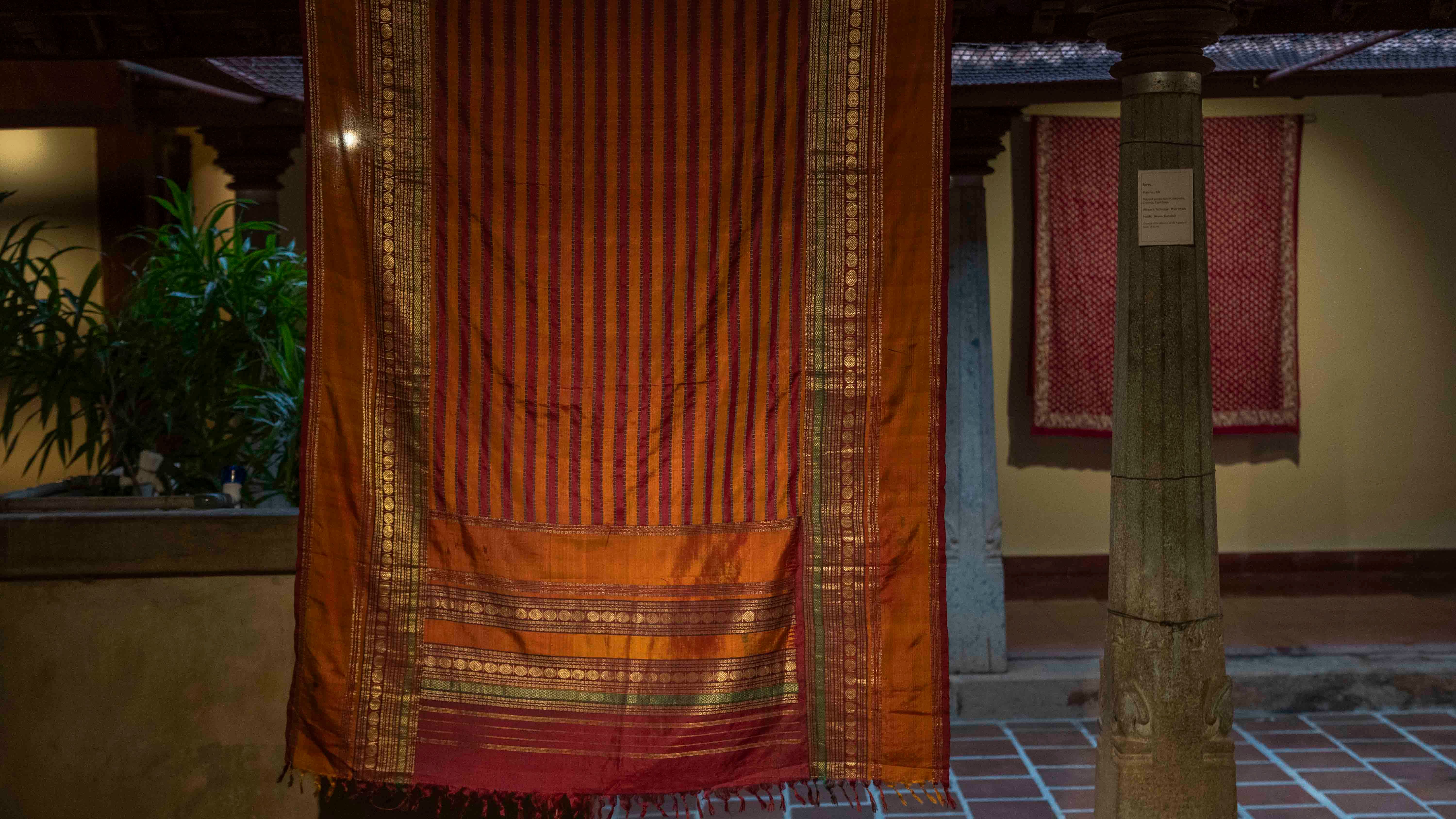
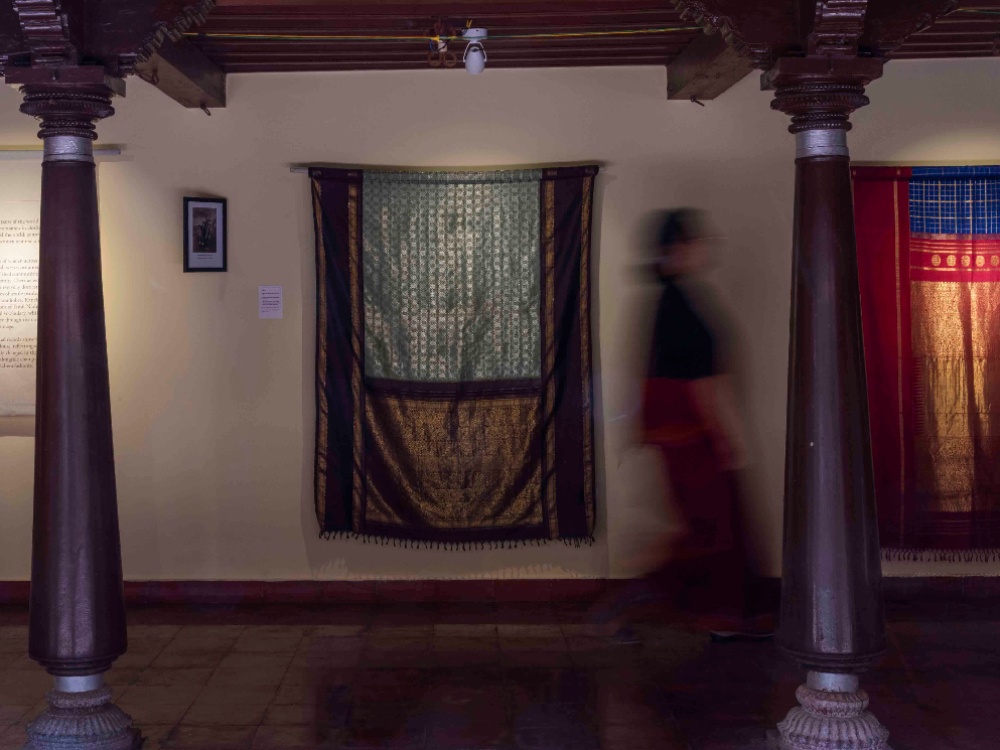
I’m at the famed MS House in Karaikudi on a Monday morning. It’s sweltering and still, but the Athangudi tiles under my feet are cool. In the pillared corridors framing one courtyard hang textiles that are as much a lesson in craft as geography and confluence.
The exhibition Coming Home: Fashioned Lives of the Chettiar, Parsi and Peranakan Communities, put together by The Registry of Sarees, demanded a zooming in instead of a casual walkthrough where you’re distracted by the architecture of the venue.
There’s a burgundy Parsi gara that, if you look closer, reveals a row of five Chinese bayonet-wielding soldiers. Close to them is a riderless horse. (Did the five just off the rider?) On the same gara is a steamer trailing a plume of smoke, a steam engine, and pagodas too. In a little corner: the stamp of the Chinese manufacturer.
In another gara, amid the jal motifs are pairs of Japanese people—a woman and a child, two men gesticulating…
The pièce de résistance is a black gara that traces the opium trade between India’s west coast and Canton—the harvest, the product weighed and moved, a yellow dotted line tracing the shipping routes, the underwater creatures inhabiting said shipping route. The Parsi garas came from the personal collection of designer Ashdeen Lilaowala.
ADVERTISEMENT
A bimpoh (handkerchief) from Penang featuring satin-stitch embroidery on Madras cotton, from the collection of Mr and Mrs Lee Kip Lee, Singapore
A batik gendongan (baby carrier) from 20th-century Java featuring phoenix motifs
The embroidery on a Parsi gara from the personal collection of Ashdeen Lilaowala features Chinese motifs
Inside the ‘Coming Home’ exhibition by The Registry of Sarees in Karaikudi
There’s a bimpoh, or handkerchief, from early 20th-century Penang with a two-sided satin stitch, pull-work borders, and crochet trim—but the base is checked Madras cotton fabric. The embroidery is so fine you want to run your fingers on it to convince yourself it’s not printed—it’s a good thing it’s in a glass case. A turquoise silk and gold zari sari from Varanasi, sourced from a Chettiar woman and from The Registry of Sarees’ collection, is draped next to a small black-and-white photograph of a woman—but the photograph was taken in Burma. Then, there’s a batik-dyed gendongan, or baby carrier, from Java, from the private collection of Mr and Mrs Lee Kip Lee of Singapore, hanging on a wall not far from where iron rings in the courtyard jut out, where generations of Chettiar women would have probably suspended their own version of cloth slings for their little ones.
The crosscurrents are mind-boggling—the whole idea of what went from where to where, how, and by whom, and in what form.
It made sense that the venue was MS House, residence of the formidable, wonderful matriarch Meenakshi Meyyappan—the hotelier, author, and conservationist known simply as Aachi. The mansion is an enduring, thriving example of the residences that the Chettiars, the prosperous trading community that migrated to Madras, Burma, and Malaya, built in the region in the 19th and early 20th centuries. Magnificent magpie creations that drew from European styles and Art Deco, combining pillars carved from Burmese teak, walls featuring Japanese tiles, and floors of Italian marble reflecting light filtered through the colourful Belgian glass panels in the skylights, are testament to the riches of trade and travels and a very amplified love of keepsakes.
The Coming Home exhibition by The Registry of Sarees was part of the Chettinad Heritage and Cultural Festival, an annual event that sets the region abuzz with performances, talks, exhibitions, and culinary explorations. (This year’s edition featured performances by Uthara Unnikrishnan, a conversation on ‘The Idea of India’ between Shashi Tharoor and Manu Pillai, and a talk by architect Benny Kuriakose, among others.)
On why they chose to focus on the Chettiar, Parsi, and Peranakan communities for the show, The Registry of Sarees’ Aayushi Jain, who curated the exhibit, says, “Obviously, the Chettiars made sense as the exhibition was in Chettinad, but when we studied the communities’ material culture, we found that they shared several symbols of identity. The Parsis came from India’s western coast, and the Chettiars from the south. While they were culturally very different, they were very similar to each other lifestyle-wise. And textiles were a big part of their identities, which they built over a period of time…”
That the textiles of the three communities evolved during a time that the Industrial Revolution was at its peak proved another binding factor. “The colours are interesting. Synthetic dyes were invented during that time, so the amount of colour you could get multiplied. You also have Art Deco elements entering the vocabulary. So, a lot of changes were happening parallelly, which found their way into the textiles.”
‘Coming Home: Fashioned Lives of the Chettiar, Parsi and Peranakan Communities’ at MS House
On the final day of the exhibition, a talk at the Athangudi Palace, ‘Echoes of the Sea: Tracing the Routes and Roots of Parsi and Peranakan Textiles’, saw Lilaowala and Peter Lee, the Singapore-based researcher and founding curator of the National University of Singapore’s Baba House, discuss the confluence of different influences in textiles and artefacts.
Lilaowala spoke about how Parsi ladies would tack on detachable embroidered borders to the saris, only to swap them out the next day. Through photographs, he pointed out how the Parsi style of draping meant only one earring showed (and was thus worn), as a result of which several Parsi homes inherited lone earrings.
The trend of embroidered Parsi garas started when Parsi traders travelling to China to sell cotton and opium came back with specimens of elaborately embroidered silk textiles. Pointing to the image of an embroidered sari featuring marine life, Lilaowala said, “You have all kinds of beautiful underwater creatures, but when you wear it as a sari, everything is ulta—facing the wrong direction. It’s a beautiful tapestry, but not a great sari.” This was because while the Chinese were great at embroidery, they didn’t have a clue about the draping techniques of the sari. “So, if you see this, when you would drape the sari, all the birds would be facing downwards and look as if they were falling from the sky rather than flying in the sky.” It took a Parsi lady, Putlibai Dawar, to travel to Canton in her saris in the late 1800s to fix this problem.
Lilaowala took us through motifs like the kanda papeta (the dots that became as ubiquitous as onions and potatoes), chakla chakali (pair of sparrows), and, yes, bats (considered auspicious by the Chinese, which many a Parsi lady mistook for butterflies and wore happily till the truth was ultimately revealed).
Later, walking down the streets of Kanadukathan village, where I was staying, staring at the ornate towering mansions that lend the region its identity, as an abnormally high number of crowing roosters walked next to me, nothing seemed a better venue for unexpected confluences and happy accidents.