





The morning I’m meant to attend my first Gyrotonic class, I nearly cancel. After a late flight last evening, I’ve woken up with a stiff body, a heavy head, and what seems like the beginning of a cold. A few hours in, following my first session, I’m glad I didn’t—in the interest of making this deadline but also because I leave feeling lighter and more relaxed.
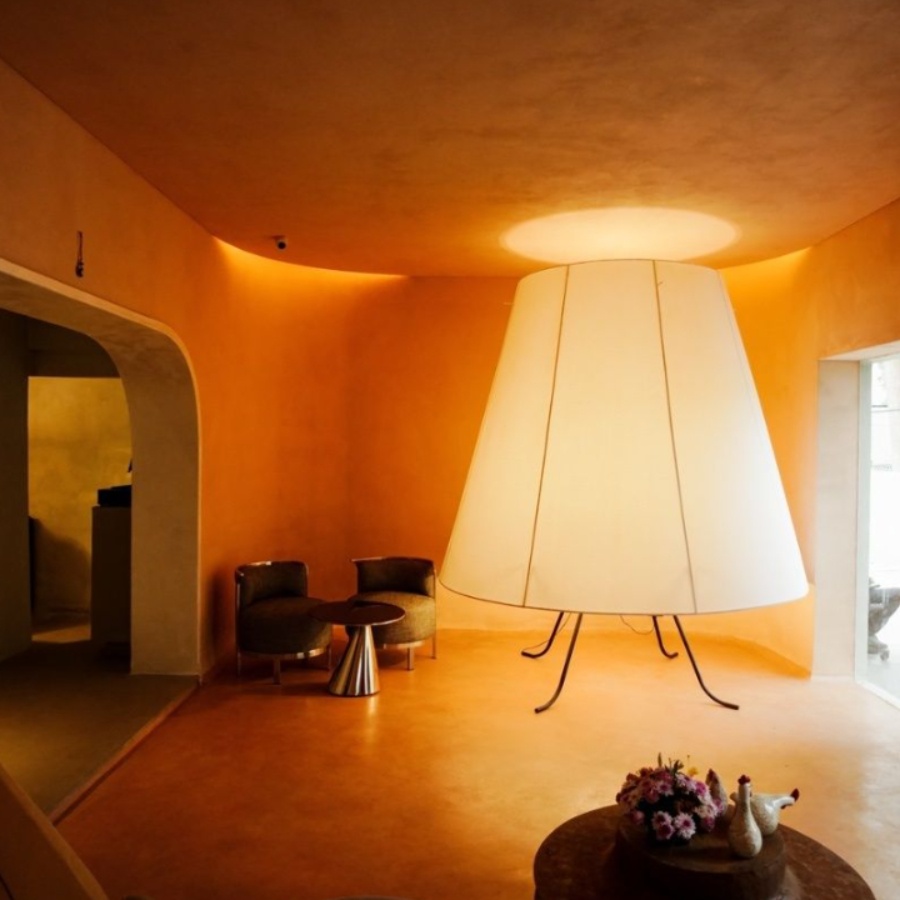
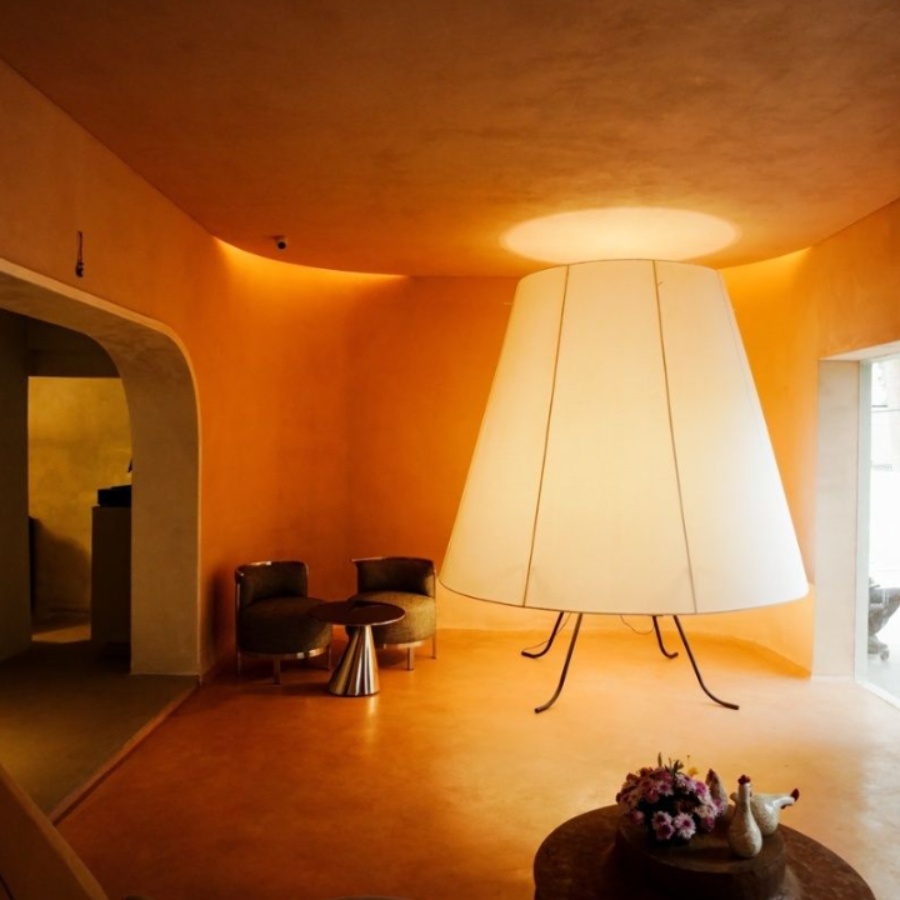
My session takes place in the recently opened light-filled Studio Novare in Mumbai’s Mahalaxmi, one of the few certified studios for the Gyrotonic Expansion System in the country. Started by school friends Simeen Colabawalla, a fitness and Pilates trainer with over three decades of experience, and Nimisha Sheth, a corporate lawyer turned fitness expert, the space, which comes with a bird’s-eye view of the race course, offers both reformer Pilates and Gyrotonic classes in private and group sessions. Both Sheth and Colabawalla have trained in Jaipur and Dubai and will be fully certified by March after finishing their apprenticeship. They are joined by Varsha Bansal, who has been focusing on Gyrotonic for the last seven years.
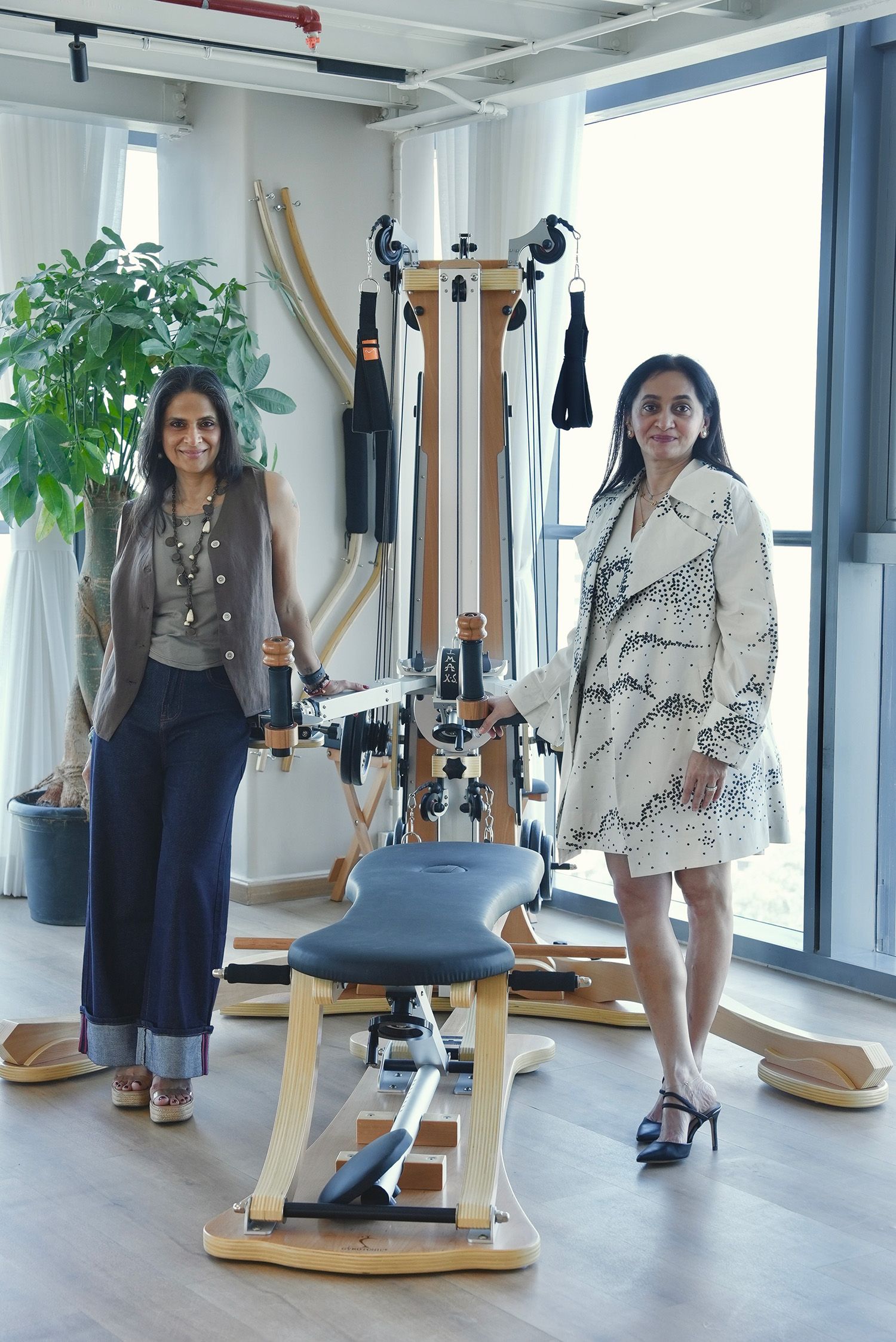
The method, which was created in the 1980s by dancer Julius Horvath while recovering from an injury, focuses on mobility, stability, and expanding and releasing the fascia. It’s a form of active recovery and a way of enhancing the mind-body connection. For Sheth, who was bed-ridden with a hip fracture after a car accident, these factors proved attractive. For Colabawalla, it was menopause and the stiffness she struggled with that led her to the practice.
“Our bodies go through this immense change, and the freedom of movement that Gyrotonic provides helps improve your workout, your game, and your daily life. Massages gave temporary relief, while this has opened up my body and had a long-lasting effect, especially when it comes to the tension we all hold in our neck and shoulders.”
I seem to be an ideal candidate then. I’m in my forties, had a slipped disc in my twenties, and I spend my days as a writer hunched over my phone and computer, with my neck constantly activated. While I’ve been doing reformer Pilates for nearly a decade now—including during my pregnancy—I’m ready to try something new.
Colabawalla, who also teaches Pilates, says it’s not a question of either/or. “Pilates is a linear movement, it’s core-focused, while Gyrotonic has more range. With circular and spiralling movements it allows for more joint mobility.” She recommends that you add in sessions at least twice a week in addition to your cardio/strength-training workouts. “There is no single workout. Rather, we assess the needs of the client and create workouts that can be more cardio-intensive but which primarily fall under three buckets—upper-body strengthening, the posterior series (focused on glutes, hamstrings, et al), and a focus on the abdomen,” Sheth adds.
The session begins on a stool, where Colabawalla guides me through a series of exercises to familiarise me with elevating the body while elongating the back and the neck. Let me tell you: it’s easier said than done. The movements need focus and, in my case, run contrary to my regular (read: terrible) posture.
We then move onto the Pulley Combination Tower Unit (which, quite frankly, resembles what I would expect a medieval torture device to look like) with a series of resistance and weights. Colabawalla starts me off with 6 kgs and takes me through a movement called the ‘arch and curl’, a swan-dive-like movement (I’m far from coordinated and graceful), and an arm series, all designed to open up my thoracic spine and focus on upper-body mobility and strength.
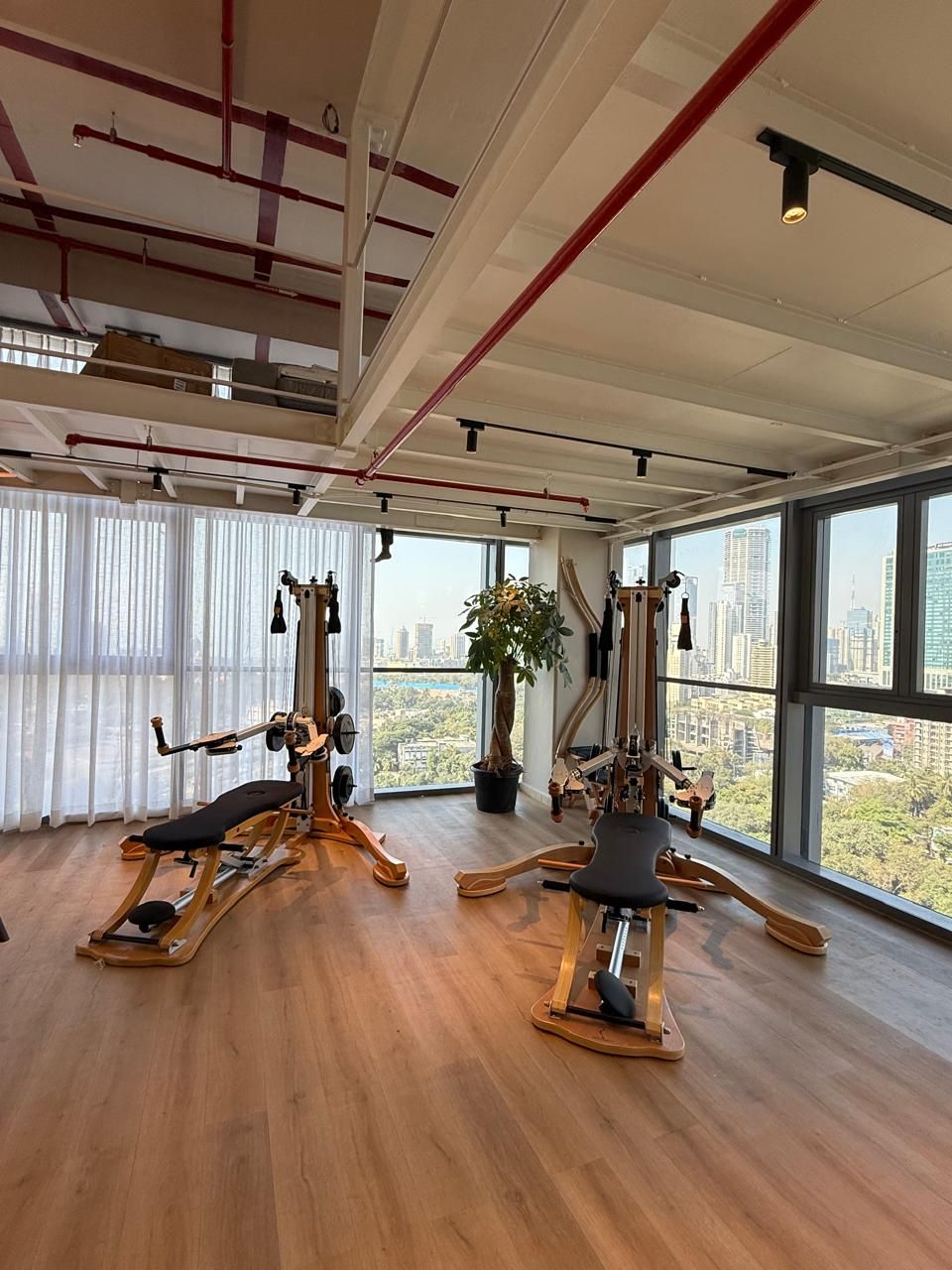
Through the session, Colabwalla patiently guides my errant arms that spiral out of control, adjusts my neck, tells me to open my eyes, and continually reminds me to elevate my pelvic floor. “Don’t rush,” she advises, as I race through her counts. “Enjoy the experience of lightness.”
I do my best, trying to focus on the green outside the window, even while my mind buzzes through my day’s to-do list.
After the session, as I mentioned, the stiffness from earlier in the morning has dissipated and I feel more energetic. It’s different from the endorphin rush that a HIIT or cardio workout gives you; this is less buzzing, softer even, but in my body and mind there’s a definite lift.
“It’s why we say that this is ideal for both men and women, especially as they get older,” Sheth says. “We’re seeing padel players, marathon runners, and senior citizens, and what we are finding is that it does open the neural pathways, gives you better mobility and range, and increases circulation.”
I can definitely see this becoming a weekly, if not bi-weekly, addition to my routine as a part of my mobility sessions. I only hope that at some point I can look graceful while at it too.
Address: Office 1602, Prestige Turf Tower, Shakti Mills Lane, off Dr E Moses Road, Opposite Shakti Mills, Mahalaxmi West, Mumbai 400011
₹3,500 for a private session; ₹2,250 for duos. Package deals are available