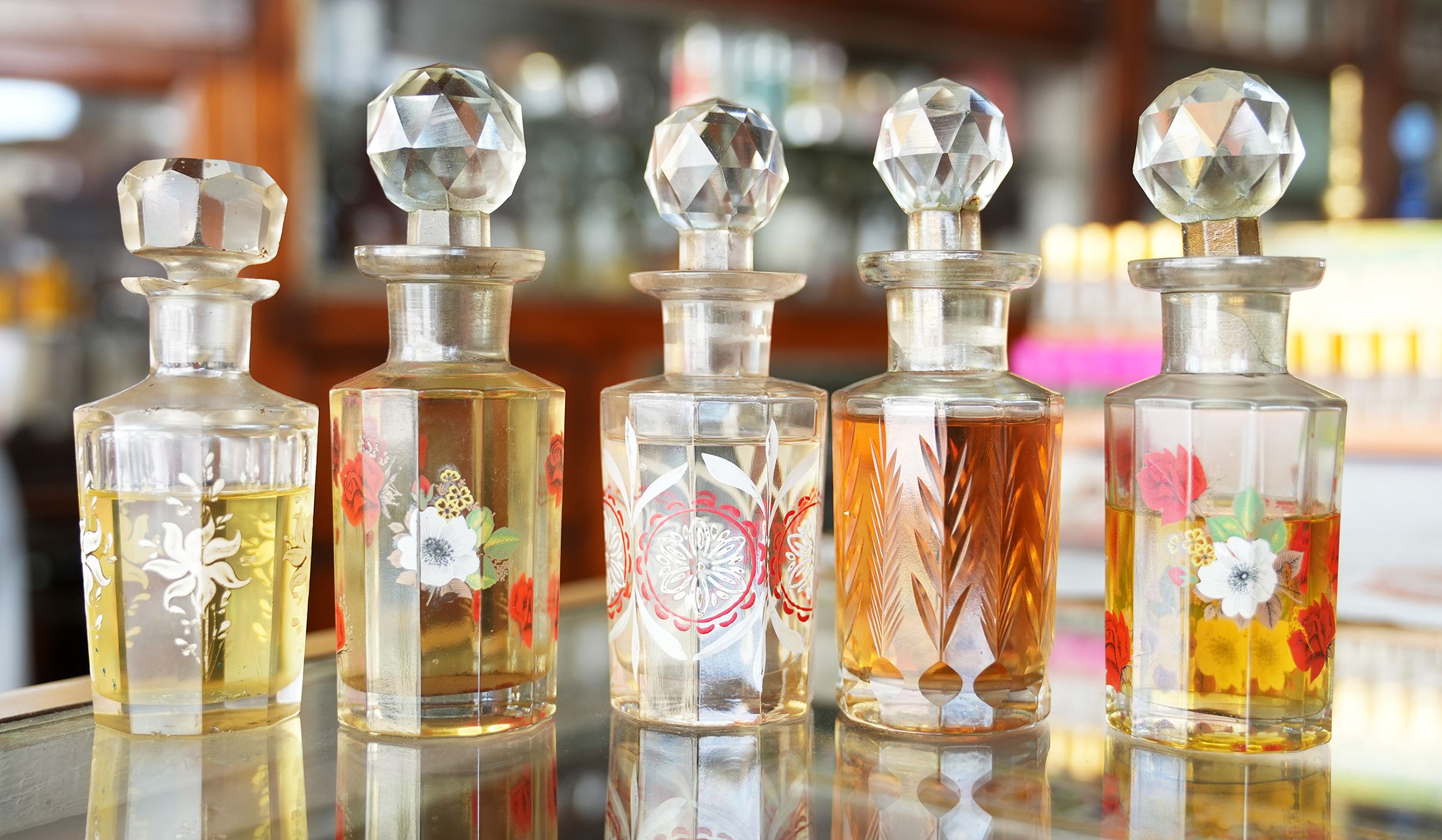






At a busy thoroughfare a short distance from where the Charminar rises majestically, tucked between stores selling college textbooks and khada dupattas, an 80 sq ft shop sits unobtrusively, unfazed by the chaos around it. Peek in and its walls glint with shelf after shelf lined with glass bottles, each holding the promise of olfactory delights.
This is Nizam Attar, a store that has been scenting local residents since 1840. Here, friends drop in without a reason (I overheard heated conversations about real estate prices in Hi-tech City), have chats over cups of chai, while customers move in and out with tiny vials of perfume. It’s a sight you’d encounter only in Hyderabad’s old city.
The man behind the counter is its fifth-generation owner, Ghulam Mohammad Fareed, 38, who runs the shop with his family. The business began with their forefather Ghulam Mohammad Ramzan, who travelled from Kannauj, Uttar Pradesh, the country’s perfume capital, in the mid 1800s, to serve the Nizams of Hyderabad.
The oldest Ramzan started selling his wares in the Chowk area, since nearby Charminar was already chock-full with shops. His most famous patron was Mahboob Ali Khan, the sixth Nizam and a known connoisseur of attars, for whom Ramzan created a special blend. It came to be called Nizam Durbar and the name stuck so firmly that, as the family tells it, no one else was permitted to sell under the Nizam Attar label. From aristocratic families to Asaduddin Owaisi, Hyderabad’s Member of Parliament, the business still counts many from the old families as its patrons.
Fareed shares that the Nizam Durbar is still made but with a variation; it now blends six flowers, among them rose, jasmine and mogra, alongside three local flowers that have replaced the ones from the original formula since they no longer bloom. The result is a powerful essence that is sold at ₹600 a tola—the old measure still used here, which roughly translates to 10 grams.