




As the day winds down, public parks begin to fill with familiar characters: elderly couples on their evening walks, uncles debating politics, mom groups catching up, dog walkers, runners, and children on the loose. And then, casually flipping 360 degrees on the bars in the open gym, is the young calisthenics crowd.
Across the country, in Tier-2 and 3 cities like Guwahati, Jamshedpur, Nongstoin, and Jammu, youth collectives are piloting a DIY calisthenics scene that has none of the frills of specialist fitness studios in the metros. There are no padded floors, expensive membership fees or personal trainers here. Instead, groups of teens and twenty-somethings are turning the neighbourhood park into makeshift training grounds, figuring out how to do muscle-ups or pistol squats off YouTube and Instagram tutorials with a banging playlist blaring in the background. Sometimes, there are free classes for anyone who wants to join. Everyone is welcome, no experience necessary.
At its core, calisthenics is a form of street workout that prioritises using your own bodyweight as resistance and relying on benches, bars or publicly available structures. So, why is this any different? It’s one thing to immerse yourself in a sporting culture that already exists, but the youth in India’s smaller towns and cities is building the ecosystem around calisthenics from scratch, with little to no infrastructure to support them.
For Tilak Basfor in Guwahati, it means turning from a self-taught practitioner into a coach for those curious to try. In Jamshedpur, 19-year-old Roshan Murmu and his friends pooled their own money into installing the equipment they needed. In the rolling Khasi hills of Meghalaya, Aiborlang Lyndoh has built a 60-member calisthenics association that collaborates on freestyle tournaments like Nongstoin Bar Battle. And in Jammu, Sahil Anand turned a lockdown pastime into the full-time job of getting the city to move in new ways. Below, we speak to them about what calisthenics is like outside the big-city bubble:
Location: Nongstoin, Meghalaya
You’re familiar with Shillong, but a car ride away in the West Khasi Hills district is the quiet town of Nongstoin where, during the Covid-19 lockdown, 18-year-old Aiborlang Lyndoh began experimenting with his workouts as a way to beat the boredom. When lockdown restrictions eased up, Lyndoh and his friends took to muddy grounds and riverbanks to further train and master moves such as dips, muscle-ups, handstands, front levers, back levers, and 360s. It’s only later that they realised that what they were doing was an established form of strength training called calisthenics.
The pandemic came to an end, but Lyndoh was just getting started. Together, six of them started the West Khasi Hills District Calisthenics Association, which is now 60 members strong, bringing free outdoor calisthenics training to the wider community. “If I can do it, other people in Nongstoin or Meghalaya can do it too. I don’t want calisthenics culture to disappear here after me,” he says in Khasi, through an interpreter.
The association has already inspired nearby villages like Pyndengrei, Siejlieh, and Mawiaban to form their own calisthenics collectives, as small as they may be. Despite limited funding, Lyndoh and other co-founders try their best to send members to other cities for competitions; he recalls with pride how fellow member Ricky Khardum won second place at the calisthenics championship Ground Zero in Bengaluru earlier this year.
Outside the sport, Lyndoh is a daily wage worker with young siblings to provide for, but calisthenics and the resulting friendships he has acquired keep him going when the going gets tough.
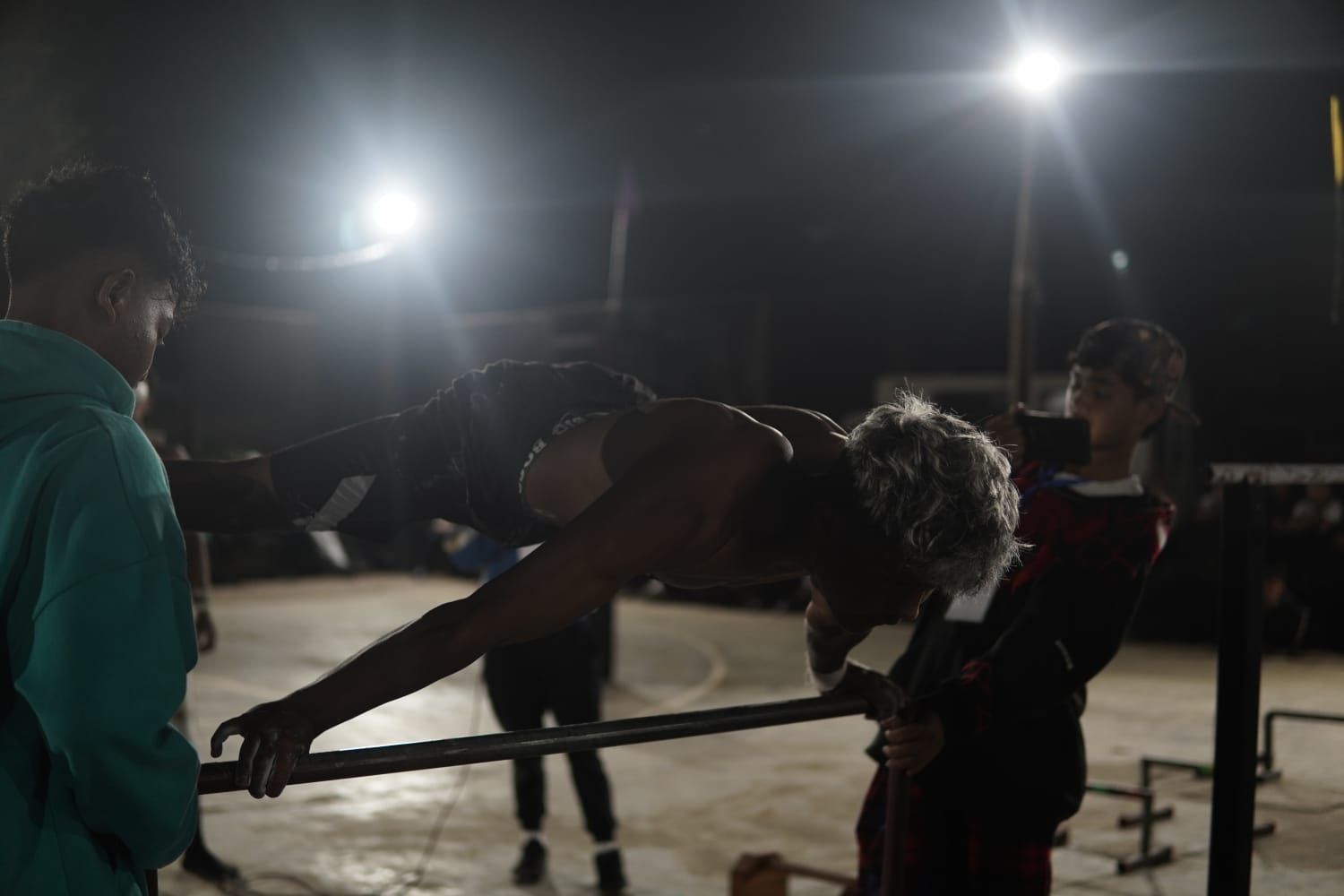
Location: Guwahati, Assam
When a park with an open gym debuted in Jamshedpur, Tilak Basfor, 20, spotted Ayush Talukdar, also 20, defying gravity on the newly installed pull-up bars. Calisthenics laid the foundation of their friendship, and it’s been over a year since they turned Uzan Bazar Park in Guwahati into their practice hub.
“Humne khud ke dum pe calisthenics start kiya aur skills unlock kartey gaye,” says Basfor, crediting the sport for not just making him physically stronger but also mentally resilient. “I used to overthink everything,” he says, “but learning and unlocking a skill like a one-arm handstand takes a lot of time and discipline, which is a healthy distraction from other worries.”
What began as a self-taught exercise fuelled by YouTube tutorials has, over the past six months, turned into a passion project to make calisthenics more accessible. “There is a calisthenics club in Guwahati but that’s not affordable for many of us. If it is outdoors, it can be free for all but still guided. Hopefully one day Ayush and I can open our own coaching centre,” he shares.
For now, the duo hosts free sessions every evening, attended by a handful of kids and young adults who build on foundational exercises and core strength. Practising in public also gives them moral support in the form of an audience, particularly elderly people on their evening strolls, who look both amazed and alarmed at their acrobatic stunts. A passerby once told Basfor: “Kaash maine bhi yeh jawaani mein kiya hota.”