Design24 Jun 20266 MIN

“You can learn or buy style but not taste”: Udayshanth Fernando

For nearly four decades, the Paradise Road founder has shaped how Sri Lanka shops, hosts, eats, and lives with design. A new book pays the ultimate tribute to the tastemaker of Colombo

Image

Striped linen, burnished cutlery, coloured glassware, sculptural pottery, and crockery printed with Sinhala and Tamil letterforms… These are objects many Sri Lankans have lived with for decades, in homes, restaurants, and hotel rooms across the island nation. Yet when Sri Lankan design maestro Udayshanth Fernando began creating them in the late 1980s, the idea of turning local scripts, craft traditions, and everyday forms into a contemporary design language was far from obvious.

At the time, Colombo was a city with a formidable creative inheritance. The visionary architect Geoffrey Bawa had reimagined tropical modernism, making architecture feel inseparable from its landscape, climate, and the particular pleasures of island life. Architect Minnette de Silva had drawn local craft, colour, and building traditions into a radical modernist vocabulary; textile artist Ena de Silva had brought batik into the realm of serious design; artist and textile designer Barbara Sansoni had done the same for handloom textiles; and Colombo-based design store Barefoot had made craft feel cheerful, accessible, and part of everyday life.

While these categories of modernism, craft, antiques, and objects made for tourists rarely crossed over, Fernando saw the possibility of bringing them together. “There was already a style of living, but I found that what I knew—what I call my taste—had an opportunity,” he says of his more layered proposition at the time: local but not folkloric, international but never generic; a Dutch-period chest sitting alongside a clean white ceramic bowl, a temple motif with a graphic pattern, and a Sinhala alphabet travelling from a classroom chart to a dining table.

Not surprisingly, Fernando is also the subject of a new book, Udayshanth Fernando: Living Design, written by Sonal Singh, Bandana Tewari, and Sean Anderson. The book not just offers us an insight into his thought process, it also takes us through his most significant work across hospitality, interiors, and product design.

The boy who drew

“From a very young age, I was interested in art and design, and I think that was because my mother recognised my talent, trusted me, and encouraged me. She had very good taste, and a very good eye,” says Fernando recalling his childhood.

He was born in 1949, a year after Sri Lanka gained independence, and grew up in a middle-class Burgher household in Colombo, where British, Dutch, Portuguese, and Sri Lankan influences were part of his daily life. “Unlike India, where there was a strong movement to reject the cultural legacy of colonial rule after independence, Sri Lanka retained many of its inherited European traditions, particularly among Burgher families. India is so large, so that connection with the colonisers was rejected more strongly. In Sri Lanka, it was embraced and became part of our own culture. Our food is also very strongly connected to this, and we were brought up with at least one meal a day that was more Anglicised or was Dutch, Portuguese or British food combined with our food.”

In school, Fernando won the art prize every year. “Even when art was not formally taught, I entered a painting in a boys’ exhibition and won first prize,” he laughs. While his mum recognised his artistic ability early, encouraging him to become an architect, his father, like many parents of his generation, would have preferred a more conventional future for him in engineering or medicine. “He hated the fact that I was creative,” Fernando says. But after his mother died when he was 15, and his father four years later, her belief in him became a lasting force. “That is the thing that put me where I am today.”

After a brief spell in advertising, Fernando left Sri Lanka to study and work overseas, doing hotel apprenticeships in the Netherlands, moving through kitchens, restaurants, front offices, and reception desks before becoming a purchasing manager at the Hyatt in Sydney, where he spent five years. It was not a conventional design education, but hospitality taught him the mechanics behind an experience—how to source well, negotiate prices, assess quality, and understand the innumerable details that make a space feel effortless to its guest.

By then, Fernando had also begun importing European children’s toys and ceramics into Australia. But when the Australian dollar collapsed, importing became untenable, and he began designing and producing objects in Sri Lanka instead. “Life in Australia could feel very lonely, and I wanted my daughters to grow up with a stronger sense of Sri Lankan identity.” Returning home to Colombo with a trained eye and, “nothing to do”, he found himself with time on his hands as he ran his Australian toy business remotely…till he came across a small shop.

A store of his own

“I found this shop that inspired me to pursue something for myself,” he shares. Paradise Road opened in 1987 with the things Fernando was drawn to: stripped-back old furniture, Dutch-period antiques, plain white porcelain, ceramics, stylised batik, and objects produced in collaboration with local artisans, often reworking familiar craft techniques and materials into new, pared-back forms. “I would be inspired to design for that artisan or a craftsman who would come in with an innovative use of a material. It was always an organic progression of production rather than a business-driven decision.”

That is how the store and its signature style took shape: “I discovered a batik artist, and I stylised batik in what is now a distinct Paradise Road style. Then I recycled old furniture in minimal, clean lines. If something was overly carved, I didn’t buy it. I also started selling authentic Dutch antiques, ceramic ware and porcelain, but everything was very plain, very white. I even have a white room in my shop today with just white porcelain and ceramic, because that is essentially my taste.”

Soon, Paradise Road’s inventory and visual vocabulary began to emerge with its now-iconic black-and-white stripes, hand-painted ceramics, woven pieces, wrought-iron furniture and vivid sheets of crushed kite paper used for gift wrapping. Then came the Sinhala and Tamil letterforms that appeared on crockery, mats, and linen. The idea, Fernando says, began with an old English ceramic plate edged with the alphabet. Looking at the rounded Sinhala script and the more angular Tamil one, he saw two beautiful calligraphic forms waiting to be used differently. During a period when the country’s ethnic divisions were painfully visible, using both scripts felt poignantly significant too. Fernando designed ceramics carrying Sinhala and Tamil lettering together and later made a cloth bag with one script on either side. These remain one of the top selling souvenirs from the store even today.

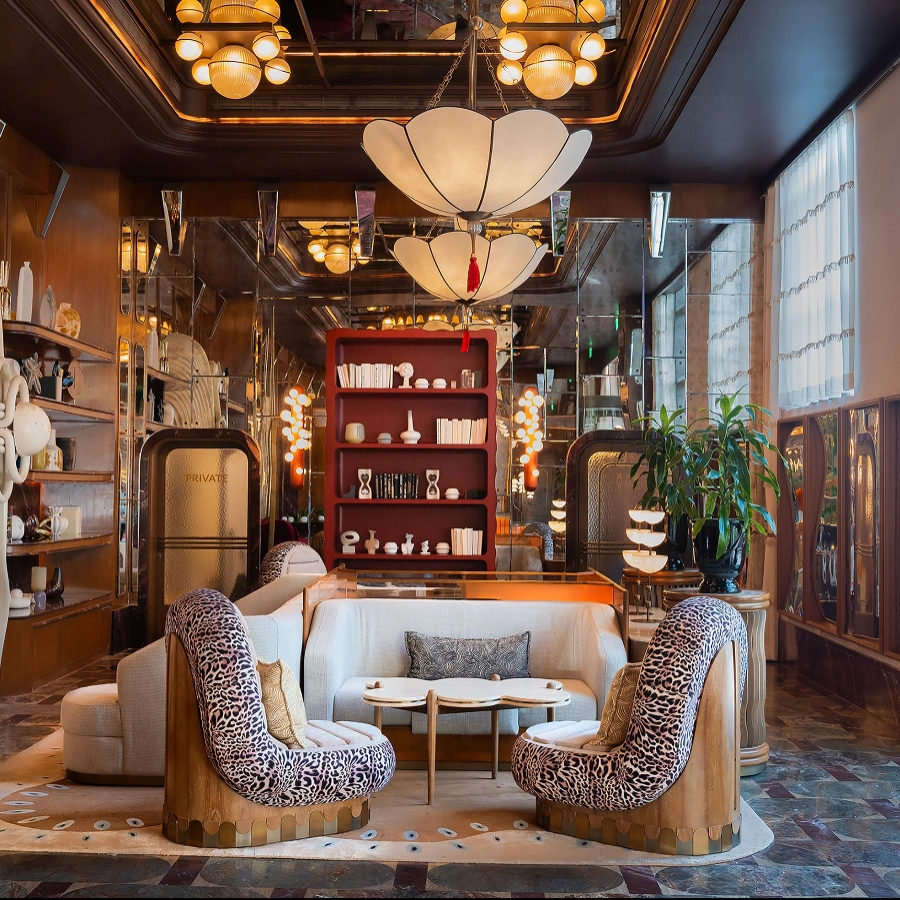
Fernando continued to respond to spaces that stirred something in him. Like a small shop that went on to become the first Paradise Road, a grand old house became an emporium, Geoffrey Bawa’s former office became The Gallery Café; and another historic residence became the 10-suite hotel Tintagel. While The Gallery Café brought together art, dining, and design, giving Lahore-based artist Ali Kazim his first solo exhibition outside Pakistan, Tintagel became Fernando’s take on what a hotel could feel like.

The last tastemaker

While Bawa taught the world how Sri Lanka could build, Fernando helped shape the aesthetic of the interiors in Sri Lanka and how the island could live: with its antiques, craft traditions, scripts, and inherited histories not preserved behind glass but brought into the home, the restaurant table, and the hotel room. Paradise Road began during Bawa’s later years, and its pieces soon found their way into many of the architect’s post-mid-1980s spaces.

“We all seek inspiration. When I travel to Europe, I go to the most beautiful stores to discover colour and material combinations, and it all goes into my mental filing cabinet. Then, when I’m trying to create something, I pull these ideas out one by one. No design is 100 per cent original; it is all a variation on a form.” Though the septuagenarian is active on Instagram, he has not yet ventured into Pinterest. “I’m a toad in a well!” he exclaims. “I love poring over magazines and I love my books. I have a huge library. If I buy a book and get one idea to replicate or inspire me, I am content.”

Today, Fernando still draws every design himself, works directly with craftspeople, and remains involved in the smallest decisions, from the shape of a bowl to the colour of a stripe. Spend any time speaking with him and one word keeps returning: taste. Not as a marker of status, but as a habit of looking closely, remembering what moves you and knowing, instinctively, what belongs together. “You can learn or buy style but not taste. Taste is something you believe in wholeheartedly, and it has nothing to do with money,” he muses.

Udayshanth Fernando: Living Design is distributed by Rizzoli, and available in-store at Nilaya Anthology; ₹5,700

The Nod Newsletter

We're making your inbox interesting. Enter your email to get our best reads and exclusive insights from our editors delivered directly to you.