Whether an antique poshak in Jodhpur or a rare carpet sourced from an Iranian family in Sicily, these young connoisseurs see true luxury in one-of-a-kind craft-led pieces instead of designer logos and hype kicks
Niha Elety with a sohrai painting from the Sohrai Kala Mahila Sahyog Samiti in Hazaribagh
My Instagram algorithm has been undergoing a strange but delightful change. Instead of OOTDs and recipe videos, my feed is now populated with Reels of young netizens pan India showing off their latest ‘craft fits’. Somebody upcycled their grandma’s Kanjivaram into a corset. Elsewhere, a Rabari tapestry is making for viral pants. Instagram fodder aside, craft is finally obtaining value in a generation raised on fast fashion.
“Craft brings with it a sense of intimacy that is immediately felt. There is a growing curiosity about where something comes from, how it was made, and the hands behind it. Younger consumers today are becoming more house proud—I have seen them wearing tangaliya shirts not only after Brad Pitt wore one but also as a more conscious and rooted choice,” shares textile curator Lavina Baldota.
The result is that there’s been a realignment of values for the new generation—no longer is luxury purely about having a logo-fied luxury bag or the latest pair of sneakers. These creatives aren’t vying for the next Birkin. Instead, for them it’s about the next one-of-a-kind textile or a rare object bought directly from an artisan. Scroll ahead to see their finds.
Jaahal Gadhvi
ADVERTISEMENT
Jaahal Gadhvi
A restored poshak featuring green and rose gold zardozi wires
For this 21-year-old Art History student based in Ahmedabad, the fascination with craft began in the simplest way. “At my Nani’s house, hot rotis were brought to the table in woven cane baskets. I begged my mother to take me to the farm where the artisans made these. I knew I had to have some made to play house with my dolls.”
Today, she’s transformed this inherent fascination into a clothing brand that she launched in 2024, Raedh, which works towards conserving ancient embroidery techniques.
One of Gadhvi’s most prized possessions is a restored poshak from Jodhpur acquired for her brother’s wedding. “It features green and rose gold zardozi wires, winding and twisting unto themselves to create this incredible floral pattern. Iridescent sequins resembling beetle-wing embroidery make the stems; peach and sage threads form flowers; and a wonderfully meticulous thread and zardozi knot technique lines the kurti-kanchli. I could never get bored wearing this.”
She also collaborated with karigars from the Dholka region of Ahmedabad to create her very first sari when she was just 17. The embroidery pattern, discovered in a museum archive, is inspired by a men’s waistcoat from 17th-century France, which she transposed onto a silk sari using mukaish (badla) embroidery. The threadwork is completed with iridescent beads that turn blue and green in the light.
Gadhvi explains how her idea of luxury has been vastly shaped by her family: “My mother didn’t own a single ‘designer’ handbag and I never found the need to ask my father to buy me pieces that were trending. True luxury isn’t waiting months for an It-bag; it’s working with artisans to create something of my dreams that only I would have and that only the artisan can make.”
Prachi Popat
ADVERTISEMENT
An appliqué artwork by Champa Ben from Kutch
Popat in a pink bandhani shirt from Sifar Nama
Craft might be an intimidating subject to some, but Prachi Popat makes it palatable and fun through her Reels, which trace the cross-pollination of textiles and offer cultural context. The content creator and freelance writer urges the rest of her young audience to introduce more homegrown craft into their wardrobes through her #coolgirlswearcraft slogan. In her closet, that often means pieces that pay ode to her Gujarati heritage, like an appliqué textile she discovered while travelling through Kutch.
“I met Champa Ben, who welcomed me with such warmth. She pulled me into her house to show me her cats and then proceeded to show us her embroidery collection. The piece represents the daily goings-on of her life with cows, camels, and trees and reminds me of a simpler non-urban life—embroidered by hand using ajrakh fabric,” she says.
She carries on the practice of buying directly from the artisan, like a vibrant bandhani shirt purchased from Rahid Khatri of Sifar Nama, its pattern inspired by the underwater life of sea creatures.
In a fast-paced retail culture, Popat finds her consumption choices unperturbed by the excess. “I’ve never grown up with ‘branded’ culture, so the switch from fast fashion to craft-based purchases came very naturally to me. I think with the decline of traditional luxury houses, people are looking to invest in quality pieces that carry a history that is closer and more representative of them. To me this signals that you care about fashion in a larger context than just its monetary value.”
Gaurav Ogale
ADVERTISEMENT
Ogale in 1940s-50s French blue cotton workshirt acquired in Tokyo
The jajim on Ogale's couch
A 1930s lava cameo ring carved in Pompeii
A multidisciplinary visual designer, Pune-based Gaurav Ogale is a bit of a nomad. He often travels between art residencies around the world and, along the way, he discovered the joy of owning one-of-a-kind craft pieces.
“I acquired this jajim [a kind of thin carpet] from an Iranian family in Palermo, Sicily. Jajims are usually quite colourful, and this one caught my eye because of its stark monotone. Unlike a weft-faced weave like the kilim, these are lighter in weight and have a warp-faced weave, with the vertical threads dominating the stripe patterns. Hand-spun with sheep wool by the Qashqai or Kurdish communities of Iran, these weaves carry tales of migration, inheritance, and lived histories. The family told me this piece was over 70 years old and was used by them to wrap freshly baked bread during migration. It now gently sits on my couch, where I spend a lot of time reading or lying around, or sometimes on my dining table in my Pune home studio, even further away from both Iran and Sicily.”
Other pieces he treasures include an early-20th-century lava cameo ring that is part of a pair of two identical rings made for members of a British family, carved in Pompeii on the Amalfi coast. “While both rings were unbelievably identical, only one fit me perfectly. Maybe someday, in some subway or square of some city, I will meet the person wearing its counterpart,” he says. Another is a 1940-50s French-blue cotton work shirt from a trip to Tokyo, a visible allure in its pleated sleeves and dipped hem. “There are designers making impeccable, perfectly crafted products, but for me the imperfections matter. I find unparalleled beauty in things that embody history, touch, scars, and artistry. And with something as vulnerable, one cannot put a price tag on it.”
Nabina Nazar
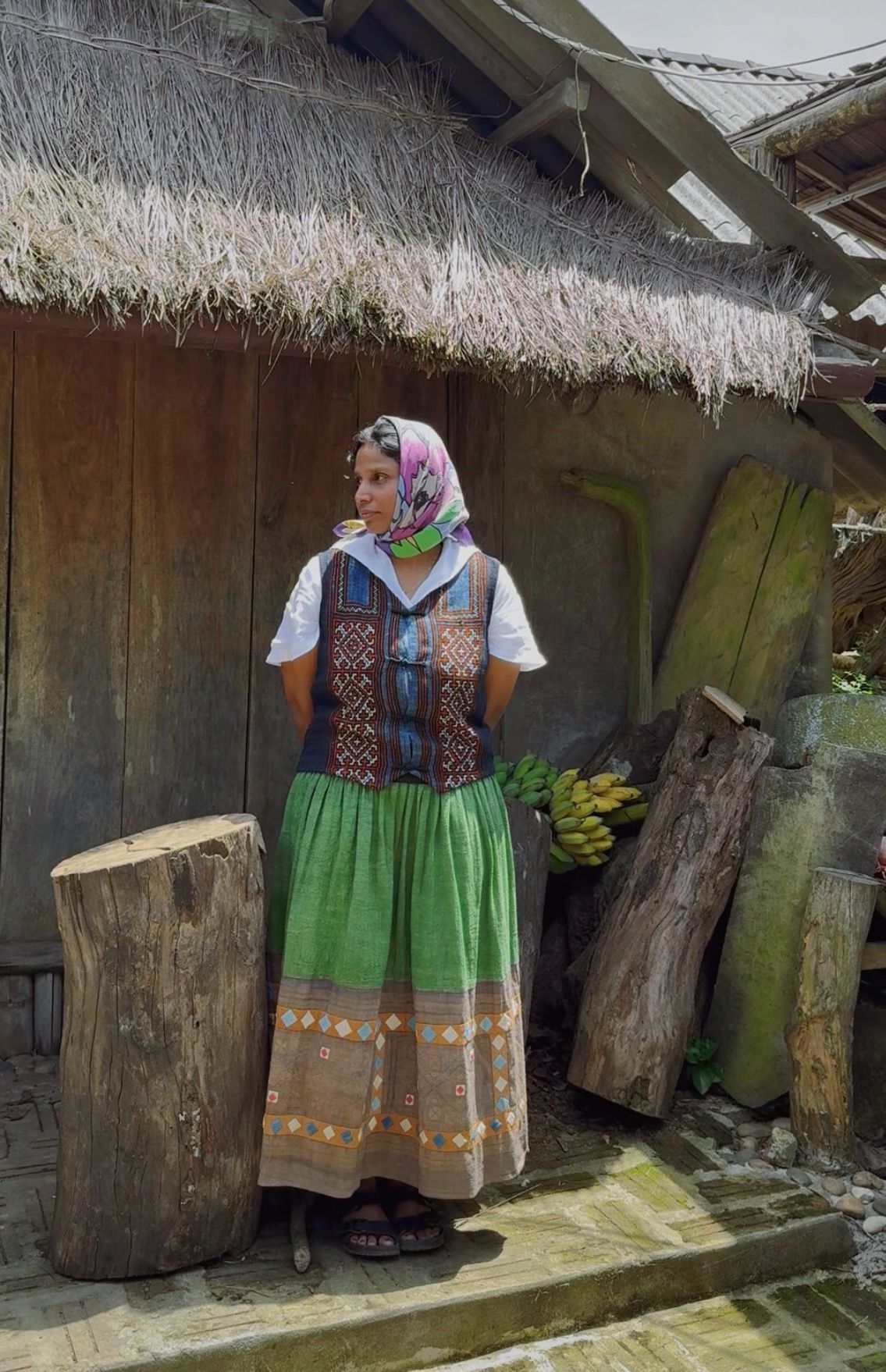
Nazar in a handwoven appliqué cotton skirt purchased in Vietnam
“As a kid I used to collect scraps from the tailor’s shop—just to admire. It was like a treasure hunt for me. I felt so happy finding these scraps, and even the tailor made sure I got the best of the lot,” shares Nabina Nazar, the Kerala-based photographer and creative director, who specialises in the documentation of boutique hotels and global textile traditions.
Last April, during a trip to Vietnam, Nazar chanced upon the Black Hmong tribes, known for their intricately hand-embroidered traditional gear. Nazar purchased a handwoven appliqué cotton skirt with a batik print. She matched it with an indigo-dyed vest in handwoven hemp featuring cross-stitch embroidery from a tribe in a neighbouring village. For the photographer, the allure of craft lies in its timelessness. “I like investing in pieces that I can use everyday. I’ve never perceived luxury in a mainstream sense because I was never born into it. So, this is my take on it.”
Shruti Sitara Singh
ADVERTISEMENT
Shruti Sitara Singh
An ikat chappan aquired in Istanbul
A 17th-century Chinese smoking pipe
“It began in Benaras, almost subconsciously. My mother is from there, and our summers were always spent in the city. I grew up surrounded by textiles that felt larger than life; kinkhab, brocade, silks that shimmered in a way that felt almost unreal as a child. I didn’t understand the vocabulary of craft then, but I remember being deeply aware that these were not just fabrics; they were outcomes of immense human effort,” shares Shruti Sitara Singh, the Mumbai-based creative consultant and curator whose has worked with the Fashion Design Council of India.
Over the years, Singh has interacted closely with emerging homegrown talent. Today, her home is peppered with precious wearable art and antiques collected over the years. “The chappan I own comes from the bylanes of Istanbul. I’ve always been drawn to ikat as a technique. There is something incredibly poetic about it—the idea that the design is imagined, dyed, and mapped onto threads before the fabric even exists. It requires a kind of foresight and trust that feels almost philosophical,” she says, referring to the robe mounted proudly on a wall.
Also in her space is a 17th-century Qing dynasty smoking pipe that she sourced from Cherish Vintage Collectors in Madurai and a collection of Golu dolls from around Tamil Nadu. “What fascinates me about them is not just their craftsmanship but also their role within ritual and storytelling. They are not static objects; they come alive during Navratri, arranged, rearranged, and contextualised each year.”
For Singh, unlike traditional luxury, craft is about participation, not just passive consumption. “For me, it’s about choosing to live with objects that have a past and, in some way, allowing them to shape my present.”
Niha Elety
ADVERTISEMENT
Nina Elety
A handwoven rug crafted by the Nivucha tribal weaving cluster
Raised between Hyderabad and the US, Niha Elety is the co-founder of Understory, a platform focused on preserving indigenous knowledge systems across craft, agroforestry, and sustainable materials through storytelling, community collaboration, and emerging technologies. “One of my earliest memories is from when I was about five years old. I cut up my grandfather’s old dark green lungi and hand-stitched it into a skirt and blouse while sitting with my grandmother and her friends during afternoon chai. At the time, it felt like pure play, but looking back it was my first act of upcycling, of transforming something personal into something new,” she shares.
Thanks to her work, Elety has discovered her most precious craft pieces. “While filming a documentary in Jharkhand, I chanced upon a handwoven rug created by the Nivucha tribal weaving cluster. The weavers construct their own pit looms using wood sourced from surrounding forests and use natural dyes derived from local plants. The rug is woven in the phuta style, a traditional weave from the Mayurbhanj region known for its bold checks and geometric patterns.”
Another dear piece is a sohrai painting from the Sohrai Kala Mahila Sahyog Samiti in Hazaribagh [Jharkhand], created by Santhal, Munda, and Oraon women artists. Sohrai is a mural tradition that uses pigments from crushed stones and earth, often depicting stories of nature, harvest, and folklore. She adds, “During our time there, artists shared the folklore behind the flora and fauna pictured in their work and their efforts to revive the practice through community-led schools. What drew me to these pieces was the sense that they carried not just aesthetic value but also entire ecosystems of knowledge, history, and resilience. I wanted to bring a piece of that world into my home not as decor but as living memory. For me, investing in craft is not just preservation; it’s a reimagining of how we value labour, heritage, and creativity.”
ADVERTISEMENT
The Nod Newsletter
We're making your inbox interesting. Enter your email to get our best reads and exclusive insights from our editors delivered directly to you.