Raves, anti-capitalism, and eBay: Conversations with CSM’s class of 2026
Following their showcases at London Fashion Week, designers Adya, Kai Ghattaura, and Pranjali Menaria discuss influences, camel saddle straps, and the meaning of “local”
The Central Saint Martins graduate show, on the opening night of London Fashion Week’s autumn/winter edition, has long existed as a launchpad for designers who would go on to reshape fashion’s visual lexicon. Remember John Galliano’s 1984 collection, ‘Les Incroyables’, or Stella McCartney’s 1995 show where her supermodel friends Kate Moss and Naomi Campbell walked down the runway? But beyond the surrounding—and often deeply nerve-racking—whispers of it being the space to watch for “the next big thing” in the fashion industry, the show continues to remain something far more electric: a space where emerging designers can present works that are unabashedly charged with risk, instinct, and offer an unfiltered perspective.
A day after this year’s show, I sit down with Adya, Kai Ghattaura, and Pranjali Menaria, three South Asian designers who were among the 18-odd students who were presenting their six-look graduate collections on the opening night of London Fashion Week. We meet at a bustling coffee shop in Granary Square the day after their show and the table is quickly occupied with our order—two orange juices, a cup of tea, a caramel latte and a box of cigarettes carried over from the night before.
With decidedly distinct collections, what unites these three South Asian creatives and friends is the sheer conviction and purity with which they filter their cultural inheritances into a design language that is audacious and ready for a modern, urban consumer. Ahead, they talk to The Nod about process, pressure, and what it means to showcase on one of fashion’s most closely watched stages.
ADVERTISEMENT
Looks from Adya’s CSM 2026 graduate show
How are you feeling now that the show is finally over?
Kai Ghattaura: Hungover, if I am being honest.
Adya: Tired but good. Hungover.
Pranjali Menaria: I’m already thinking about the next thing, which is finishing my portfolio. It will now also include everything that went into the making of this collection.
What was the starting point for you as regards this collection?
PM: It started from conversations we were having based on the future of fashion going local and I was asking myself, what is my local? I come from Rajasthan and I keep collaborating with artisans across Gujarat and Rajasthan. As I was revisiting those clusters, I kept coming across the same sentiment of fashion heading towards a localisation of sorts in terms of craft. I also realised that India is becoming an important global player and, while it sounds amazing financially, at a micro level it is also diluting artisanal cultures, which is quite dystopian, to be honest. I wanted to project that in my collection—how capitalism is actually leading to this cultural erosion, commodification, and homogenisation.
KG: That’s really interesting because, in a similar way, this collection started with me feeling disconnected with the Indian side of me, as I am British-Indian. The collection allowed me to learn about my own heritage. When I started researching, I was reading this book called Hidden Tribes of India and the word that kept recurring was ‘semi-nomadic’ along with reflections on post-colonial India. I tried imagining this scenario where these Indian nomadic communities find discarded British garments and reclaim them with their own traditional adornment.
A: For me it was very different. My collection is called ‘What I Don’t Know’, and it was primarily about approaching things I don’t know how to do. Like knitwear! But finding my own language of doing it without having the knowledge of knitting. To bounce off what Pranjali and Kai said, Pranjali has an anti-capitalist angle, which I feel my work also has. One of the main inspirations were these sew-at-home catalogues that I found from the ’20s and ’30s.
ADVERTISEMENT
Looks from Kai Ghattaura’s show
To take off from that, now that this collection is out in the world, do you feel you know something about your work and yourself that you did not know before?
A: I think one of my biggest learnings was to keep asking why you are doing what you’re doing, what it is for, and where it is going to end up.
What were some of the techniques you explored while creating the collections?
A: I struggle with overthinking and I was very firm about not doing that in terms of technique. I went in knowing that I did not know too much! I was very inspired by this carpenter turned artist from the ’30s called Bill Traylor, who made these beautiful drawings of people and clothes. And one of my references came directly from how he was so careless and free with his drawings and still ended up expressing so much.
PM: ...which is very different from me, because I come from a textile background and for me it always begins with the textile. I had to unlearn a lot of that in this course and find a balance with textile and design. For this collection I collaborated with a student from Central Saint Martins who created biomaterial for me to make my own flowers and I also got to collaborate with this artisan based in Kutch. He created this amazing strap for me that is used to tie the saddle around camels, but the craft for it no longer exists as he’s the last surviving artisan to practise it.
KG: One touch point for me was the Nike tech fleece, which is literally just like the most quintessential British item of clothing I know. I merged that with fabric-covered beads, and fabric-covered bangles and then developed my own wood block prints, which would be put onto these items.
ADVERTISEMENT
Looks by Pranjali Menaria
What was the process leading up to the show like?
A: It was intense, but I feel like that wasn’t the point for me. I feel I finally understood myself as a designer and found my language in a way. We started in October and I didn’t do anything all summer except go on eBay and search vintage fabrics and discover how much people want to let go of!
PM: So true! I actually started working on my collection during the summer because I was developing a lot of textiles. But I started working on my final silhouettes really late, which made the fittings very intense.
What’s next for you?
A: I would love to have my own practice—not a brand—and actually kill it at some point as well because I don’t want it to go on forever. Something that’s B2C with a community of my own.
PM: For now, I want to take a break. But I do want to learn the manufacturing aspect and the technical aspect of fashion because of my textile background.
KG: I think there’s a stagnancy in the industry right now and there’s no better time than now to be doing a brand as a young creator. The whole reason I did the MA in the first place was to start my own brand because I got some traction off my BA, which proved that there are people who are interested in buying the clothes I make.
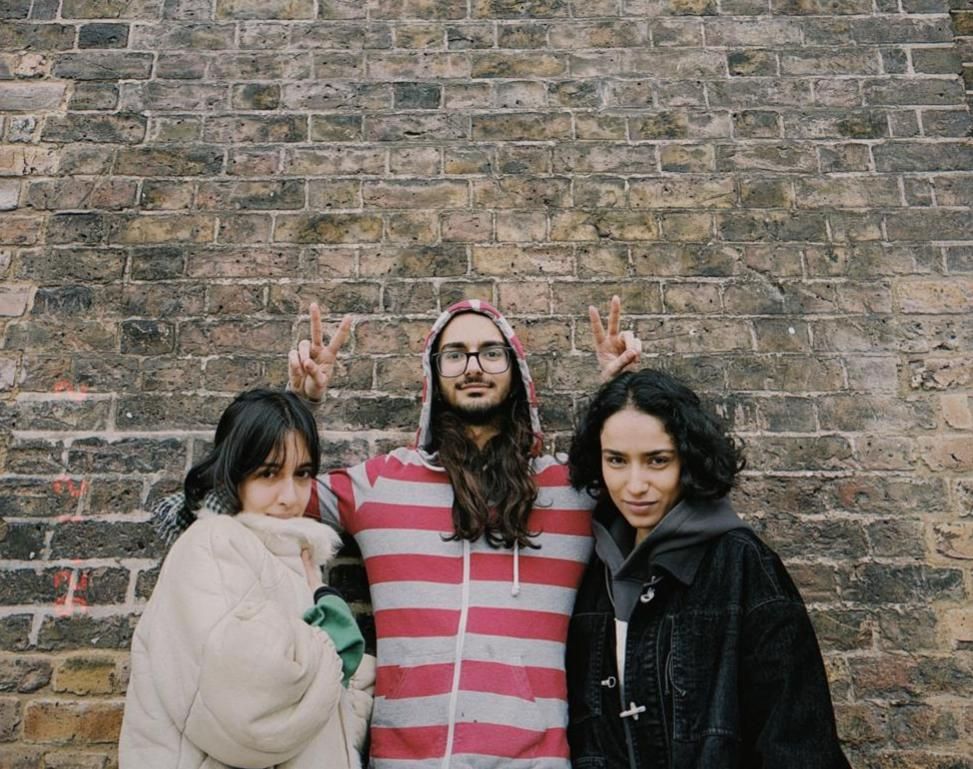
Adya, Kai Ghattaura, and Pranjali Menaria
Did all of you always know that you wanted to work in fashion growing up?
A, KG, PM (unanimously): No.
Love an origin story! Let’s unpack that
KG: My mum signed me up for a clothes course at a local college when I finished my GCSEs. I didn’t even know then that you could have a career in fashion.
A: For me it was my dad. He used to always take me to museums when we travelled, although I used to be thoroughly bored by it. But he’s a big reason why I had my eyes open to art and design growing up.
PM: Same. I used to enjoy painting very much, so it started from fine arts. Then textiles happened quite accidentally when I was in college, and slowly I found myself in the world of fashion and actually enjoying it!
As young creatives, how do you engage with London as a city?
KG: I moved to London when I was 18 and forced myself to go out and meet people. I was part of the rave scene in London up until like a year ago when I stopped going out altogether. That’s how I met everyone and learned everything about the city. These were people that helped me out so much with my practice, be it modelling or casting or working on the team. These are all people I’ve met through partying.
So, partying hard clearly is the memo!
KG: You have to go out! It influences your work so much more than looking at a book.
Growing up, did you have design or fashion inspirations that you looked up to?
A: I love the fun and rebellious feeling from the ’20s but also the simplicity of the ’60s, which also comes with a retro futurism.
KG: Before the MA, all my work was inspired by fairy tales and folklore because it’s what my mum would read to me growing up. The MA pushed me to get references from real life so that the work felt more rooted in reality.
A: I just wanted to go back and also say that in terms of inspiration, I’ve been pretty interested in my own gaze at India right now. I have always felt like it’s a very maximalist country with people who have a very minimalist way of life.
PM: I agree. I hate that there is this stereotypical image attached with India. The country changes every 50 kilometres, so which India are people trying to point at? That constant sense of change inspires me. You go to Rajasthan and you can see people wear dhotis with bomber jackets, something that I have tried to hint at in my collection. Yes, India can be inspiring, but it’s more than the colours and the embroideries!
If you guys had one word to describe each other’s collection, what would it be?
A: For Kai’s I would say lol [Kai starts laughing] because it’s just so contemporary. And I mean it in the best way. And for Pranjali, I would say pure.
PM: For Adya, I would say cute and intelligent. For Kai, I have to think.
KG: [To Pranjali] You stole my answer! I was going to say smart for both of them because it’s not in your face and quite clever in the way things are referenced.